
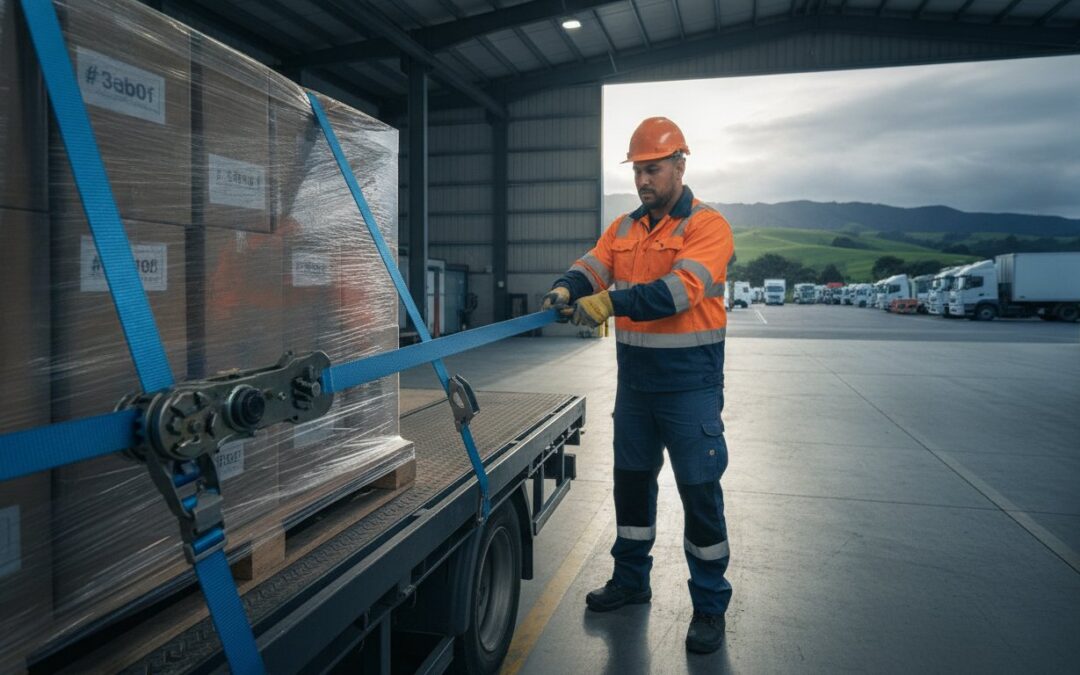
A single failure in your restraint system can cost your company NZ$10,000 in fines before the cargo even hits the bitumen. You know that maintaining full compliance with the 80/50/50 force rule is a constant challenge when facing tight turnaround times and diverse freight types. Mastering the current NZ load securing standards is the only way to protect your business from cargo damage and heavy legal penalties.
This 2026 guide provides the technical clarity required to ensure every Maxibinder and ratchet tie down in your fleet meets the latest safety requirements. We’ll break down the updated Truck Loading Code, clarify lashing techniques for curtain-siders, and outline the specific hardware standards required to ensure zero cargo movement during transit. Following these protocols ensures your loading processes remain efficient while keeping your operation on the right side of the law.
Key Takeaways
- Apply the 80/50/50 rule to ensure all restraint systems withstand the specific forward, sideways, and rearward forces required by the NZ Transport Agency.
- Utilise high-performance Maxibinders for heavy loads to achieve greater tensioning efficiency and safety than traditional lever-style binders.
- Protect fragile cargo by using 1042mm plastic pallet angles to distribute lashing pressure evenly across the load surface.
- Maintain full compliance with NZ load securing standards by selecting hardware that aligns with the technical requirements of the 2026 Truck Loading Code.
The NZ Load Restraint Code: Essential Rules for Compliance
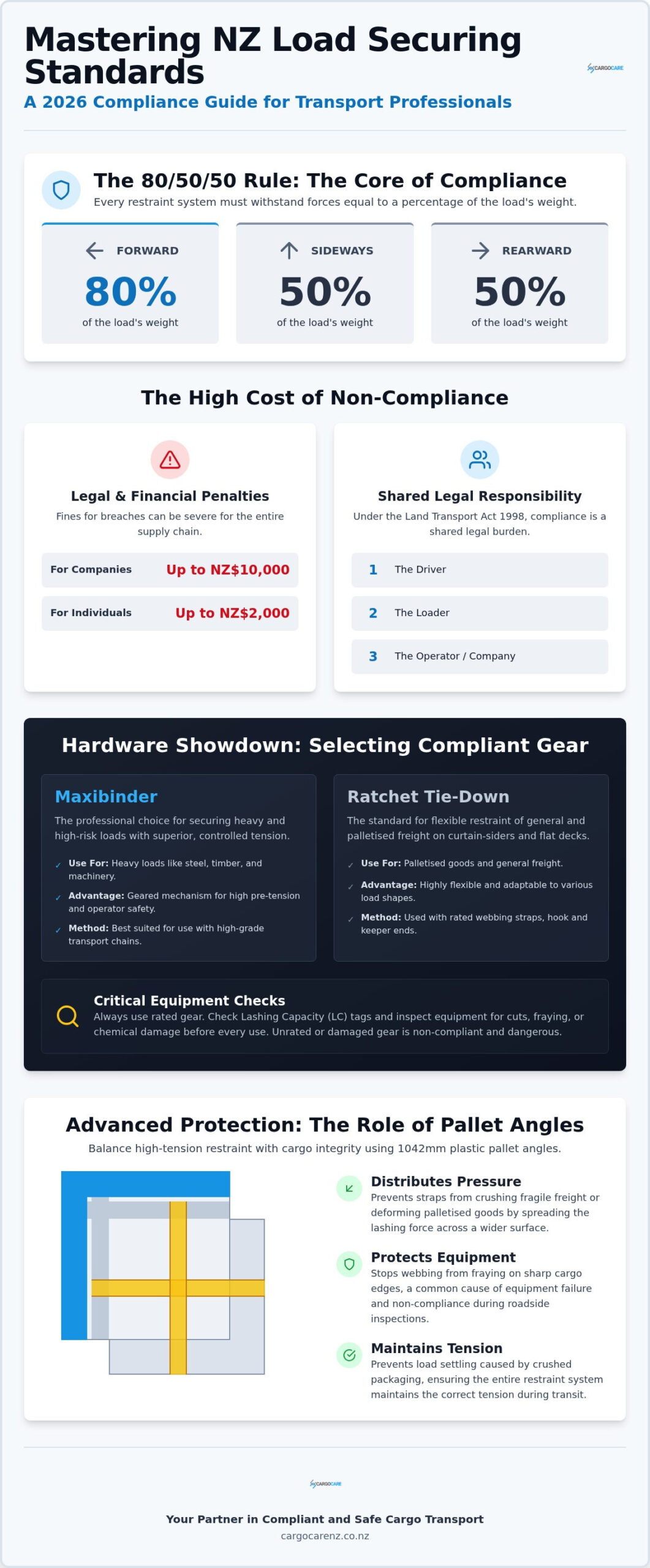
The NZ Load Restraint Code serves as the primary regulatory framework for all heavy and light vehicles on New Zealand roads. It dictates the minimum physical requirements to prevent cargo from shifting or falling. A central pillar of these NZ load securing standards is the 80/50/50 rule. This requires that every restraint system withstand forces equal to 80% of the load’s weight in the forward direction, and 50% in both sideways and rearward directions. Understanding these Principles of Load Securing is vital because friction alone rarely provides sufficient stability. Heavy machinery or palletised goods can easily overcome surface friction during emergency braking or sharp cornering, leading to catastrophic outcomes.
Compliance is a shared legal burden. Under the Land Transport Act 1998, the driver, loader, and operator all hold responsibility for ensuring a secure load. Fines for breaches in 2026 reach up to NZ$2,000 for individuals and NZ$10,000 for companies. Relying on guesswork or outdated habits isn’t just dangerous; it’s a significant financial risk for the entire fleet.
Understanding Lashing Capacity (LC) and Ratings
Components used for restraint are defined by their Lashing Capacity (LC), which is the maximum force a component is designed to sustain. Using unrated or damaged equipment is a direct violation of NZ load securing standards. Every piece of hardware must feature a legible rating tag. Regularly inspect your load restraint straps NZ for visible wear, cuts, or chemical damage. Even minor fraying significantly reduces LC, rendering the entire restraint system non-compliant.
Selecting Compliant Hardware for NZ Load Securing Standards
Hardware selection is the physical implementation of the NZ Truck Loading Code. It’s not enough to have a strap or chain; the hardware must match the cargo’s mass to prevent catastrophic movement. For heavy loads, Maxibinders provide superior tensioning compared to traditional lever binders. Lever binders can kick back and cause operator injury, whereas the geared mechanism of a Maxibinder ensures controlled, high-force tension. This level of precision is essential for meeting NZ load securing standards across the rugged terrain of the North and South Islands. For lighter, general freight, ratchet tie downs with a hook and keeper remain the standard for secure, flexible restraint.
Durability is a critical factor in New Zealand’s high-UV and salt-heavy coastal environments. Hardware must withstand these conditions without losing structural integrity or LC ratings. We distribute Silverback-grade hardware because it is engineered for these specific environmental challenges. You can browse our compliant transport hardware to find equipment that maintains its rating over years of heavy-duty service.
Maxibinder vs Ratchet Tie-Downs: Which to Use?
Choosing between a Maxibinder vs ratchet binder NZ depends on the load weight and the required restraint method. The 8mm Maxibinder is the professional choice for heavy-duty applications like steel, timber, and machinery transport. Its ergonomic design reduces physical strain while achieving the high pre-tension levels necessary for NZ load securing standards.
- Utilise Maxibinders for heavy loads requiring chain restraints and maximum pre-tension.
- Select ratchet tie downs for palletised goods and general freight where webbing is appropriate.
- Re-check tension frequently during the first 25 kilometres of any long-haul route.
Maintaining tension is vital for compliance. Vibrations and load settling can loosen restraints, so checking gear at every scheduled stop is a non-negotiable safety protocol for any professional fleet.
Advanced Techniques for Pallet and Cargo Protection
High-tension lashing is required to meet the 80/50/50 force rule, but excessive pressure can inadvertently crush fragile freight or deform palletised goods. Professional operators use protective intermediaries to balance restraint force with cargo integrity. It’s the industry standard to implement 1042mm plastic pallet angles for distributing lashing pressure across a wider surface area. This prevents the strap from cutting into the packaging, which often leads to load settling and subsequent tension loss. For smaller vehicles, a heavy-duty cargo safety net provides the necessary containment for loose items in utes or open trailers. This prevents debris from becoming a road hazard and ensures the vehicle remains compliant with NZ load securing standards. You can find a full list of compliant gear in our essential guide to cargo safety equipment NZ.
The Role of Pallet Angles in Load Stability
Using 1042mm blue plastic pallet angles provides dual protection for the load and the restraint hardware. The use of these angles prevents straps from fraying against sharp edges. Fraying is a common cause of equipment failure and non-compliance during roadside inspections. By maintaining the integrity of the webbing, you ensure your fleet consistently meets NZ load securing standards. These angles are manufactured from high-durability plastic to withstand the rigours of national freight routes without cracking under high tension. Stability depends on correct placement. Angles must be positioned squarely at the top corners of the load to convert horizontal strap tension into vertical downward pressure. This mechanical advantage increases the effective friction between the pallet and the vehicle bed, significantly reducing the risk of lateral or rearward movement during transit.
Future-Proof Your Fleet Compliance
Adhering to the 80/50/50 force rule is essential for operational safety and legal protection. By integrating high-rated hardware like Maxibinders and protecting cargo with 1042mm pallet angles, you ensure your transport processes remain efficient and secure. Maintaining strict NZ load securing standards is a continuous commitment to safety that pays dividends in reduced cargo damage and zero compliance fines.
As the official NZ distributor for Silverback, we provide the heavy-duty hardware required to meet these rigorous national requirements. We stock a full range of heavy-duty Maxibinders and cargo safety gear with nationwide shipping available to keep your fleet moving. View our range of compliant Silverback load restraint hardware to upgrade your restraint systems today. Implementing these professional standards ensures your operation remains a leader in New Zealand transport safety.
Frequently Asked Questions
What is the 80/50/50 rule in NZ load restraint standards?
The 80/50/50 rule specifies the minimum force a restraint system must withstand to meet NZ load securing standards. It requires that restraints hold 80% of the load’s weight against forward movement, and 50% against both sideways and rearward movement. This ensures the cargo remains stationary during emergency braking or sharp turns. Friction alone isn’t enough to satisfy these ratios for most heavy freight.
Are ratchet straps legal for securing heavy machinery in New Zealand?
Ratchet straps are legal for heavy machinery provided they meet AS/NZS 4380 standards and possess a sufficient Lashing Capacity (LC) for the load’s mass. While webbing is versatile, many operators prefer chains and Maxibinders for heavy equipment to achieve higher pre-tension. Always check the manufacturer’s rating tag to ensure the strap is rated for the specific weight and force requirements of the machinery.
How often should I inspect my load restraint equipment for compliance?
You should inspect your restraint equipment before every trip and during every scheduled stop. Check for cuts, fraying, or chemical damage on webbing, and look for cracked links or faulty locking mechanisms on chains and binders. Consistent inspections are a core part of maintaining NZ load securing standards. Equipment that shows visible wear must be removed from service immediately to avoid safety risks.
Can I be fined if my load is secure but my straps are frayed?
Yes, you can be fined up to NZ$2,000 as an individual or NZ$10,000 as a company for using frayed straps. NZTA regulations state that any restraint equipment with visible damage is non-compliant because its Lashing Capacity is compromised. Even if the load hasn’t moved, the presence of damaged gear constitutes a breach of safety standards. It’s vital to replace worn straps to ensure full legal compliance.

Article by
Steve O'Malley