

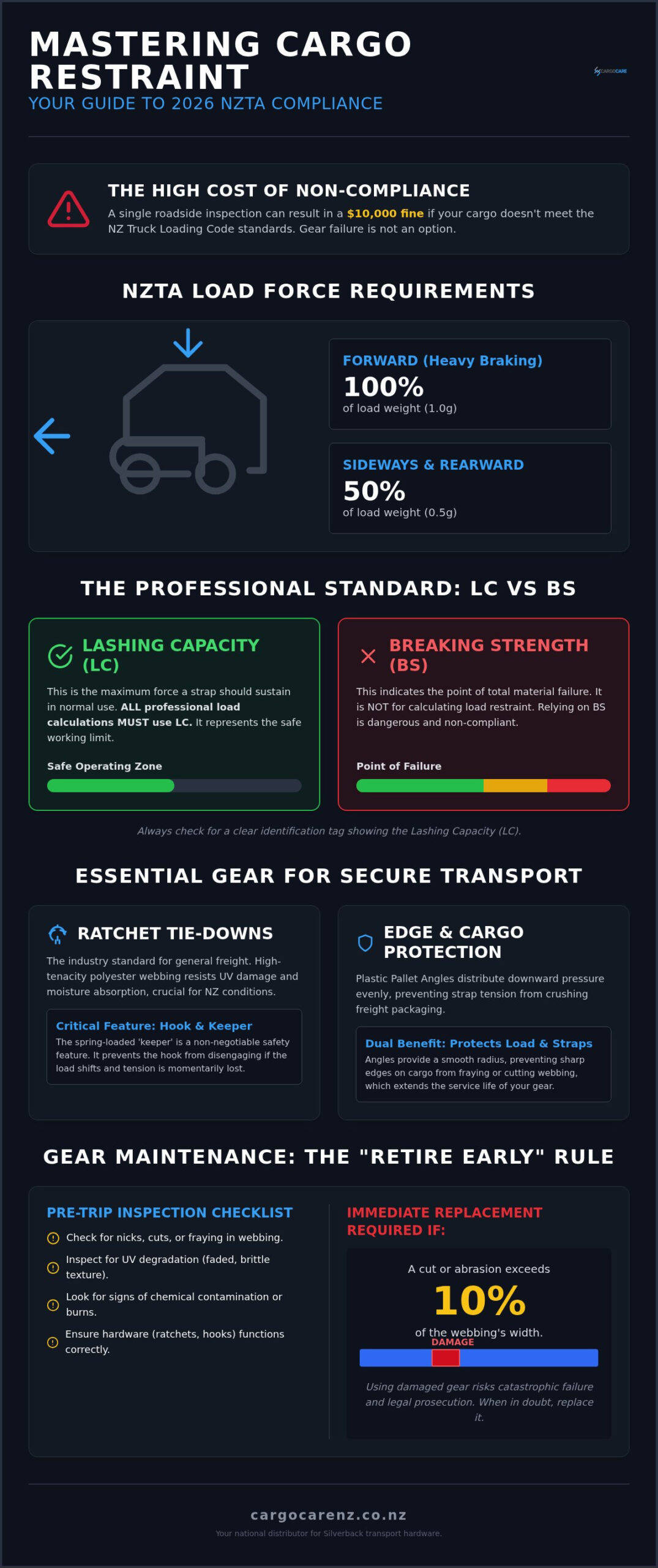
A single roadside inspection by the Commercial Vehicle Safety Team can result in a $10,000 fine for your company if your cargo doesn’t meet the 2026 NZ Truck Loading Code standards. You understand that securing freight is a high-stakes responsibility where gear failure simply isn’t an option. It’s about more than just tying things down; it’s about managing 1.0g of forward force during heavy braking and ensuring your load restraint straps NZ can withstand the rigours of long-haul transit.
This guide provides the technical clarity you need to master NZTA compliance and cargo safety. You’ll learn how to select the right lashing capacity for your specific freight and why high-quality Silverback hardware is the preferred choice for the professional transport sector. We’ll also examine the critical role of edge protection and the latest regulatory updates to ensure your equipment remains fit for purpose on every journey.
Key Takeaways
- Understand the 2026 NZTA Load Restraint Code requirements to ensure your fleet avoids heavy fines and stays compliant during roadside inspections.
- Learn why calculating load security based on Lashing Capacity (LC) rather than breaking strength is the only professional standard for heavy transport.
- Identify the specific performance attributes of high-quality load restraint straps NZ, such as Silverback ratchet tie-downs featuring hook and keeper hardware.
- Discover how integrating plastic pallet angles protects freight from strap tension while maintaining the necessary downward pressure for load stability.
- Master the “Retire Early” rule for gear maintenance, including how to identify critical webbing damage that necessitates immediate equipment replacement.
Understanding NZ Load Restraint Standards and Lashing Capacity
Compliance with the 2026 NZTA Load Restraint Code is a non-negotiable aspect of modern logistics. This code dictates that all load restraint systems must withstand specific forces: 100% of the load weight in the forward direction and 50% sideways or rearward. Using uncertified load restraint straps NZ risks more than just fines. It compromises the safety of every road user. Roadside inspections by the Commercial Vehicle Safety Team (CVST) focus on the presence of clear identification tags and the physical condition of the webbing.
A critical distinction for any professional is the difference between Lashing Capacity (LC) and Breaking Strength. While breaking strength indicates the point of total material failure, LC represents the maximum force a strap should sustain under normal operating conditions. Professional calculations always rely on LC to align with global standards for load securing. Generic straps from hardware retailers often lack clear LC tagging. They don’t have the industrial-grade construction needed for heavy-haulage. Reliability also depends on hardware components. A “Hook and Keeper” system is standard for professional transport because the keeper prevents the hook from disengaging if the load settles and the strap momentarily loses tension.
Calculating Your Restraint Requirements
Determining the correct number of straps requires assessing cargo weight and the friction between the load and the deck. The “Alpha” angle, or the angle of the strap relative to the deck, is a major factor. As this angle decreases, the effective downward pressure drops. If the tie-down angle is low, you must increase the number of straps. This achieves the required friction force to prevent load shift.
The Silverback Advantage for NZ Transport
As the national distributor for Silverback, CargoCare NZ provides hardware specifically engineered for the local environment. New Zealand’s high UV levels and frequent rain can degrade inferior webbing quickly. Silverback’s 50mm and 75mm load restraint straps NZ are manufactured with high-tenacity polyester to resist moisture absorption and sun damage. This ensures long-term operational continuity for operators facing diverse weather conditions across the country. Working with an authorised Silverback distributor New Zealand logistics professionals trust guarantees you receive genuine, certified hardware that meets the 2026 NZTA Truck Loading Code requirements.
Selecting the Right Gear: Ratchet Tie-Downs and Pallet Protection
Ratchet tie-downs are the operational standard for general freight across the country. The Hook and Keeper configuration ensures the hook remains engaged with the anchor point during transit, even if the load settles. This hardware choice is fundamental to meeting Cargo Securement Rules regarding equipment reliability and safety. For heavier applications involving G70 chain, operators should transition to a Maxibinder. These devices provide superior tensioning compared to traditional lever binders; they reduce physical strain on the driver while ensuring a secure, controlled lock. Understanding the key differences when evaluating Maxibinder vs ratchet binder NZ transport professionals rely on can help you select the right tool for each application. For a deeper look at how these two binder types compare across tensioning power, safety features, and NZTA compliance standards, see our complete Maxibinder vs ratchet binder NZ guide for 2026.
Securing freight involves more than just tension; it requires protecting the cargo from the force used to hold it. Integrating Plastic Pallet Angles is the most effective way to prevent load restraint straps NZ from crushing delicate packaging. We supply industrial-grade 1042mm angles to distribute downward pressure across the entire face of the pallet. This creates uniform stability and prevents the top layer of freight from shifting independently during transit.
Hardware Configurations: Hooks, Keepers, and Buckles
The Keeper is a spring-loaded safety latch. It’s a non-negotiable requirement for professional transport compliance because it prevents accidental detachment. Ergonomic long-handle ratchets are often preferred for their ability to generate higher pre-tensioning force with less manual effort. This helps drivers reach the necessary lashing capacity more efficiently. You can find these high-performance components in our range of Silverback transport hardware.
Protecting the Load and the Webbing
Edge protection extends the service life of your gear by preventing abrasion. Sharp edges on timber or steel can fray polyester webbing, leading to immediate non-compliance. Plastic pallet angles provide a smooth radius for the strap to pass over, effectively eliminating the “sawing” effect that occurs when a vibrating load moves against a sharp edge. This simple addition ensures both cargo integrity and equipment longevity.
Maintaining Compliance and Ensuring Gear Reliability
Maintaining the integrity of your load restraint straps NZ is a continuous operational requirement. A pre-trip inspection is the first line of defence against equipment failure. Drivers must check for nicks, cuts, and signs of UV degradation, which often appears as a faded or brittle texture in the polyester. Chemical exposure can also weaken fibres without immediate visible change. If you’re hauling specialised freight, you must also integrate dangerous goods transport equipment NZ into your safety protocols to remain fully compliant with Land Transport Rules.
The “Retire Early” rule is a standard industry safety benchmark. If a strap has a cut or abrasion exceeding 10% of its width, its lashing capacity is compromised. In these instances, 100% replacement is required immediately. Using damaged gear risks catastrophic failure and legal prosecution. Proper storage is equally vital. New Zealand’s humid climate promotes mould and rot, so store straps in a clean, dry area away from direct sunlight when they’re not in use. This simple habit ensures your gear remains dependable for its full service life.
When to Replace Your Load Restraint Straps
“Fuzzing” on the surface of the webbing indicates that internal load-bearing fibres are breaking down. This is often caused by friction or age. Beyond the webbing, inspect the ratchet mechanism itself. Look for frame distortion, spring fatigue, or a sticking handle. If the mechanism doesn’t lock smoothly or shows signs of bending, it’s a safety hazard and must be removed from service.
Compliance Documentation and Labelling
Every strap must have a legible manufacturer’s tag. This tag provides the Lashing Capacity (LC) and the specific standard it was manufactured to meet. Roadside inspectors will deem any unlabelled or modified strap as having zero lashing capacity. The legal consequences for companies using unlabelled equipment include fines of up to $10,000, as the load is technically considered unrestrained. Ensure your load restraint straps NZ are always correctly tagged and the information remains readable throughout their use.
Securing Your Operational Future on NZ Roads
Freight security requires a systemic approach that goes beyond simply throwing a strap over a load. Achieving 2026 NZTA compliance involves precise calculations based on Lashing Capacity and the strategic use of pallet angles to protect both cargo and webbing. By prioritising hardware with integrated safety features like hook and keeper systems, you ensure your equipment remains engaged despite the constant vibrations and shifting forces of the journey.
Operational continuity depends on gear that withstands the high-UV and high-moisture conditions of the New Zealand landscape. Selecting industrial-grade load restraint straps NZ ensures your fleet is equipped for the most demanding routes. A comprehensive freight security strategy also includes using tamper evident security seals NZ to protect shipments from theft and maintain cargo integrity from the loading dock to final delivery. As the official Silverback NZ distributor, CargoCare NZ provides the durability required for heavy transport alongside expert technical support to help you navigate complex safety standards. Secure your next load with total confidence.
View our full range of Silverback Load Restraint Hardware
Frequently Asked Questions
What is the legal lashing capacity for a 50mm ratchet strap in New Zealand?
A standard 50mm heavy-duty ratchet strap typically carries a Lashing Capacity (LC) of 2,500kg. You must always verify this rating by checking the manufacturer’s identification tag stitched into the webbing. This LC value is the legal figure used for all restraint calculations required by the NZTA Truck Loading Code. Using hardware without a confirmed LC rating prevents you from legally demonstrating compliance during a roadside inspection.
Can I use a ratchet strap if the manufacturer’s tag is missing or illegible?
No, you cannot legally use a strap if the manufacturer’s tag is missing or cannot be read. Under New Zealand transport standards, any unlabelled load restraint straps NZ are automatically assigned a lashing capacity of zero. Roadside enforcement officers will treat the load as unrestrained if the equipment lacks a clear, legible LC rating. You should remove any unlabelled gear from service immediately to maintain safety and avoid heavy fines.
What is the difference between a hook and keeper and a standard J-hook?
A hook and keeper includes a spring-loaded safety latch that locks the hook onto the anchor point, while a standard J-hook relies entirely on constant strap tension to stay in place. The keeper is a vital safety feature because it prevents the hardware from detaching if the cargo settles or the strap momentarily loses tension during transit. This configuration is the professional choice for ensuring a secure connection on unpredictable road surfaces.
How often should I replace my load restraint webbing?
Webbing must be replaced immediately if you discover visible damage like cuts exceeding 10% of the strap width, severe surface fuzzing, or chemical degradation. There is no fixed calendar expiry date for polyester webbing; however, New Zealand’s high UV levels and humidity gradually weaken the material fibres over time. Regular pre-trip inspections are the only way to confirm if your load restraint straps NZ remain fit for purpose and safe for heavy-haulage tasks.

Article by
Steve O'Malley