
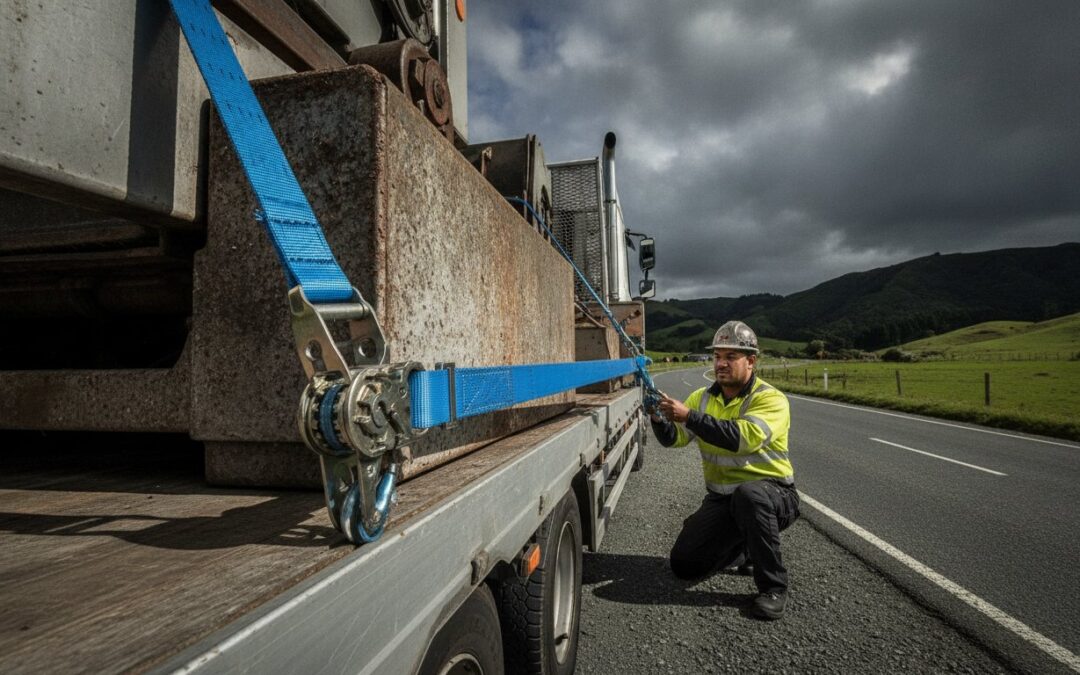
A single failed ratchet mechanism or an abraded strap doesn’t just risk your cargo; it puts your commercial operator’s licence and your company’s bottom line at immediate risk. With corporate fines for insecure loads reaching up to $10,000 under the Land Transport Act 1998, the cost of using sub-standard equipment far outweighs any initial savings. You understand that professional load restraint is a precise science, requiring gear that maintains tension across every kilometre of New Zealand’s challenging terrain.
This guide provides the technical expertise needed to select heavy duty tie down straps NZ that meet the 1.0g forward force requirements of the Truck Loading Code. We will outline the essential selection criteria for high-tenacity webbing, explain the current status of AS/NZS 4380:2001 standards, and demonstrate how professional-grade hardware reduces replacement costs while ensuring your fleet remains fully compliant and operational.
Key Takeaways
- Understand the NZTA compliance framework and the legal necessity of a 2500kg Lashing Capacity for heavy duty tie down straps NZ in commercial freight operations.
- Identify high-performance strap components, including gold-passivated hardware and high-tenacity polyester webbing designed to withstand extreme tension without losing integrity.
- Learn why the Ratchet Tie Down with Hook and Keeper is the preferred choice for professional flatbed transport, providing reliable security for diverse cargo types.
- Implement a rigorous pre-trip inspection and storage routine to mitigate the effects of UV degradation and abrasion, extending the service life of your restraint systems.
Understanding Heavy Duty Tie Down Standards in NZ
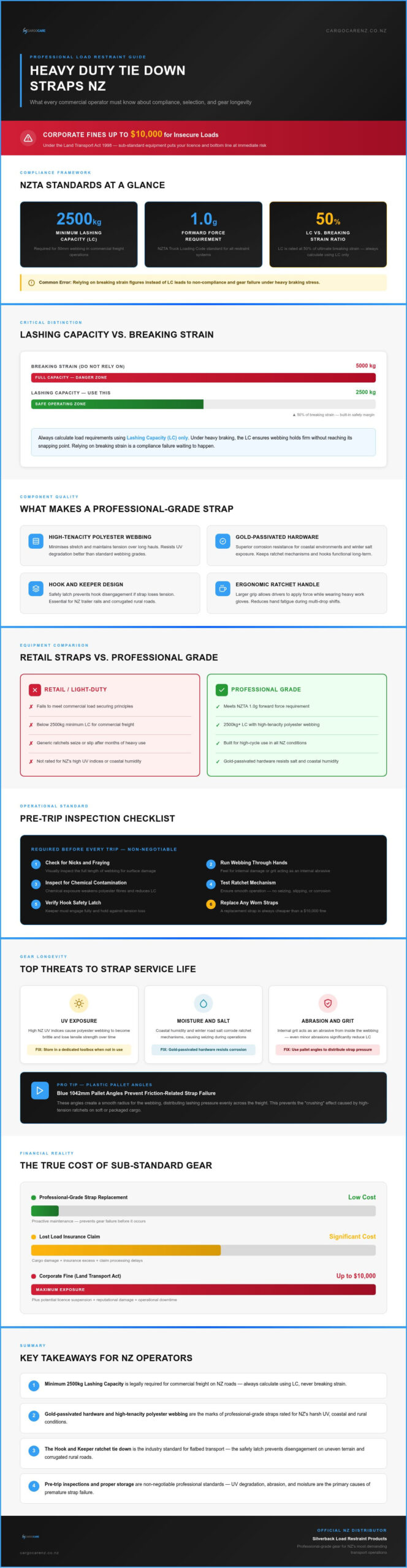
Professional transport operations require equipment that withstands substantial forces. In the New Zealand market, heavy duty tie down straps NZ are defined by a minimum Lashing Capacity (LC) of 2500kg for 50mm webbing. While light-duty straps found in retail centres might suffice for domestic use, they fail to meet the rigorous load securing principles required for commercial freight. NZTA compliance frameworks demand that restraint systems handle 1.0g of forward force. This makes professional-grade Silverback equipment a legal necessity for operators moving heavy cargo across the national roading network.
Lashing Capacity (LC) vs. Breaking Strain
Operators must distinguish between Lashing Capacity and Breaking Strain to avoid dangerous miscalculations. The LC is rated at 50% of the strap’s ultimate breaking strain. Professionals calculate load requirements based solely on the LC to ensure a safety margin. Relying on breaking strain figures is a common error that leads to non-compliance and gear failure under stress. When your rig is under heavy braking, the LC ensures the webbing holds firm without reaching its snapping point, keeping the freight secure.
The Hook and Keeper Design
The “Hook and Keeper” configuration is the standard for New Zealand trailer rails. This design features a safety latch that prevents the hook from disengaging if the strap loses tension. It’s a vital component for heavy duty tie down straps NZ, especially when navigating uneven terrain or corrugated rural roads. High-quality hardware is typically gold-passivated to resist corrosion. This treatment ensures the ratchet mechanism and hooks remain functional over long-term use, even in harsh coastal environments or during winter salt exposure.
Selecting Professional Ratchet Tie Downs for Your Fleet
Selecting the right heavy duty tie down straps NZ requires looking beyond the basic Lashing Capacity. A high-performance strap relies on high-tenacity polyester webbing to minimise stretch and maintain tension over long hauls. This webbing is paired with gold-passivated hardware, which provides superior resistance to the corrosive effects of road salt and coastal humidity. The Ratchet Tie Down with Hook and Keeper has become the industry standard for flatbed transport because it offers a secure connection to the trailer rail that won’t vibrate loose. Adhering to the Official New Zealand Truck Loading Code means ensuring every component of your system is fit for purpose.
Practicality on the job is also a major factor. Ratchet handles with larger, ergonomic grips allow drivers to apply necessary force while wearing heavy work gloves. This small design detail speeds up loading times and reduces hand fatigue during multi-drop shifts. Reliable gear doesn’t just improve safety; it streamlines your entire loading process.
The Silverback Advantage in Load Restraint
As the official New Zealand distributor of Silverback products, we provide gear specifically engineered for the high UV indices and volatile weather conditions found across the country. Silverback ratchet mechanisms are built for high-cycle environments, outlasting generic alternatives that often seize or slip after a few months of heavy use. The durability of these components ensures consistent performance even when exposed to heavy rain and road grime.
For those securing machinery or heavy steel, the Maxibinder 8mm NZ serves as a rugged, chain-based alternative to traditional webbing. You can view our full range of Silverback hardware to find the right fit for your specific rig.
Extending Gear Life and Ensuring Cargo Safety
Operational continuity depends on the integrity of your webbing. A pre-trip inspection is a non-negotiable professional standard. Drivers must check for nicks, fraying, or any signs of chemical contamination that might weaken the polyester fibres. A thorough check involves running the webbing through the hands to feel for internal damage or grit that can act as an abrasive from the inside out. Even minor surface abrasions can reduce the lashing capacity of heavy duty tie down straps NZ by a significant margin. According to the NZ Transport Agency’s Truck Loading Code, restraints must be maintained in good condition to meet legal safety requirements. Replacing a worn strap is always cheaper than the cost of a $10,000 corporate fine or a lost load insurance claim.
Environmental factors, particularly high UV exposure, cause polyester webbing to become brittle and lose its tensile strength over time. Storing gear in a dedicated toolbox when not in use is a professional necessity to prevent this premature degradation. This practice also protects the ratchet mechanisms from road grime and moisture, ensuring the hardware remains functional and easy to operate during loading. It’s a simple step that significantly reduces gear replacement costs over the long term.
The Critical Role of Plastic Pallet Angles
Using blue 1042mm plastic pallet angles is the most effective way to prevent friction-related strap failure. These angles create a smooth radius for the webbing, distributing lashing pressure evenly across the freight. This prevents the “crushing” effect often caused by high-tension ratchets on soft or packaged cargo. For mixed or loose freight, professional load restraint often requires a combination of heavy duty tie down straps NZ and cargo safety nets to ensure full containment and total compliance with national safety standards.
Securing Your Fleet for Long-Term Compliance
Maintaining a compliant transport operation requires more than just meeting minimum legal standards; it’s a commitment to high-performance equipment. True security comes from understanding Lashing Capacity and choosing hardware like the Hook and Keeper that is engineered for New Zealand’s road conditions. By integrating edge protection and following a strict inspection routine, you protect both your cargo and your gear from unnecessary wear.
Investing in professional-grade heavy duty tie down straps NZ ensures your freight stays secure from the depot to the final delivery point. As the official NZ distributor for Silverback, we specialise in load restraint compliance and provide national delivery for all transport hardware. Browse our range of Silverback heavy duty tie downs and load restraint gear to equip your fleet with the industry’s most dependable tools. Keeping your load secure is the foundation of a successful logistics operation.
Frequently Asked Questions
How do I know if my tie-down straps are compliant with NZ standards?
Compliance is verified by inspecting the manufacturer’s tag permanently attached to the webbing. Under New Zealand standards, this tag must clearly display the Lashing Capacity (LC) and the manufacturer’s identification. For 50mm heavy duty tie down straps NZ, a rating of 2500kg is the professional benchmark. If the tag is missing, illegible, or doesn’t reference AS/NZS 4380, the strap is legally non-compliant.
What is the difference between a Hook and Keeper and a J-Hook?
A Hook and Keeper features a spring-loaded safety latch that locks the hook onto the trailer rail. This prevents the strap from detaching if the load settles and tension momentarily drops. In contrast, a J-Hook lacks this locking mechanism. While J-Hooks are common, the Hook and Keeper is the preferred professional standard for New Zealand transport operators navigating uneven or corrugated road surfaces.
Can I use a heavy-duty ratchet strap to tow a vehicle in New Zealand?
No, you shouldn’t use a ratchet strap for vehicle recovery or towing. Tie-down straps are engineered for static load restraint and can’t handle the dynamic snatch forces or kinetic energy generated during towing. Using heavy duty tie down straps NZ for this purpose risks catastrophic webbing failure or hardware projectiles. Always use dedicated recovery snatches or tow chains rated for vehicle weight.
How often should I replace my heavy-duty tie-down straps?
Replacement is determined by physical condition rather than a fixed calendar date. You must retire straps immediately if you identify any of the following issues during your pre-trip inspection:
- Nicks or cuts exceeding 10% of the webbing width.
- Visible UV degradation, such as severe colour fading or fibre brittleness.
- Deformed, cracked, or heavily corroded ratchet hardware.
Regular maintenance ensures your gear remains safe and compliant with the NZ Transport Agency’s Truck Loading Code.
Article by
Steve O'Malley