
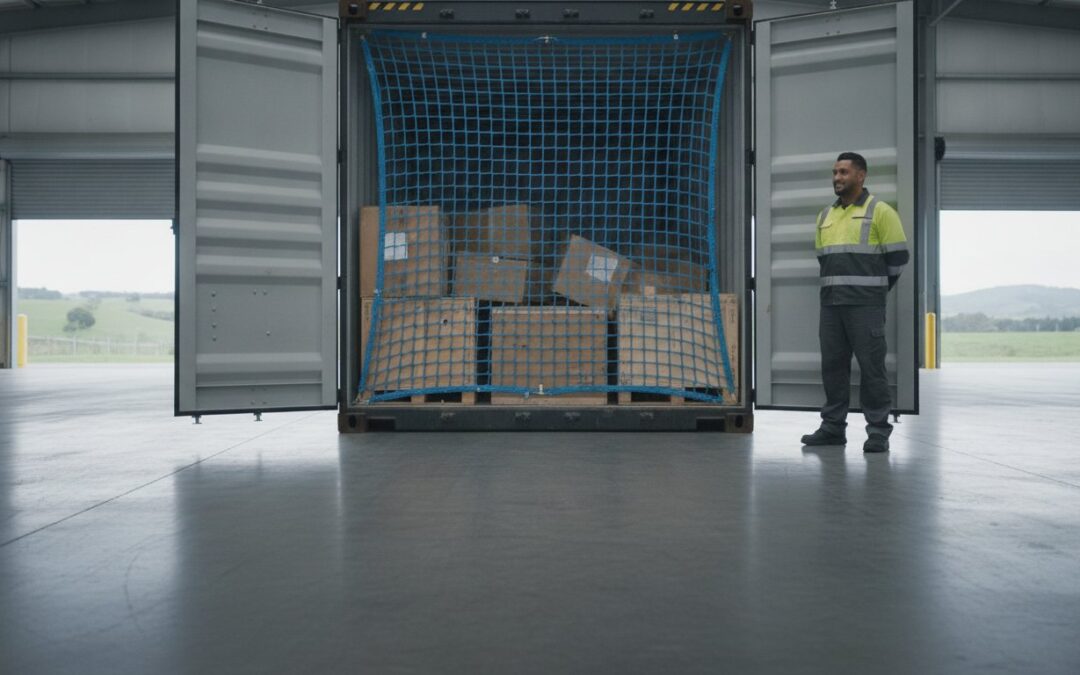
Opening a shipping container door shouldn’t be a gamble with your team’s safety. You understand the risk when freight shifts during transit, creating a hazard that can spill out the moment the latch turns. With company fines for insecure loads reaching up to NZ$10,000 under the Land Transport Act, the stakes for your logistics operation are high. Implementing a reliable cargo safety net NZ solution is the most effective way to eliminate “falling cargo” incidents at the warehouse and protect your personnel.
We recognise that maintaining operational speed while ensuring workplace safety is a constant challenge. This guide provides the technical knowledge needed to select durable, UV-stabilised containment systems that meet New Zealand professional standards. You’ll learn how to distinguish between load restraint and containment, the benefits of integrated cam buckle systems for rapid installation, and how to maintain compliance with the updated NZ Truck Loading Code.
Key Takeaways
- Distinguish between secondary containment and primary load restraint to ensure your equipment meets specific operational and legal requirements.
- Identify why a 2.2m x 2.2m high-density polyethylene cargo safety net NZ is the preferred industry standard for securing freight behind container doors.
- Master the vertical installation process using integrated cam buckles for fast, efficient tensioning in high-volume logistics environments.
- Implement effective safety barriers to eliminate falling cargo hazards and maintain strict compliance with the NZ Truck Loading Code.
Cargo Safety Net Fundamentals: Containment vs. Load Restraint
A cargo safety net NZ serves as a vital secondary containment barrier for loose or shifting freight. While many understand what is a cargo net in a general sense, professional logistics requires a clear distinction between restraint and containment. Load-rated nets act as primary restraint, designed to withstand the forces of a moving vehicle. Containment nets, however, function as safety barriers. These are the industry standard for vertical applications inside shipping containers.
Containment nets are the preferred choice for container door protection because they manage the specific risk of “spill-out” upon arrival. During long-haul transit, vibrations and movement cause freight to shift. Without a barrier, goods often lean directly against the door. Opening the latch without a net in place creates an immediate hazard. This often results in freight falling on workers or sustaining damage upon impact with the warehouse floor.
The Role of Containment in Transport Compliance
New Zealand workplace safety regulations place a clear obligation on operators to protect personnel from falling objects. Using a professional cargo safety net NZ helps businesses meet these safety standards by providing a predictable barrier between the load and the worker. For maximum reliability, industrial-grade polyethylene is essential. This material provides superior resistance against weather and abrasion compared to cheaper, domestic-grade mesh. High-density polyethylene ensures the net remains a dependable component of your safety protocol over multiple transit cycles.
Key Considerations for Selecting Cargo Safety Equipment in NZ
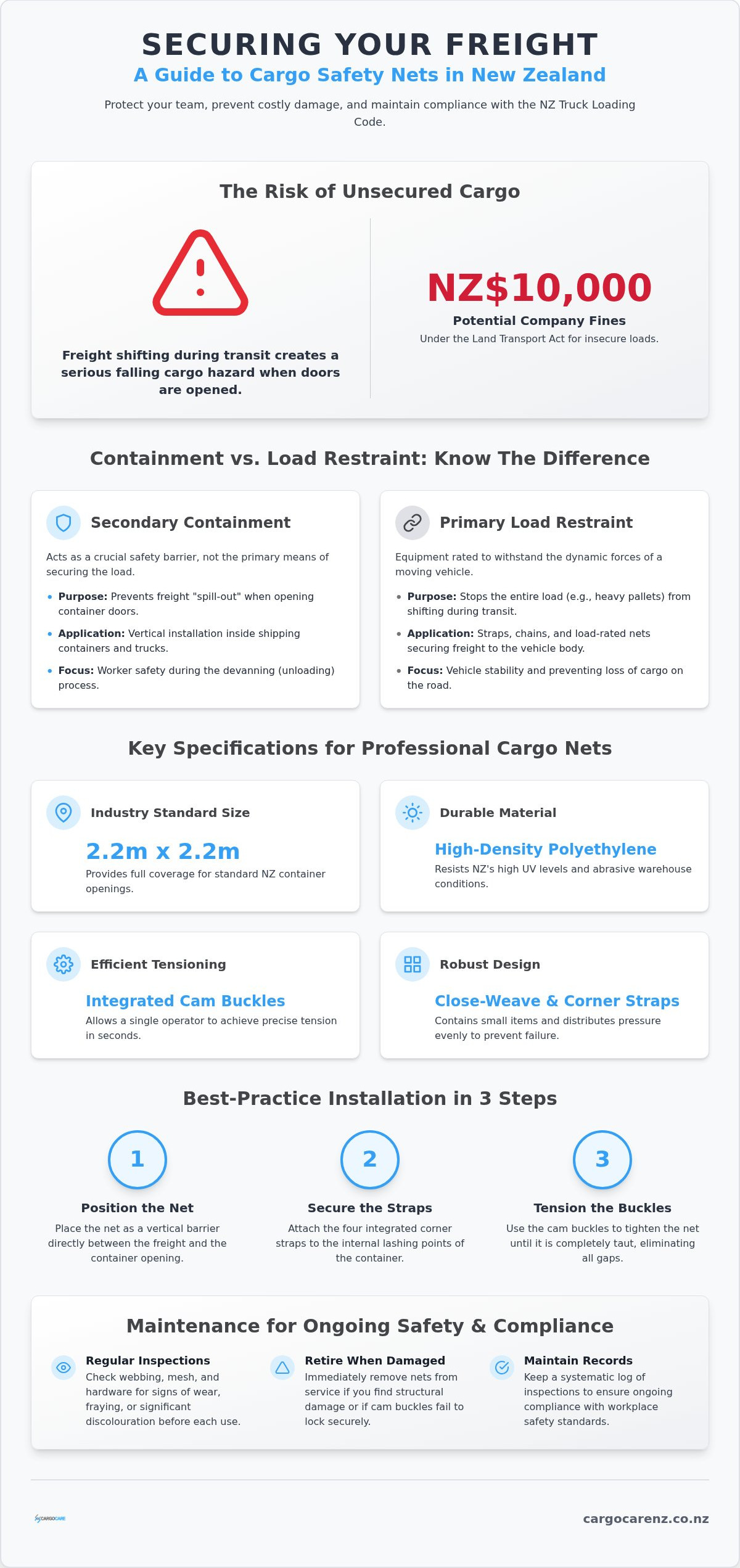
Selecting the right cargo safety net NZ requires a focus on specific technical attributes that ensure operational continuity. For standard New Zealand shipping containers, the 2.2m x 2.2m dimensions have become the industry standard. This size provides comprehensive coverage across the container opening, acting as a reliable safety barrier for shifted freight regardless of the load profile.
Durability is a non-negotiable requirement in the transport sector. High-density polyethylene construction is preferred for its exceptional resistance to New Zealand’s high UV levels and abrasive warehouse conditions. Unlike domestic-grade netting, industrial polyethylene maintains its structural integrity over repeated use, providing a lower total cost of ownership through longevity.
Efficiency in a busy depot depends heavily on tensioning hardware. Integrated cam buckles are significantly more reliable and faster than manual knots. They allow a single operator to achieve precise tension in seconds, ensuring the net remains secure without slowing down logistics workflows. For those seeking industry-standard transport hardware, choosing Silverback cargo nets ensures your team has the right tools for professional applications.
Technical Specifications for Professional Logistics
A close-weave design is critical for containing smaller cartons, bales, or loose items that might slip through larger mesh openings. This weave ensures that even irregular loads remain contained within the vehicle or container during transit. Integrated corner straps are equally vital. These straps distribute pressure evenly across the net’s surface, preventing local failure and ensuring the barrier remains effective even when subjected to significant force from shifting freight. These features combined create a robust containment system that supports both safety and speed.
Best-Practice Installation for Container and Warehouse Safety
Proper installation of a cargo safety net NZ is the final step in securing a shipment before the container doors are closed. First, position the net as a vertical barrier directly between the freight and the container opening. This placement ensures that any shifted items are caught before they can exit the vehicle. Second, secure the four integrated corner straps to the internal lashing points of the container or truck body. These points are specifically designed to handle the tension required for a stable barrier.
Finally, use the cam buckles to tension the net until it is completely taut. This eliminates gaps where loose cartons or smaller items might slip through. For a comprehensive containment strategy, these nets should be used alongside primary systems like load restraint straps NZ. While the straps provide the primary restraint for heavy pallets, the net acts as the fail-safe barrier for individual items. This multi-layered approach is the most effective way to protect warehouse staff during the devanning process. For complete container security, pairing your containment net with correctly applied shipping container bolt seals ensures your freight is protected from both shifting loads and tampering throughout the supply chain.
Maintaining Your Cargo Safety Gear
Operational safety depends on the physical condition of your containment equipment. Establish regular inspection protocols to check the webbing, mesh, and tensioning hardware for signs of wear. In the New Zealand transport environment, high UV exposure can lead to material degradation and loss of strength. Retire a net immediately if you identify structural fraying, significant discolouration, or if the cam buckles fail to lock securely. Maintaining a systematic log of these inspections ensures ongoing compliance with workplace safety standards and guarantees the net will perform as expected during a shifting cargo event.
Securing Your Logistics Chain for Safer Operations
Implementing the correct secondary containment system is a fundamental requirement for modern New Zealand transport. By distinguishing between primary restraint and vertical barriers, you ensure your team remains protected during the critical devanning phase. Selecting high-density polyethylene construction and integrated tensioning hardware guarantees both long-term durability and operational speed in the warehouse. These heavy-duty solutions are specialised for container door safety, providing a reliable barrier where standard restraints cannot reach.
At CargoCare NZ, as the official Silverback distributor in the country, we’re committed to supplying hardware that meets the rugged demands of the local industry. Choosing the right cargo safety net NZ is a direct investment in workplace safety and freight integrity. View our Silverback Cargo Safety Nets for professional containment to upgrade your fleet’s equipment today. Taking these proactive steps ensures your freight arrives safely while maintaining full compliance with national safety standards.
Frequently Asked Questions
Is a cargo safety net required by law in New Zealand?
The Land Transport Act 1998 requires all operators to secure loads effectively to prevent shifting or falling. While the legislation doesn’t mandate specific brands, failing to protect personnel from falling freight can lead to company fines of up to NZ$10,000. Using a cargo safety net NZ is a recognised professional method for meeting these workplace safety obligations and adhering to the NZ Truck Loading Code.
Can I use a containment net as my primary load restraint?
No, containment nets are designed as secondary safety barriers and don’t replace primary restraint systems. New Zealand standards require restraint equipment to withstand 80% of the load’s weight in a forward direction. A containment net is engineered to prevent loose items from spilling when container doors are opened, but it lacks the load rating required to secure the bulk weight of freight during transit.
What is the benefit of a cam buckle over a ratchet for safety nets?
Cam buckles allow for rapid, controlled tensioning without the risk of over-tightening. Because containment nets are made from polyethylene mesh, the excessive force generated by a ratchet can cause structural damage to the webbing or mesh fibres. Cam buckles provide sufficient tension to keep the barrier taut while allowing for much faster installation and removal in high-volume logistics environments where speed is critical.
Will a 2.2m x 2.2m net fit a standard shipping container?
Yes, the 2.2m x 2.2m dimensions are the industry standard for providing edge-to-edge coverage in standard shipping containers. This size ensures the net covers the entire door opening, leaving no gaps for smaller cartons or loose items to escape. When anchored to the internal lashing points, it creates a reliable vertical barrier that accommodates almost all common freight profiles arriving at New Zealand ports. To further protect your shipment from tampering once the doors are secured, consider reviewing the correct selection and application of ISO-compliant shipping container bolt seals as part of your end-to-end container security protocol.
Article by
Steve O'Malley