
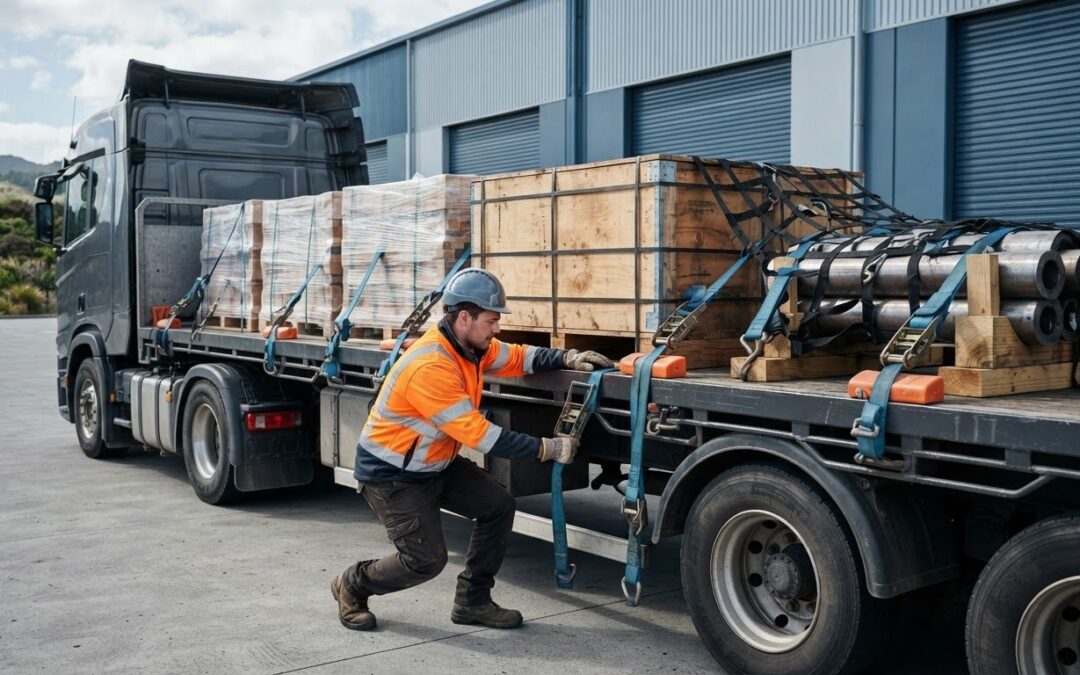
A load that looks secure at the depot can still shift when a vehicle brakes, corners or travels over uneven roads. Choosing restraint equipment for different freight and turning regulatory guidance into consistent checks can be challenging for drivers and loading teams. When securing loads for road transport NZ, start by assessing the freight and vehicle, then check the complete setup before departure and during the journey.
This guide provides a repeatable process for assessing freight, selecting suitable restraint and checking the load. It explains why restraint must suit the load rather than rely on friction or appearance alone, and points to Waka Kotahi NZ Transport Agency’s current truck loading code and WorkSafe New Zealand guidance. When a load or equipment rating is unclear, check the relevant specifications or seek competent advice.
Key Takeaways
- Match restraint choices to the freight’s weight, shape, packaging and the vehicle setup, rather than relying on appearance alone.
- Use a consistent loading sequence to position freight, distribute weight and select suitable restraint points.
- For securing loads for road transport NZ, check equipment ratings and instructions against the assessed load before use.
- Choose tie-downs, binders or cargo nets for the application, and use pallet angles to help protect freight edges without treating them as restraint.
Securing loads for road transport in NZ: the principles behind a stable load
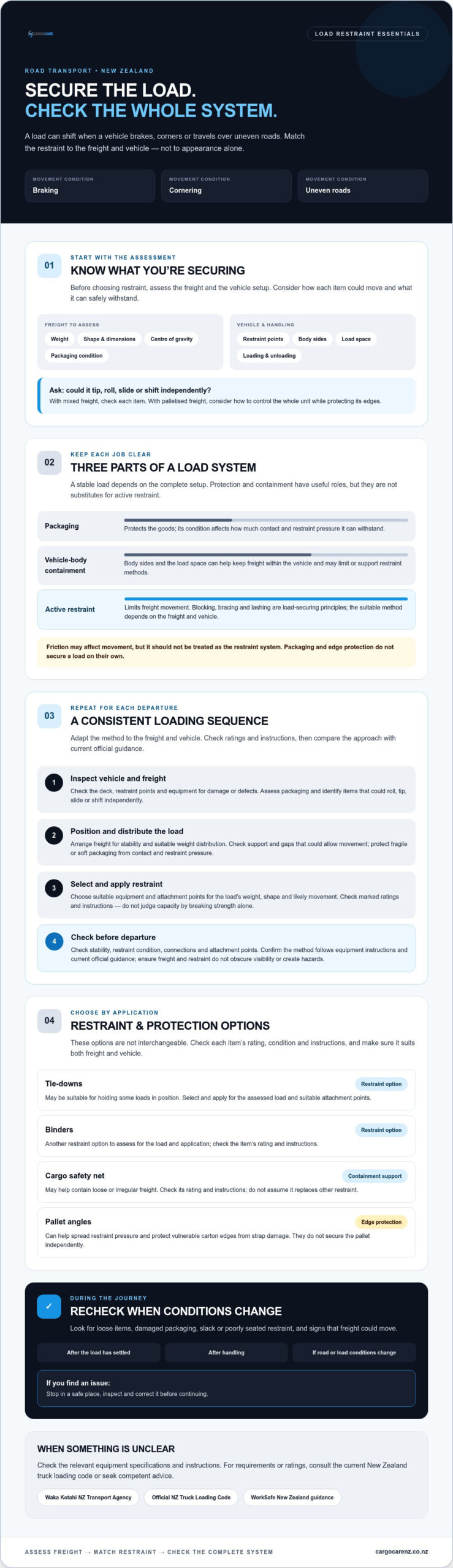
Load restraint is the system used to prevent freight moving in an unacceptable way under conditions reasonably expected during transport. Braking, cornering and uneven road surfaces can all place forces on a load. The Principles of load securing include blocking, bracing and lashing. The suitable method depends on the freight and vehicle, not simply on which equipment is available.
Assess the load’s shape and centre of gravity to identify whether it could tip, roll or slide. Weight distribution affects vehicle stability, while packaging condition influences how much contact and restraint pressure the freight can withstand. Friction between freight and the deck may affect movement, but it shouldn’t be treated as the restraint system. Check the vehicle’s anchor points, body sides and load space too, as these can limit or support particular methods.
Keep the functions of each component clear. Packaging protects goods; vehicle-body containment helps keep freight within the vehicle; active restraint limits movement. A net or tie-down may restrain freight, while a pallet angle can help protect carton edges from strap pressure. Packaging and edge protection do not secure a load on their own.
What should be assessed before choosing a restraint method?
Before choosing a method, check the freight’s weight, dimensions, centre of gravity and packaging condition. Consider which directions it could move, the vehicle’s restraint points, and how the freight will be handled during loading and unloading. With mixed freight, assess whether separate items need different restraint approaches. For palletised freight, consider how to control the whole unit while protecting its edges.
No single method suits every load. Assess the freight and vehicle setup, then consult the current New Zealand truck loading code and equipment instructions if you need to confirm requirements or ratings.
How to secure a load for NZ road transport: a repeatable loading sequence
Use the same sequence for each departure, adapting the restraint method to the freight and vehicle. For securing loads for road transport NZ, verify the equipment ratings and instructions, then compare your approach with the Official NZ Truck Loading Code.
- Inspect the vehicle and freight. Check the deck, restraint points and equipment for damage or defects. Assess the packaging and identify items that could roll, tip, slide or shift independently.
- Position and distribute the load. Arrange freight to create a stable load and suitable weight distribution. With mixed or irregular freight, check how each item is supported and whether gaps could allow movement. Consider protecting fragile or soft packaging from contact and restraint pressure.
- Select and apply restraint. Choose suitable attachment points and equipment for the load’s weight, shape and likely movement. Check the equipment’s marked rating and instructions. Don’t judge its capacity by breaking strength alone. For help assessing strap selection, see this load restraint straps guide.
- Check before departure. Check the load’s stability, restraint condition, connections and attachment points. Confirm that the method follows equipment instructions and current official guidance. Make sure the freight and restraint don’t obscure visibility or create hazards.
What should the pre-departure load check cover?
Look for loose items, damaged packaging, slack or poorly seated restraint, and signs that freight could move. Recheck the load during the journey, particularly after it has settled, after handling, or if road or load conditions change. If you find an issue, stop in a safe place to inspect and correct it before continuing. Once you’ve identified the load requirements, browse CargoCare NZ’s cargo restraint equipment to see products that may be relevant.
Choosing load restraint equipment and protecting freight in transit
Restraint equipment and freight protection have different jobs. Tie-downs may be suitable for holding some loads in position, while binders are another restraint option to assess for the load and application. A cargo safety net may help contain loose or irregular freight, but shouldn’t be assumed to replace other restraint. These options aren’t interchangeable. Check each item’s rating, condition and instructions, and make sure the chosen method suits both the freight and the vehicle.
For palletised goods, plastic pallet angles can help spread restraint pressure and protect vulnerable edges from strap damage. They don’t secure the pallet independently. The restraint system still needs to control the load, and the angle must be suitable for the packaging and application.
When do pallet protection and cargo nets support a restraint plan?
Use edge protection where restraint could crush or abrade packaging, after checking the product’s intended use. A cargo safety net may help contain loose or irregular items, but check that its rating and instructions suit the load. For more detail, read the cargo safety net guide and the Silverback transport safety guide.
Effective load restraint means matching restraint and protection to the assessed freight, then checking that each component works as intended within the complete system. Don’t rely on a protective accessory to compensate for unsuitable restraint. Confirm current product specifications and application guidance before use.
When comparing equipment, use the load requirements you’ve established to assess which items may suit the application. Cargo Care NZ’s cargo restraint equipment includes options to consider for load restraint and freight protection.
Make load restraint part of every departure
Reliable securing loads for road transport NZ starts with assessing the freight and vehicle, choosing restraint suited to the application, and checking the complete setup before departure and during the journey. Keep restraint, containment and packaging protection in their proper roles. Check equipment ratings and instructions rather than assuming one method fits every load.
Cargo Care NZ supplies ratchet tie-downs, Maxibinders, cargo safety nets and plastic pallet angles, and is the official New Zealand distributor of Silverback products. Check each product’s specifications for its intended use. Review Cargo Care NZ’s load restraint and freight protection products to find equipment relevant to your operation.
Frequently Asked Questions
What are the basic principles for securing loads on New Zealand roads?
Assess the freight and vehicle, then use a restraint system that prevents unacceptable movement during transport. Consider the load’s weight, shape, packaging, centre of gravity and likely directions of movement, along with suitable vehicle attachment points. Arrange freight stably, check equipment ratings and instructions, and don’t rely on friction or packaging alone to restrain the load. Recheck the setup before departure.
How often should a driver check a load during a journey?
Check the load before departure and recheck it during the journey, particularly after it has settled, after loading or unloading, or if conditions change. There isn’t a single interval that suits every load and trip. Use safe opportunities to inspect restraint tension, attachment points and load stability. If freight has shifted or restraint is damaged, stop safely and address the problem before continuing.
Can a cargo net or pallet angle replace load restraint equipment?
No, not automatically. A cargo safety net may help contain loose or irregular freight when its rated use and instructions suit the load, but containment isn’t necessarily a substitute for restraint. A plastic pallet angle can help protect pallet edges from pressure or abrasion caused by restraint. It doesn’t secure freight independently. Use each item according to its purpose within the complete restraint plan.
How do I know which load restraint equipment is suitable for my freight?
Match the equipment to the freight’s weight, dimensions, shape, packaging and likely movement, as well as the vehicle’s attachment points. Check the equipment’s ratings, condition and manufacturer instructions, and confirm the method against current New Zealand load-restraint guidance. For securing loads for road transport NZ, don’t assume one type of tie-down, binder or net suits every application. Seek competent advice if you’re uncertain.

Article by
Steve O'Malley