
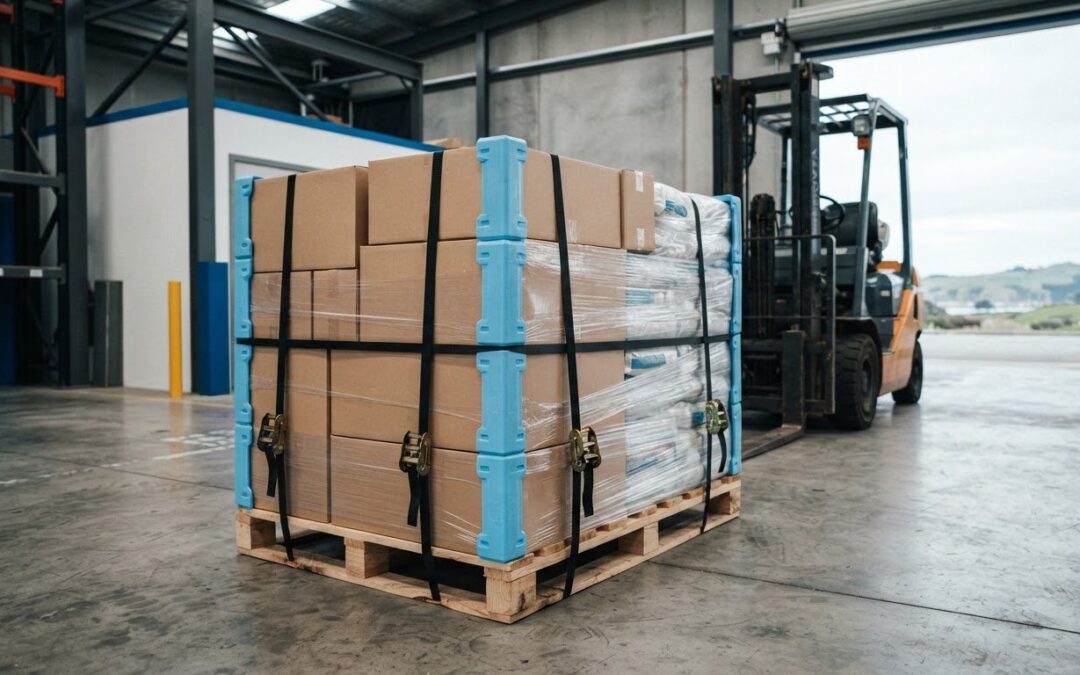
Cranking a heavy-duty ratchet tie-down can easily crush outer cartons and rupture bagged stock long before reaching necessary road restraint tension. Transport operators know the costly headache of arriving at a receiver only to find buckled packaging, load shift, or rejected consignments caused by flimsy protectors snapping mid-transit. Choosing industrial-grade pallet strapping corner guards NZ freight operators trust ensures severe strap bite is eliminated while maintaining total pallet stability under full tension.
This 2026 buying guide evaluates heavy-duty edge protection engineered to handle severe tie-down pressure and keep freight compliant with the official New Zealand truck loading code. You’ll discover how durable, reusable solutions like 1042mm plastic pallet angles prevent transit damage claims, protect your fleet from non-compliance penalties, and secure cargo reliably across nationwide transport routes with CargoCare NZ.
Key Takeaways
- High-tension tie-down straps concentrate severe point pressure, making industrial edge protection essential to stop carton crush and load destabilisation.
- Choosing proven pallet strapping corner guards NZ transport operations trust eliminates transit damage claims and maintains outer packaging integrity.
- Utilising 1042mm plastic pallet angles delivers full-span coverage across standard pallets, ensuring uniform tension distribution without cracking under load.
- Proper edge protection allows drivers to apply maximum legal strap pre-tension while adhering strictly to the official New Zealand truck loading code.
Why Heavy-Duty Corner Guards Are Critical for Palletised Road Freight
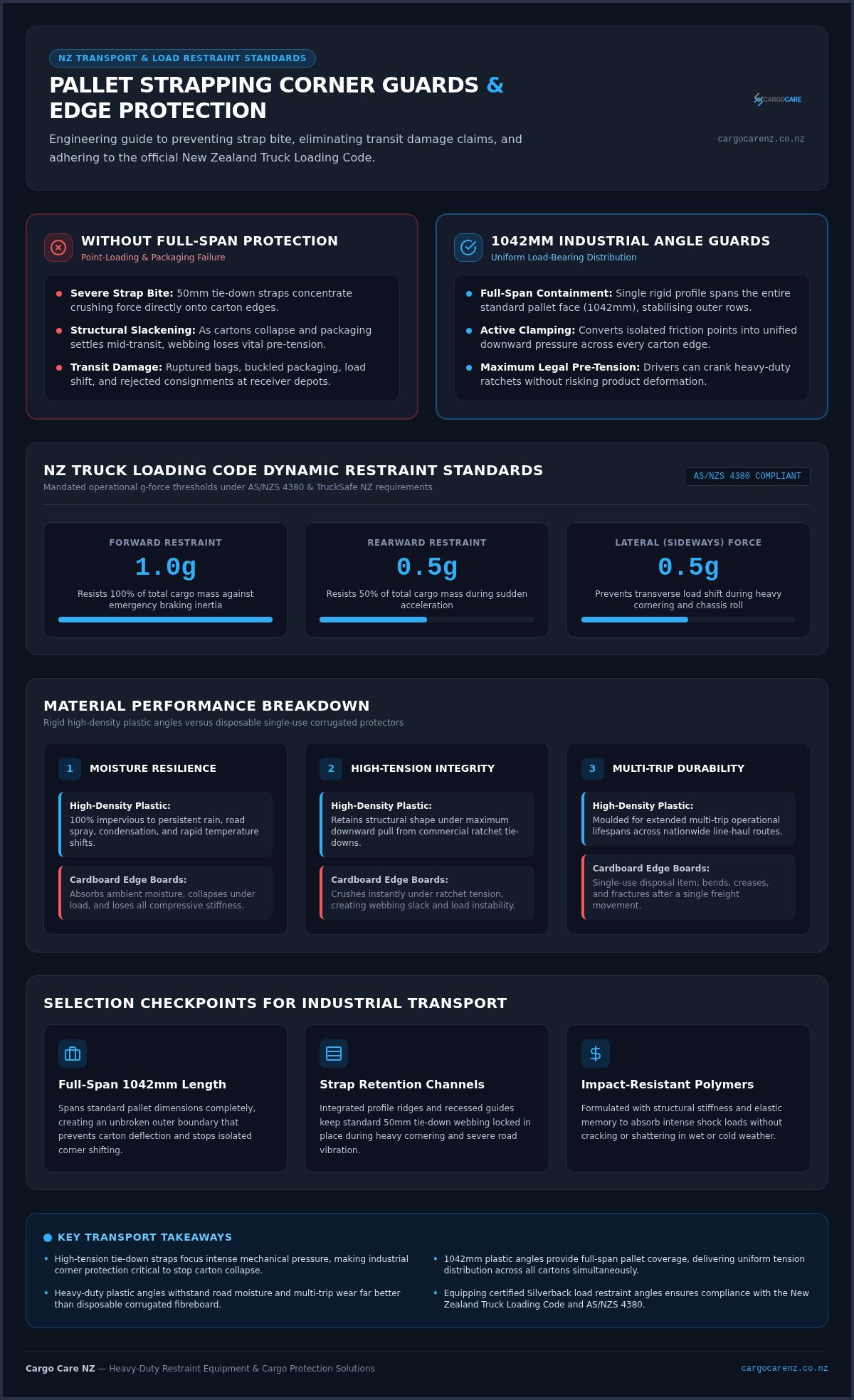
A pallet strapping corner guard is a rigid protective profile placed along cargo edges to dissipate tie-down tension evenly, preventing webbing from cutting into goods while keeping restraint tension intact throughout transit. Standard road transport subjects palletised freight to continuous vibration, vertical acceleration, and shifting lateral forces. Without adequate protection, 50mm tie-down straps focus intense mechanical pressure onto narrow contact points, generating severe “strap bite”. This crushes outer cartons, punctures bagged stock, and causes cargo layers to lose structural alignment.
Deploying heavy-duty pallet strapping corner guards NZ transport operators rely on prevents point-loading failures. Industrial guards transform isolated friction points into unified load-bearing lines. As outlined in global standards for strapping materials and applications, effective edge containment is vital for stabilising packaged goods during movement. Stabilising the top corners keeps the entire pallet block rigid, ensuring tie-down webbing maintains active tension without slackening as packaging settles.
Rigid Plastic Angles versus Disposable Cardboard Protectors
Lightweight corrugated protectors collapse under industrial restraint tension. While single-use cardboard edge boards suit internal dust covers or warehouse storage, they fail quickly on open transport decks:
- Moisture Resilience: Persistent road moisture softens cardboard, stripping its compressive strength. Rigid high-density plastic angles remain completely impervious to rain, road spray, and temperature shifts.
- High-Tension Integrity: Significant pre-tension from commercial ratchet tie-downs crushes fibreboard, leading to loose straps. Rigid plastic angles retain their structural shape under maximum downward pull.
- Multi-Trip Durability: Cardboard bends and fractures after one trip. Moulded plastic angles provide an extended multi-trip operational lifespan across nationwide logistics networks.
Key Criteria for Selecting Pallet Strapping Corner Guards in NZ
Selecting the right pallet strapping corner guards NZ transport operators depend on requires matching hardware specs directly to road dynamics. Short, isolated corner pieces leave cargo rows vulnerable to shifting. Industrial edge protection demands full-span profiles that cover standard pallet dimensions, creating a continuous boundary that stops outer carton deflection. Polymer formulation matters just as much. The material must provide high structural stiffness yet retain enough elastic memory to absorb chassis vibration without fracturing under high lashing tension.
Key selection checkpoints include:
- Full-Span Length: Spanning the entire pallet face ensures uniform load distribution across every carton edge.
- Strap Retention Channels: Recessed guides keep 50mm tie-down webbing centred during transit.
- Impact-Resistant Polymers: Heavy-duty plastics absorb shock loads without cracking in cold or wet conditions.
Matching Edge Guards to Transport Strapping and Load Dynamics
Guards must work seamlessly with commercial load restraint straps NZ regulations require under AS/NZS 4380. Integrated profile ridges prevent 50mm tie-down webbing from wandering off line during cornering forces or sudden braking. Whether securing uniform cartons or uneven timber, properly seated guards distribute clamping forces evenly into the pallet base. Aligning your restraint equipment with industry programs like the TruckSafe NZ safety management system keeps your fleet safe and compliant nationwide. To equip your vehicles with proven, durable gear, check the range at CargoCare NZ.
Implementing Silverback Plastic Pallet Angles for Total Cargo Protection
Generic corner clips often fail to stabilise an entire pallet face, leaving cargo vulnerable to transverse shifting under transport stress. Full-length 1042mm plastic pallet angles solve this vulnerability by spanning standard pallet widths in a single, rigid profile. Engineered specifically for heavy transport conditions, these durable units distribute downward restraint forces across all top cartons simultaneously. Drivers can apply maximum legal pre-tension using a ratchet tie down with hook and keeper without crushing packaging or deforming box profiles.
Securing freight to transport standards means adhering strictly to the NZ Truck Loading Code. Under these regulations, restraint assemblies must hold loads firmly against 1.0g forward, 0.5g rearward, and 0.5g lateral forces. Integrating certified Silverback products NZ transport operators rely on guarantees your edge restraint interfaces cleanly with commercial strapping. This combination delivers predictable clamping force across every line haul, preventing costly transit claims.
Standardising Pallet Restraint to Prevent Damage and Delays
Standardising your fleet with dedicated pallet strapping corner guards NZ logistics managers recommend creates operational consistency across loading docks:
- Fleet-Wide Protection: Outfitting line-haul units with 1042mm plastic pallet angles ensures loaders always have rugged, reusable edge guards ready on the deck.
- Integrated Restraint Systems: For mixed pallet heights or part-loads, pair edge angles with a cargo safety net NZ fleets utilise for total perimeter containment.
- Nationwide Compliance: Equipping vehicles with commercial-grade transport angles prevents roadside fines of up to $2,000 for drivers and $10,000 for transport operators.
CargoCare NZ provides national distribution of official Silverback cargo control equipment, ensuring transport operators receive dependable hardware built for New Zealand roads.
Secure Your Freight with Heavy-Duty Edge Protection
Protecting freight from crushing damage demands purpose-built transport hardware. Replacing disposable cardboard with heavy-duty 1042mm plastic pallet angles distributes high tie-down tension evenly across every carton edge. This simple upgrade preserves structural pallet geometry, eliminates transit damage claims, and prevents load shift. Investing in proven pallet strapping corner guards NZ transport operators depend on ensures your loads stay strictly compliant with national road restraint standards on every journey.
As the official New Zealand distributor of Silverback transport safety equipment, CargoCare NZ provides nationwide dispatch of durable cargo restraint hardware built for tough commercial demands. Equip your fleet with Silverback plastic pallet angles from CargoCare NZ to secure your consignments, protect packaging integrity, and keep your transport operations running safely without disruption.
Frequently Asked Questions
How do pallet strapping corner guards prevent freight damage?
Pallet strapping corner guards prevent damage by spreading concentrated strap tension across a broad, rigid surface area rather than a single focal point. This stops 50mm webbing from biting into cardboard cartons or tearing sacks during transit. The distributed force also locks top rows together, preventing internal shifting and maintaining pallet geometry under heavy braking and cornering.
Can plastic pallet angles be reused across multiple transport trips?
Yes, high-density plastic pallet angles are engineered specifically for continuous, multi-trip commercial use. Unlike disposable fibreboard or lightweight packaging guards that crush under high lashing force, heavy-duty polymers resist cracking, deformation, and impacts. They survive hundreds of transport cycles on open decks or curtainsiders, offering substantial operational savings over single-use cardboard edge boards.
What length corner guard is required for standard New Zealand pallets?
Standard transport pallets require full-span 1042mm plastic pallet angles to protect the entire load face. Standard New Zealand timber pallets measure approximately 1000mm to 1200mm. A 1042mm profile ensures the guard spans across every outer box along the perimeter. Using dedicated pallet strapping corner guards NZ logistics operators rely on stops isolated pressure spots and stabilises the entire pallet layer.
Are plastic pallet corner protectors suitable for weather-exposed road transport?
Yes, commercial plastic pallet angles excel in open-deck, weather-exposed transport environments. Moulded from industrial-grade polymers, they don’t absorb water, soften in driving rain, or degrade when subjected to road grime and spray. This weather resistance ensures they maintain their full compressive strength and protective form under tight tie-down straps, regardless of challenging road conditions across New Zealand.

Article by
Steve O'Malley