
Over 50% of workplace falling injuries in New Zealand occur from heights under 3 metres, a statistic that prompted WorkSafe to lower the active fall prevention threshold to 1 metre in August 2026. For transport professionals, this makes choosing the right equipment a matter of both safety and legal necessity. You’ve likely dealt with the frustration of freight damage claims or seen cheap protectors crack after a few months in the harsh Kiwi sun. It’s a costly drain on operational efficiency that demands the right strap guard plastic corner protectors NZ fleets can trust.
This guide ensures you master the selection of heavy-duty strap guards to secure cargo and maintain compliance. We’ll show you how to identify high-impact, UV-stabilised gear that handles the 0.8g forward thrust requirements of the Truck Loading Code. You’ll learn how to reduce damage costs and select equipment that survives tough transit conditions across the country.
Key Takeaways
- Learn how to prevent crush damage and maintain structural integrity by distributing high-tension tie-down forces across the entire edge of your freight.
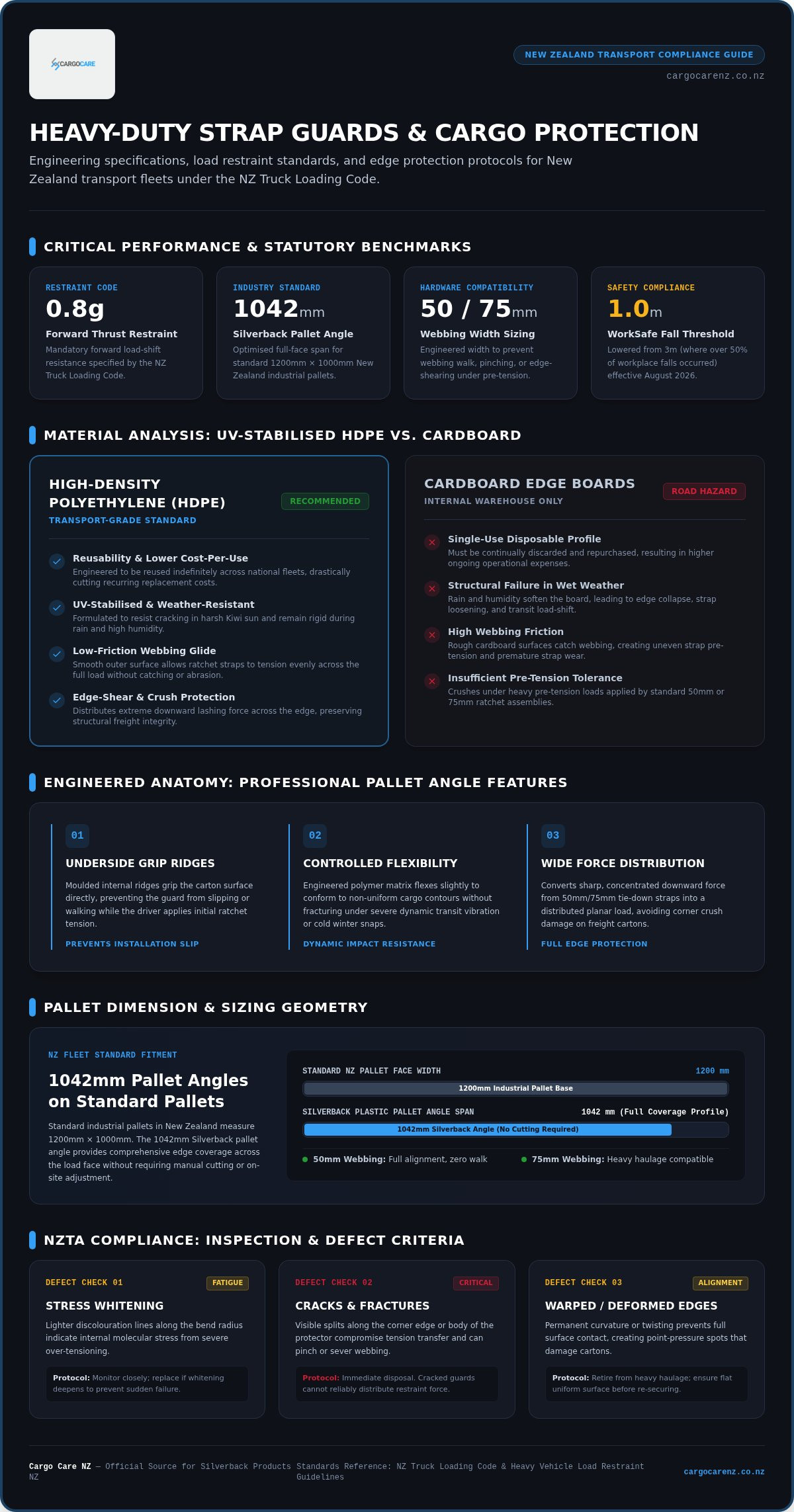
- Discover why the 1042mm Silverback pallet angle is the preferred choice for strap guard plastic corner protectors NZ fleets use to secure standard industrial pallets.
- Identify the technical features of UV-stabilised HDPE guards that ensure long-term durability and resistance to cracking in the New Zealand climate.
- Master NZTA load restraint compliance by understanding the correct inspection intervals and placement strategies for professional-grade corner protection.
The Role of Strap Guards in Professional Cargo Protection
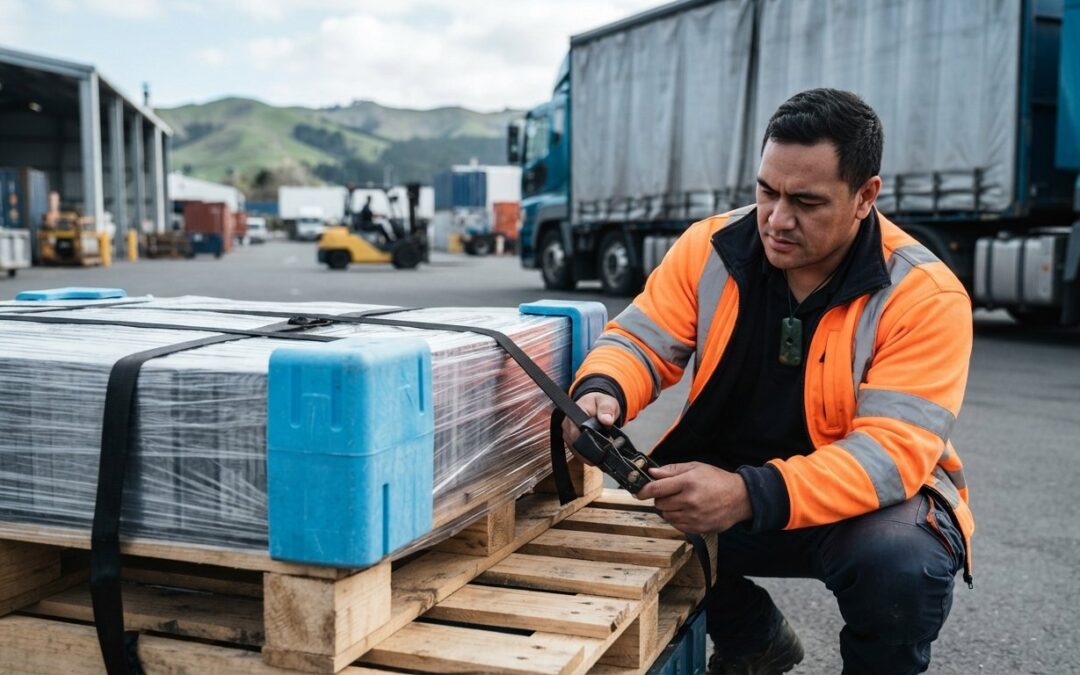
Professional transport relies on high-tension ratchet tie-downs to meet strict safety standards. However, the massive force required to secure a load can easily cause crush damage to the edges of your cargo. It’s a critical buffer. Heavy-duty strap guard plastic corner protectors NZ operators use distribute downward lashing force across a wider surface area, protecting the structural integrity of the freight. This follows established cargo securing principles, ensuring the strap remains tight without biting into the product. Unlike lightweight warehouse alternatives, transport-grade guards are engineered to withstand the extreme pre-tension forces generated by a standard 50mm or 75mm ratchet assembly. They don’t just protect the goods; they shield the lashing equipment from edge-shear and premature wear.
Plastic vs Cardboard: Why Material Choice Matters
While cardboard edge boards are common for internal palletising, they fail in the demanding New Zealand transport environment. Exposure to rain or high humidity causes cardboard to soften and collapse under tension. This leads to loose straps and hazardous load shift during transit. High-impact, UV-stabilised plastic guards offer superior durability and can be reused indefinitely across national fleets. This reusability provides a significantly lower cost-per-use than single-use disposables. Plastic also prevents strap abrasion. Its smooth, low-friction surface allows webbing to slide and tension evenly across the load without catching on rough edges. For professional logistics, high-density polyethylene (HDPE) remains the industry benchmark, making these strap guard plastic corner protectors NZ fleets trust a vital component for operational continuity.
Selecting the Right Plastic Corner Protectors for Your Fleet
Standard New Zealand industrial pallets measure 1200mm by 1000mm. Using a 1042mm plastic pallet angle ensures comprehensive coverage across the load face without the need for manual cutting or adjustment. Silverback products have established themselves as the industry benchmark for ruggedness in the local transport sector. These angles are manufactured from impact-modified, UV-stabilised polymers designed to survive high-tension applications. Selecting the correct size of strap guard plastic corner protectors NZ fleets require is essential for meeting the NZ Truck Loading Code. It’s about ensuring every component of your lashing system works in unison.
Compatibility with your lashing equipment is another critical factor. You must match the protector width to the dimensions of your load restraint straps NZ operators typically use, such as 50mm or 75mm webbing. A guard that’s too narrow will pinch the strap, while one that’s too wide may allow the webbing to walk during transit. For fleets prioritising long-term durability, our range of Silverback plastic pallet angles provides the necessary strength for heavy-duty haulage.
Key Features of Professional-Grade Strap Guards
Operational efficiency depends on the physical design of the guard. Professional-grade strap guard plastic corner protectors NZ drivers prefer often include moulded grip features on the underside. These internal ridges prevent the protector from sliding or shifting while you apply initial tension to the ratchet. Flexibility is equally vital. A high-quality guard should flex slightly to accommodate non-uniform cargo surfaces without snapping under pressure. This impact resistance ensures the equipment doesn’t fracture during dynamic transit forces or on cold winter mornings. Choosing guards with these specific attributes reduces equipment replacement costs and maintains load security across the entire journey.
Compliance and Best Practices for NZ Load Restraint
Compliance is mandatory for every operator on the road. The NZTA requires load restraint systems that prevent shift during sudden deceleration or cornering. Utilising strap guard plastic corner protectors NZ fleets trust is a standard method for ensuring even tension distribution across the entire load. This practice mirrors international heavy vehicle load restraint guidelines focused on friction optimisation and webbing protection. Without these guards, straps often lose tension at the corners, compromising the security of the freight and risking heavy fines.
Regular inspection prevents equipment failure during transit. Look for stress whitening, cracks, or warped edges that indicate material fatigue from over-tensioning. Damaged guards cannot reliably distribute force and should be replaced immediately to maintain safety standards. These components must work in unison with your primary tensioning hardware. Deciding between a Maxibinder vs ratchet binder NZ option involves assessing your specific load weight, but both systems benefit from professional-grade edge protection to maintain webbing integrity under high pre-tension.
The CargoCare NZ and Silverback Advantage
CargoCare NZ serves as the official source for Silverback products NZ logistics firms depend on for statutory compliance. We supply hardware engineered specifically for the heavy-duty transport sector. Our strap guard plastic corner protectors NZ range uses high-visibility colours to aid driver inspections during roadside stops. Bright securement points ensure that any equipment shift is spotted immediately during routine transit checks. It’s a practical solution for maintaining safety standards and operational continuity across the country.
Optimising Fleet Safety and Load Compliance
Securing freight effectively requires a shift from generic packaging to professional transport-grade hardware. High-impact strap guard plastic corner protectors NZ operators trust provide the tension distribution necessary to meet the 0.8g forward thrust standards of the Truck Loading Code. Selecting UV-stabilised HDPE components, such as the 1042mm Silverback pallet angle, ensures your equipment survives the local climate and fits standard industrial pallets perfectly. It’s the most reliable way to prevent crush damage while maintaining load security.
CargoCare NZ is the official Silverback NZ distributor, offering specialist transport safety knowledge and national supply capability. Our hardware is engineered for logistics professionals who value operational continuity and strict regulatory adherence. View our range of professional strap guards and pallet angles to secure your next consignment with confidence.
Frequently Asked Questions
Do plastic corner protectors prevent straps from cutting into the freight?
Yes, strap guard plastic corner protectors NZ fleets use act as a structural buffer between the tie-down and the cargo. It’s a critical safety measure. By increasing the radius of the corner, they prevent webbing from exerting concentrated pressure on a single point. This eliminates the risk of straps cutting into soft freight while ensuring the lashing remains secure.
Are these strap guards suitable for all types of New Zealand weather?
Yes, professional-grade strap guards are engineered for the New Zealand climate using UV-stabilised high-density polyethylene. This material prevents the plastic from becoming brittle under high UV exposure or cracking during cold winter mornings. Silverback products retain their impact resistance and flexibility throughout the year. They handle the country’s diverse environmental conditions without structural failure.
What is the standard length for a pallet corner protector in NZ?
The standard length for a full-face pallet angle in New Zealand is 1042mm. This specific dimension provides edge-to-edge protection for standard industrial pallets measuring 1200mm by 1000mm. Using 1042mm strap guard plastic corner protectors NZ wide allows drivers to secure entire pallet stacks efficiently. It’s a precise fit. This eliminates the need for multiple smaller guards during loading.
Can these plastic guards be used with both chains and webbing straps?
These plastic guards are designed specifically for use with synthetic webbing straps, such as 50mm and 75mm ratchet tie-downs. While they are durable for webbing applications, they aren’t suitable for use with transport chains. Chains require dedicated steel corner protectors to handle concentrated metal-on-metal pressure. For webbing systems, these plastic angles are the benchmark for preventing strap abrasion.

Article by
Steve O'Malley