
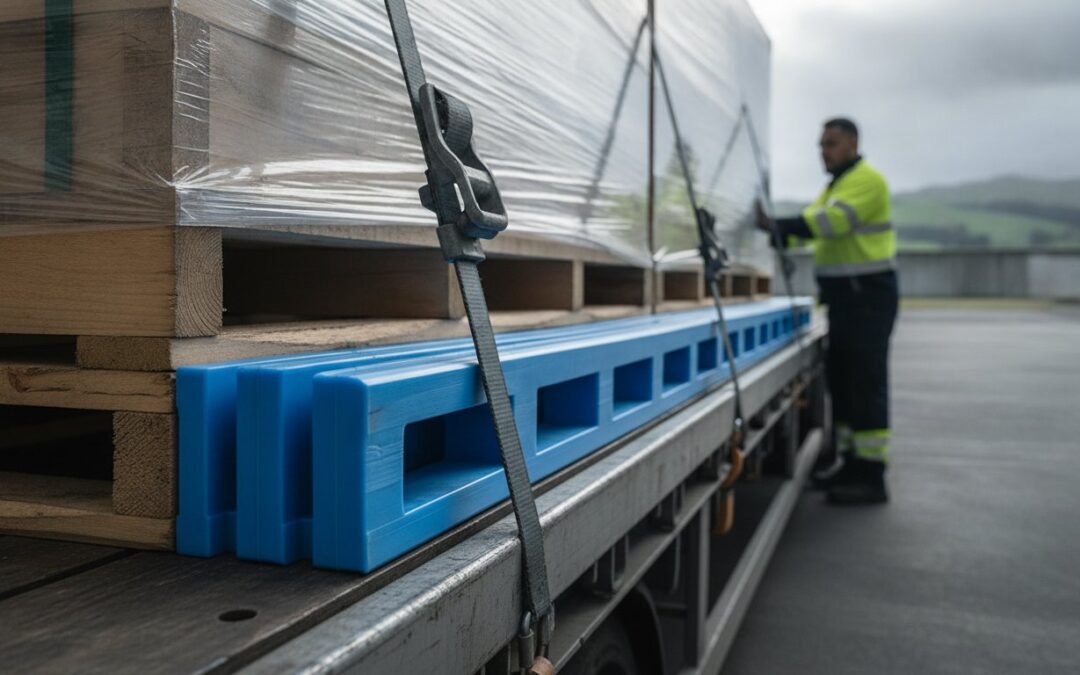
Did you know that a single insecure load violation can result in a corporate fine of up to $10,000 under the Land Transport Act? For transport operators crossing rugged terrain, the struggle with crushed cardboard corners and shifting freight is a constant, costly headache. You need equipment that survives the trip and keeps the CVST inspectors satisfied. Finding the right 1042mm plastic pallet angles New Zealand drivers can rely on is critical for maintaining operational safety and avoiding heavy penalties.
This guide explains why these tools are the essential standard for maximising load security and eliminating freight damage. We’ll examine the technical specifications, the cost-per-trip benefits over cardboard, and how they ensure your fleet meets the 1.0g forward deceleration requirements of the NZ Truck Loading Code. Discover how to protect your cargo and your compliance record with gear built for the job.
Key Takeaways
- Understand why the 1042mm length is the precise industry standard for providing edge-to-edge protection on New Zealand’s 1000mm-wide pallets.
- Analyse the long-term financial benefits of investing in 1042mm plastic pallet angles New Zealand logistics experts recommend for reducing cost-per-trip expenses.
- Learn how to position plastic angles to distribute strap tension effectively, ensuring compliance with national load restraint performance standards.
- Compare the durability of UV-stabilised, high-impact plastic against cardboard alternatives that fail under heavy tension or in wet weather conditions.
Why the 1042mm Plastic Pallet Angle is the NZ Industry Standard
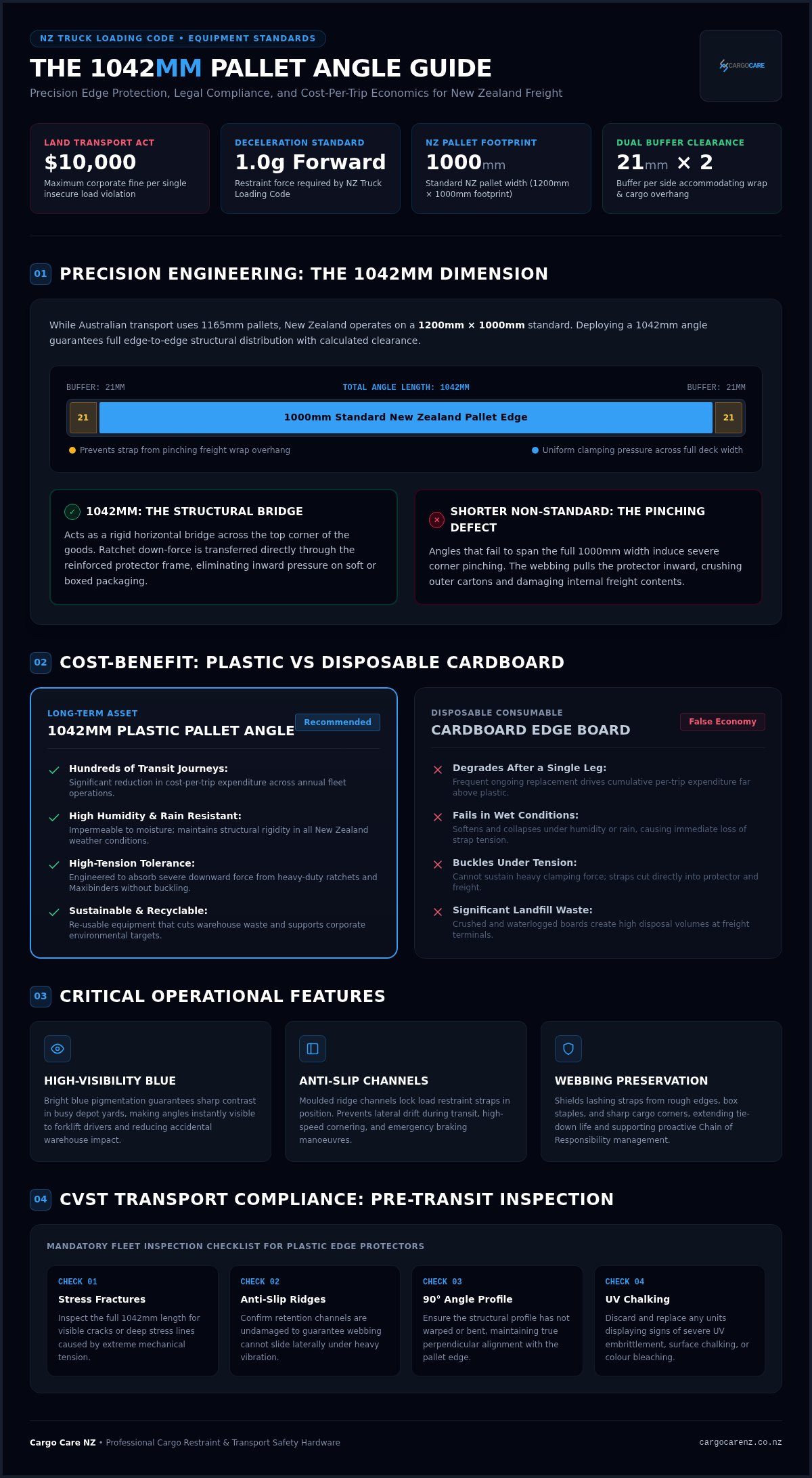
In the New Zealand transport sector, precision determines the success of load restraint. The 1042mm plastic pallet angle has emerged as the industry standard because it aligns perfectly with standard pallet dimensions used across the country. While Australian pallets often measure 1165mm, the standard New Zealand footprint is 1200mm x 1000mm. By utilising 1042mm plastic pallet angles New Zealand operators ensure complete edge coverage across the 1000mm width. This specific length provides a critical 21mm buffer on either side, which accommodates wrapped freight overhang and prevents strap contact with the cargo itself.
Durability is a core requirement for local logistics. These angles are manufactured from high-impact plastic, specifically engineered to withstand the significant downward force generated by heavy-duty ratchets. Unlike cardboard, this material doesn’t buckle under tension; it prevents strap crush and distributes clamping pressure evenly across the entire load. High-visibility blue is the chosen colour for these units. This ensures they remain clearly visible to forklift operators and drivers within busy freight hubs, which reduces the risk of accidental damage during the loading and unloading process.
The Geometry of Cargo Protection
Correct geometry is vital for maintaining the integrity of boxed goods. Shorter, non-standard angles often cause a “pinching” effect where the strap pulls the protector into the corner of the freight, leading to internal product damage. The 1042mm angle creates a structural bridge for load restraint straps, ensuring that tension is applied to the protector’s rigid frame rather than the soft packaging. By deploying 1042mm plastic pallet angles New Zealand drivers maintain consistent downward pressure without compromising the cargo’s structural integrity. This design ensures the load remains secure throughout the entire transit cycle.
Choosing Plastic Over Cardboard: A Cost-Benefit Analysis for NZ Logistics
Relying on disposable cardboard edge protectors often proves to be a false economy in the transport industry. While the initial purchase price is low, cardboard boards typically degrade after a single transit leg, especially when exposed to New Zealand’s high humidity and rainfall. In contrast, the 1042mm plastic pallet angles New Zealand operators invest in are long-term assets. The cost-per-trip for a UV-stabilised plastic angle is a fraction of the cost of cardboard, as these units survive hundreds of journeys. By sourcing 1042mm plastic pallet angles New Zealand logistics professionals can significantly reduce their annual equipment spend while maintaining superior cargo protection.
Adopting reusable plastic solutions also supports environmental targets by reducing warehouse waste. Cardboard protectors frequently end up in landfill after being crushed or soaked, whereas high-impact plastic angles are both durable and recyclable. This shift ensures consistent compliance with the official New Zealand Truck Loading Code, which mandates that restraint systems must remain effective under all environmental conditions.
Performance in Demanding NZ Conditions
Heavy-duty pallet angles maintain their structural shape even under the extreme tension of a Maxibinder, preventing the strap from biting into delicate freight. To ensure ongoing transport compliance and safety, use the following inspection checklist:
- Check for deep stress fractures or visible cracks in the plastic.
- Verify that the anti-slip ridges are intact to prevent strap drift.
- Ensure the 90-degree profile is not warped or bent.
- Discard any units showing signs of severe UV embrittlement or chalking.
Regular maintenance ensures your load restraint gear remains dependable. You can view our selection of professional cargo protection tools to find the right fit for your operations.
Integrating Pallet Angles into Your Load Restraint Strategy
Effective load restraint requires a systematic approach. When positioning 1042mm plastic pallet angles New Zealand drivers should ensure the angle sits flush against the top edge of the freight before applying tension. This placement allows the load restraint straps to run through the moulded channels, preventing lateral movement during transit. By using these rigid protectors, you can apply the high downward force needed for security without crushing delicate outer packaging. This synergy is most effective when using Silverback products NZ professionals trust, creating a unified safety system that withstands high-speed cornering and emergency braking. Using the correct length ensures the strap tension is distributed across the full width of the pallet, rather than concentrating force on a single point.
Correct integration also prevents the strap from making direct contact with sharp edges, which preserves the lifespan of your webbing. It’s a practical way to manage the Chain of Responsibility, as it demonstrates a proactive approach to freight protection. When every component of the restraint system works together, the risk of load shift is significantly minimised.
Ensuring National Transport Compliance
Meeting NZTA heavy vehicle standards is a legal necessity for every transport operator. According to WorkSafe New Zealand guidance on securing loads, maintaining gear in good working order is essential for site safety and operational continuity. Drivers can increase efficiency by pre-threading their ratchet tie downs through the 1042mm plastic pallet angles New Zealand warehouses provide before lifting them into place. This technique reduces time spent working at height and ensures the strap is centred on the protector. Always check that the strap is not twisted; a flat contact surface maximises friction and prevents point-loading damage. Consistent use of these angles ensures that your fleet remains compliant with the Land Transport Act 1998, reducing the risk of roadside delays or fines.
Optimising Your Fleet’s Load Security
Securing cargo effectively requires high-performance hardware designed for local conditions. Transitioning from disposable cardboard to 1042mm plastic pallet angles New Zealand professionals trust ensures your freight remains undamaged during long-haul transits. These high-impact, weather-resistant tools provide the edge-to-edge coverage necessary for standard NZ pallets while maintaining strict compliance with national load restraint rules. As the official Silverback NZ distributor, we provide the durable equipment needed to reduce insurance claims and lower equipment replacement costs. Implementing these precision-engineered angles into your daily operations protects both your reputation and your bottom line. Take the next step toward a more efficient logistics strategy by investing in gear built for the job.
Enquire about bulk orders of 1042mm Plastic Pallet Angles today to secure your next load with confidence.
Frequently Asked Questions
Why is 1042mm the standard length for plastic pallet angles in New Zealand?
The 1042mm length is specifically engineered to match the standard New Zealand pallet footprint of 1200mm x 1000mm. By spanning the full 1000mm width with a slight overhang buffer, these angles ensure that load restraint straps don’t pinch the corners of the cargo. This geometry provides consistent edge-to-edge protection, which is essential for maintaining the structural integrity of boxed freight during long-haul transit.
Can these plastic pallet angles be recycled at the end of their service life?
Yes, high-quality 1042mm plastic pallet angles New Zealand transport companies use are manufactured from heavy-duty, high-impact polymers like polypropylene. These materials are fully recyclable at the end of their operational lifespan. Unlike single-use cardboard protectors that contribute to warehouse waste, these durable assets can be processed into new industrial products once they no longer meet safety inspection standards for load restraint.
Are plastic pallet angles compatible with all types of ratchet straps and load binders?
These angles are designed for universal compatibility with standard 50mm and 75mm webbing straps. The moulded ridges and channels securely house the straps, preventing lateral movement under tension. They’re robust enough to withstand the high downward force generated by heavy-duty hardware, including Maxibinders and standard ratchet tie-downs, making them a versatile component for any professional load restraint system across the country.
How do plastic pallet angles help in avoiding load restraint fines in NZ?
Using 1042mm plastic pallet angles New Zealand operators can more easily meet the 1.0g forward deceleration requirements set by Waka Kotahi. These tools prevent straps from losing tension due to edge crushing, which is a common cause of insecure load fines. By ensuring consistent clamping pressure and preventing freight from shifting, drivers maintain compliance with the Land Transport Act and avoid costly roadside penalties.

Article by
Steve O'Malley