
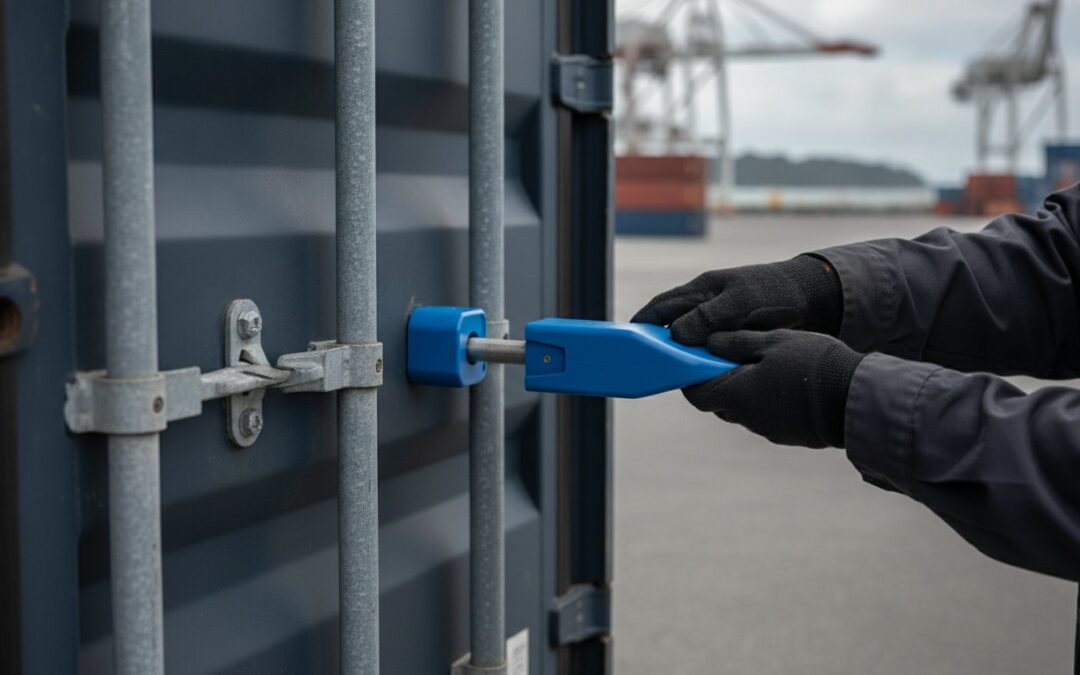
Following the June 2026 Executive Order that mandates stricter C-TPAT enforcement, the security of your shipping containers is now under intense regulatory scrutiny. You likely recognise that maintaining a secure national supply chain requires more than just a physical barrier; it demands a system that provides undeniable proof of entry. High-quality tamper evident bolt seals serve this exact purpose, acting as a technical deterrent that ensures your freight arrives exactly as it was loaded. While the threat of cargo theft is rising, your security protocols don’t have to be a source of operational friction.
We understand the pressure to balance zero-breach security with the need for rapid unloading at the distribution centre. This guide provides a professional deep dive into the technical standards of ISO 17712:2013 and the selection criteria for high-security hardware. You’ll learn how to achieve full regulatory compliance while utilising modern tools to eliminate unloading bottlenecks. We will examine the VVTT inspection protocol and the specific attributes that distinguish a certified “H” class seal from inferior counterfeits, ensuring your logistics workflow remains both safe and efficient.
Key Takeaways
- Understand the technical requirements of ISO 17712:2013 to ensure your hardware meets the “High Security” classification for international and national transit.
- Learn how to select the most durable tamper evident bolt seals by evaluating material composition, such as carbon steel and ABS plastic coatings, against your specific cargo value.
- Implement a rigorous VVTT (View, Verify, Tug, Twist) inspection protocol to identify signs of manipulation and prevent “cut and replace” fraud schemes.
- Maximise unloading efficiency at your distribution centre by pairing high-security seals with specialised removal tools like the Phoenix 18V cordless cutter.
- Maintain full C-TPAT compliance and safeguard your chain of custody through disciplined seal number logging and storage procedures.
High-Security Standards: Understanding ISO 17712 Bolt Seals
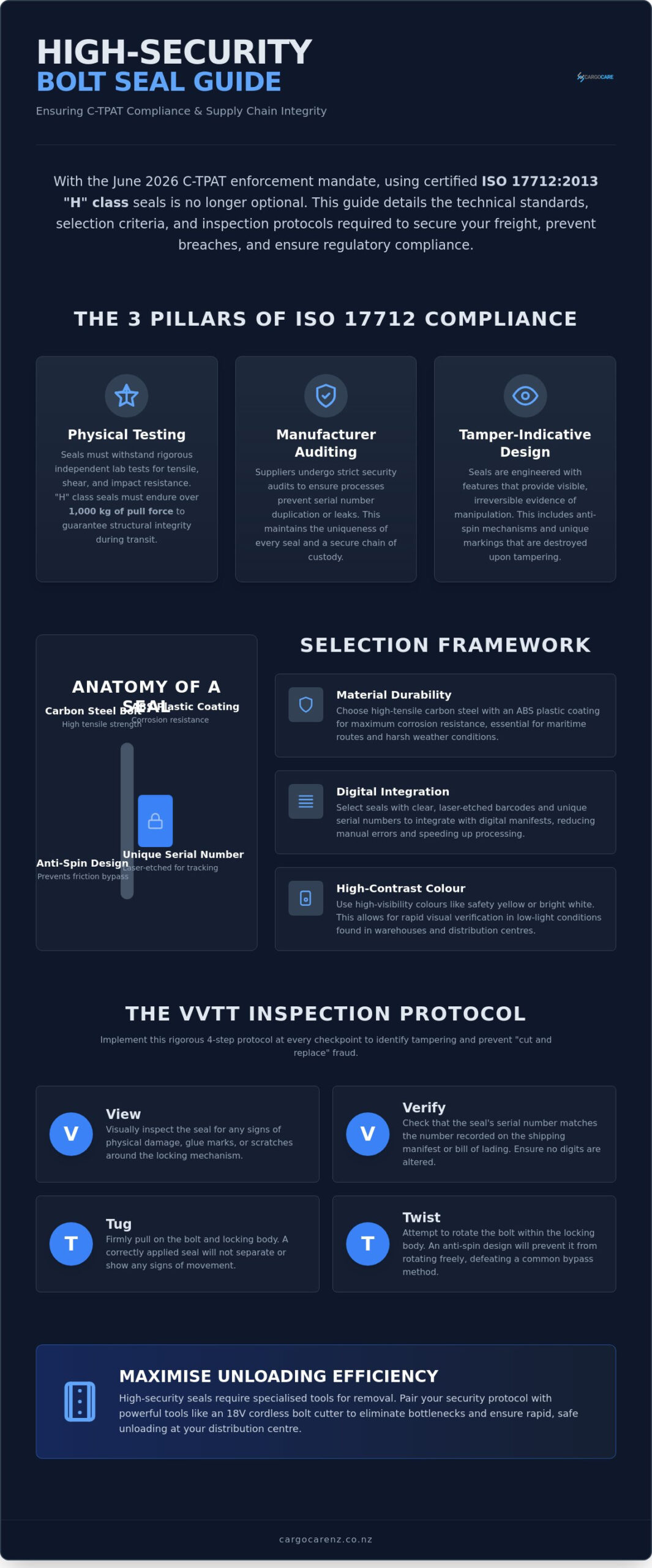
High-security bolt seals are single-use barrier devices engineered to secure shipping containers and trailers against unauthorised access. While they provide significant physical resistance, their primary function is to serve as a definitive record of a breach. This comprehensive Security Seal Overview shows that these tools are categorised by their physical strength and the specific tamper-indicative features they employ. To qualify as “High Security” (H class) under ISO 17712:2013, tamper evident bolt seals must undergo rigorous laboratory testing to withstand over 1,000 kg of pull force. This ensures the seal doesn’t just snap under the standard vibrations of a long-haul road trip or sea voyage.
The ISO 17712 standard rests on three critical pillars that every logistics manager should verify before purchase:
- Physical Testing: Independent evaluation of tensile, shear, and impact resistance to confirm the seal’s structural integrity.
- Manufacturer Auditing: Assessment of the supplier’s security procedures to ensure serial numbers aren’t duplicated or leaked.
- Tamper-Indicative Features: Intentional design vulnerabilities that provide visible, irreversible evidence if someone attempts to manipulate the lock.
The Mechanics of Tamper Evidence
The core of a bolt seal’s security lies in its internal locking mechanism, which usually consists of a high-tensile steel snap-ring. Once you press the bolt into the locking body, this ring expands into a precision-machined groove, making retraction impossible without destroying the component. Each unit features unique serial numbering and barcoding to prevent “cut and replace” fraud, where a criminal might swap a broken seal with a generic alternative. The anti-spin design ensures the bolt cannot be rotated at high speeds to generate friction heat, which is a common method used to bypass lower-grade locking mechanisms.
This degree of security is particularly important for businesses dealing in premium goods; a wholesale leather bags supplier, for example, relies on these mechanisms to ensure that their products reach retailers without being compromised by “cut and replace” schemes.
Why Compliance Matters for National Freight
Using certified tamper evident bolt seals is now a fundamental requirement for many logistics operators. The June 2026 C-TPAT enforcement updates mean that non-compliant hardware can lead to significant delays at customs checkpoints and intermodal transfer points. Beyond regulatory requirements, using ISO-certified hardware often helps reduce insurance premiums by proving a commitment to industry-standard cargo protection. It’s a simple way to ensure your freight moves through the supply chain without unnecessary stoppages or administrative hurdles, and it allows you to compare international shipping rates with greater confidence in your cargo’s security.
Maintaining high standards for your physical assets is just as important as the seals you use; for those sourcing new units, you can learn more about Atlanta Container & Trailer and their range of durable storage trailers and containers.
For logistics managers looking to extend security beyond the container to the facility perimeter, Kaputechnika Bolt provides valuable technical education on automated gate systems and entry point protection.
Selection Framework: Choosing the Right Tamper Evident Seal
Selecting the appropriate hardware for your container fleet requires a balance between the commercial value of the cargo and the technical specifications of the seal. While unit cost is a factor, the cost of a security breach or a rejected shipment far outweighs the investment in certified hardware. Mega Fortris explains the ISO 17712 standard by categorising seals based on their intended application, emphasising that high-security freight requires hardware capable of withstanding both physical assault and environmental degradation. For procurement teams looking to buy security seals online NZ with confidence, understanding these classifications is the essential first step toward selecting compliant hardware for your fleet.
Material Durability and Environmental Resistance
Logistics professionals operating in coastal regions or maritime routes must prioritise corrosion resistance. Tamper evident bolt seals featuring high-tensile carbon steel bolts with ABS plastic coatings are the industry standard for these conditions. The plastic shroud prevents rust-seizure within the locking chamber, which is a common issue during long-haul sea transit. This durability ensures that the seal remains functional and legible despite exposure to salt spray or extreme temperature variations during trans-Tasman movements. For a broader understanding of how these devices fit within the wider compliance landscape, our guide to tamper evident security seals NZ covers the specific requirements of the NZ Customs Secure Exports Scheme and MPI regulations in detail.
Integration with Digital Logistics Systems
Modern supply chains rely on speed and accuracy. High-contrast colours like safety yellow or bright white improve visibility in low-light logistics centres, allowing for rapid visual verification. Most high-spec hardware now features laser-etched barcodes and unique serial numbers to facilitate digital manifests. This integration is vital for maintaining a clear chain of custody, as detailed in our ISO 17712 Compliant Bolt Seals NZ: The 2026 Guide to Freight Security. Using scan-ready hardware reduces manual entry errors and speeds up the check-in process at the destination.
Ensuring the bolt diameter is compatible with standard container locking bars and cam buckles avoids operational delays during the loading process. For those managing high-volume freight movements, choosing a consistent, high-visibility range of Tamper Evident Secure Bolt Seals ensures that your security protocols remain both robust and easy to audit. Clear, permanent marking is non-negotiable for a professional logistics operation.
Operational Efficiency: Application and Rapid Removal
High-security protocols are only as effective as their physical execution. Even the most robust tamper evident bolt seals provide no protection if the locking mechanism isn’t fully engaged. Beyond the initial application, logistics managers must also consider the destination workflow. Manual removal of high-tensile steel bolts often creates a significant bottleneck in high-volume distribution centres, leading to operational delays and increased labour costs. Streamlining this process requires a disciplined approach to both fastening and removal.
Step-by-Step: Correct Bolt Seal Application
Precision during the loading phase prevents “cut and replace” fraud and ensures the integrity of the manifest. Follow these technical steps for every container:
- Insert the bolt through the locking aperture on the container door.
- Snap the locking cap onto the bolt end until you hear a distinct metal-on-metal click.
- Verify that the unique serial numbers on both the bolt and the cap are identical to prevent component swapping.
Give the seal a firm downward tug to confirm the internal snap-ring is properly seated and the lock is irreversible. Recording these numbers immediately upon application ensures a verifiable chain of custody that withstands regulatory audits.
Optimising Removal with the Phoenix Cordless Cutter
Traditional manual bolt cutters are a liability in modern warehouse environments. They require significant physical force, which slows down the unloading process and increases the risk of repetitive strain injuries. Transitioning to a powered solution like the Phoenix Cordless Bolt Seal Cutter 18V eliminates these manual handling risks. This tool allows operators to shear through ISO-certified high-security bolts in seconds with minimal effort, significantly reducing operator fatigue during long shifts.
In high-volume logistics hubs, the time saved per container adds up to substantial gains in daily throughput. Using powered removal technology ensures that your unloading team remains safe while maintaining a fast-paced workflow. For more technical insights on maintaining a secure fleet, refer to our Silverback Products NZ: The Professional Guide to Transport Safety and Compliance. Adopting these professional tools ensures your tamper evident bolt seals serve their purpose without compromising your site’s operational efficiency or safety standards.
Future-Proofing Your Freight Security Strategy
Maintaining a secure national supply chain requires a disciplined focus on technical standards and operational hardware. By prioritising ISO 17712:2013 compliant hardware, you ensure your cargo meets the highest international security benchmarks while avoiding costly delays at intermodal transfer points. Selecting certified tamper evident bolt seals with specific anti-corrosion properties and high-contrast markings ensures your security measures remain effective throughout the entire transit lifecycle.
This commitment to high-grade materials and security isn’t limited to industrial logistics; for professionals who require the same level of protection for their personal belongings, you can discover ALEON and their aerospace-grade aluminium luggage designed for secure, high-frequency travel.
Operational efficiency doesn’t end at the point of application. Integrating powered removal technology into your distribution centre protects your team from repetitive strain injuries and keeps your unloading schedule on track. As the official New Zealand distributor for Silverback Products, CargoCare NZ provides the technical expertise and hardware necessary to support your transport and logistics compliance requirements. We focus on providing rugged, dependable tools that mirror the demands of the local professional landscape.
Secure your cargo with Silverback Tamper Evident Bolt Seals from CargoCare NZ and ensure your operations remain both compliant and highly efficient. We look forward to supporting your commitment to operational continuity and safety.
Frequently Asked Questions
What is the difference between a bolt seal and a cable seal?
Bolt seals are rigid, high-tensile steel pins designed specifically for the heavy locking bars of shipping containers and trailers. Cable seals utilise a flexible, braided wire loop that is better suited for irregular locking points or smaller latches where a straight bolt won’t fit. While both provide security, bolt seals are the standard choice for “H” class high-security requirements because they offer superior physical resistance against forceful entry.
Can tamper evident bolt seals be reused if they are not damaged?
No, these tamper evident bolt seals are engineered as single-use barrier devices and cannot be reused. The internal snap-ring mechanism is designed to lock permanently once the bolt is pressed into the cap. Any attempt to disengage the lock results in the destruction of the internal components, providing clear evidence of interference. This ensures that the seal remains a reliable indicator of a secure chain of custody from the point of dispatch.
How do I know if a bolt seal is ISO 17712 compliant?
A compliant seal must feature a permanent “H” marking on its body to signify a High Security classification. You should also request a compliance certificate from the supplier that confirms the hardware has been tested by an ISO 17025 accredited laboratory. These tamper evident bolt seals are verified against strict parameters, including the ability to withstand over 1,000 kg of pull force as required by the ISO 17712:2013 standard.
What should I do if a bolt seal shows signs of tampering upon arrival?
Immediately stop the unloading process and document the condition of the seal with high-resolution photographs. You must notify the carrier, the shipper, and your insurance provider before the container is opened to preserve the integrity of any future claim. Use the VVTT (View, Verify, Tug, Twist) method to check for mismatched serial numbers or physical manipulation, and ensure the damaged hardware is kept as evidence for the investigation. For a comprehensive overview of how to select and manage the full range of tamper evident security seals NZ operators rely on, our professional guide covers liability protection, stock loss prevention, and regulatory compliance in depth.

Article by
Steve O'Malley