
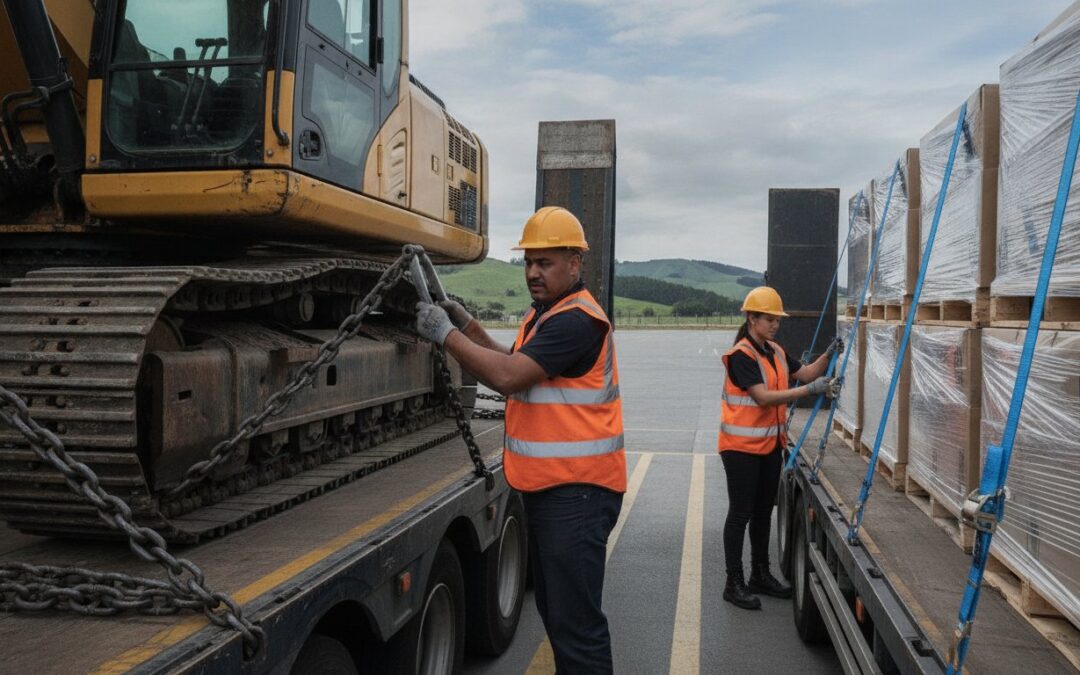
Selecting the wrong hardware doesn’t just risk your cargo; it puts your NZTA compliance and professional reputation on the line. Most transport operators understand that securement is a non-negotiable part of the job, yet the debate over load restraint chains vs straps NZ remains a constant source of confusion in the yard. You’re likely dealing with the pressure of avoiding cargo damage while maintaining a fast load-out schedule.
This guide provides the technical clarity you need to master the differences between transport chains and ratchet straps, ensuring you meet the 1.0g forward force standards required by the NZ Transport Agency. We’ll examine lashing capacities, friction requirements, and hardware selection to help you protect your freight and avoid the $10,000 fines associated with the Health and Safety at Work Act. By the end, you’ll have a clear framework for selecting the right tools for every haul.
Key Takeaways
- Identify the technical distinctions in Lashing Capacity (LC) between Grade 80 transport chains and synthetic webbing to ensure your equipment matches the mass of your freight.
- Determine the optimal application for different cargo types, from using heavy-duty chains for steel and machinery to deploying ratchet tie-downs for general palletised goods.
- Recognise the necessity of supporting hardware, such as using Maxibinders for efficient chain tensioning and plastic pallet angles to protect both straps and cargo from damage.
- Apply a strategic decision-making framework for load restraint chains vs straps NZ to maintain full compliance with the NZTA Truck Loading Code and professional safety standards.
The Fundamentals of Load Restraint in New Zealand
Compliance with the NZTA Truck Loading Code is a legal necessity for every heavy vehicle operator. Understanding the Fundamentals of load securing ensures that your setup withstands the physical forces of New Zealand’s terrain. The central decision often involves load restraint chains vs straps NZ, where the choice is governed by the cargo’s mass and the lashing capacity (LC) of the gear. LC is the maximum force a restraint is rated to sustain. While transport chains offer immense strength for heavy equipment, synthetic webbing provides the versatility required for general freight.
NZTA Standards and Lashing Capacity Requirements
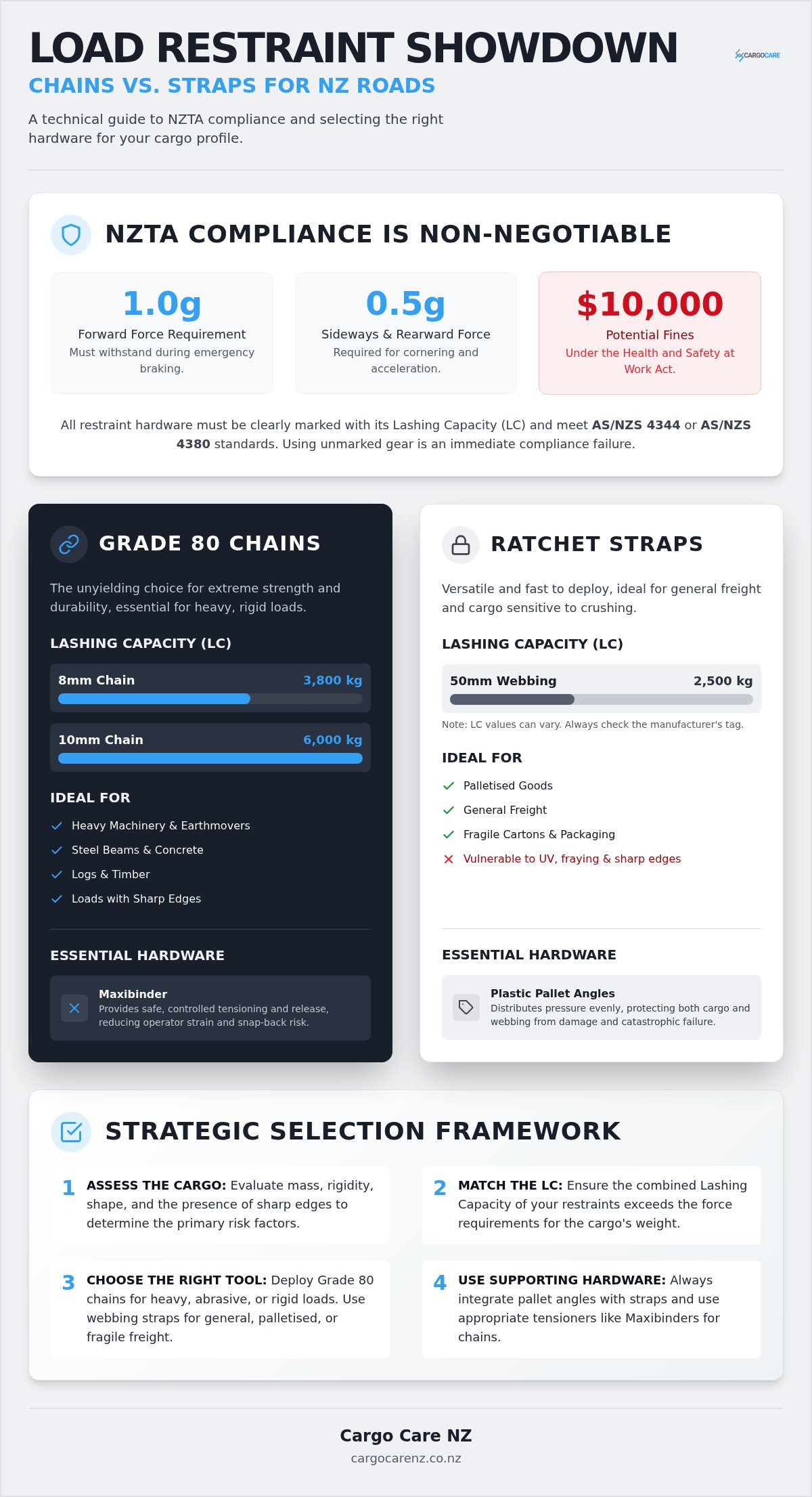
To remain compliant, your restraint system must handle 1.0g of forward force during emergency braking and 0.5g in rearward or sideways directions. Calculating the number of restraints involves assessing the weight of the load against the LC of your equipment. “In the New Zealand transport sector, lashing capacity (LC) must be clearly marked on all restraint hardware to meet NZS 4344 or AS/NZS 4380 standards.” Using gear without legible tags is an immediate compliance failure and risks safety.
There’s a clear trade-off between the high-tension capabilities of chains and the deployment speed of ratchet tie-downs. Grade 80 chains are essential for rigid, heavy loads like steel beams or excavators. Conversely, 50mm webbing straps are the industry standard for general freight because they’re easier to handle and less likely to crush fragile packaging. When evaluating load restraint chains vs straps NZ, selecting the correct hardware ensures you don’t just secure the load, but you do so efficiently without damaging the client’s assets.
Chains vs Straps: A Technical Comparison for Professional Operators
The physical properties of your cargo dictate the choice of hardware. When evaluating load restraint chains vs straps NZ, Grade 80 transport chains provide the unyielding strength required for heavy machinery, steel beams, and loads with sharp edges that would easily sever synthetic webbing. These systems are engineered to meet the strict technical requirements for load restraint hardware set by Waka Kotahi. Conversely, Silverback ratchet tie-downs with hook and keeper are the preferred choice for general palletised freight. They offer a “soft” touch that prevents structural damage to the cargo while providing reliable security.
Hardware lifespan is also a major operational factor. Synthetic straps are susceptible to UV degradation and fraying in harsh NZ coastal environments. Galvanised Grade 80 chains offer superior resistance to abrasion and weather, though they require regular inspection for link wear and elongation. Maintaining a mix of both ensures you’re prepared for any freight profile that enters the yard.
When to Deploy Grade 80 Chains and Maxibinders
Heavy earthmoving equipment and logs necessitate the use of 8mm or 10mm chains to achieve the required lashing capacity. Traditional lever binders pose a significant risk of “snap-back” injuries during release. The Maxibinder serves as a safer, more ergonomic alternative, utilising a geared mechanism to provide controlled tensioning and release. This reduces physical strain on the operator and ensures the chain remains at the correct tension throughout the journey. Selecting the right chain size is vital; an 8mm chain typically offers a lashing capacity of 3,800kg, while 10mm increases this to 6,000kg. Using the correct load restraint chains vs straps NZ configuration ensures your heavy haulage remains compliant and safe.
Selecting the Right Hardware for Your Freight Profile
Strategic selection requires a meticulous checklist based on the cargo’s physical profile. For heavy, rigid items like steel or concrete, Grade 80 chains remain the primary choice. However, for palletised goods, the decision regarding load restraint chains vs straps NZ shifts toward synthetic webbing. When using straps, plastic pallet angles NZ are a mandatory requirement. These components prevent the strap from cutting into the cargo and protect the webbing from sharp edges that cause catastrophic failure. Professional operators select Silverback products because they meet verified NZ standards for durability and safety.
Optimising Your Load with Silverback Professional Equipment
Integrating Silverback ratchet tie downs NZ with 1042mm plastic pallet angles maximises downward pressure across the entire width of the load. This distribution prevents localised crushing of packaging while ensuring the friction force is sufficient for NZTA compliance. A 1042mm angle is specifically designed to span standard pallets, providing a uniform surface for the strap to tension against. Regular hardware audits are essential to identify fraying in webbing or stretching in chain links before they lead to roadside compliance failures. By utilising high-durability blue plastic angles, you extend the life of your straps and maintain operational continuity across every haul. The choice in load restraint chains vs straps NZ ultimately depends on matching the hardware’s lashing capacity to the cargo’s specific fragility and weight.
Securing Your Cargo for New Zealand Roads
Effective transport operations rely on the strategic application of hardware to meet NZTA standards. Mastering the technical differences in load restraint chains vs straps NZ allows you to protect your freight while maintaining full compliance with the Truck Loading Code. Whether you’re securing heavy machinery with Grade 80 chains or protecting palletised goods with synthetic webbing, the right tools are essential for operational safety. Integrating specialist equipment like Maxibinders and 1042mm plastic pallet angles ensures your setup is both ergonomic and durable.
As the official NZ distributor for Silverback products, Cargo Care NZ supplies professional-grade hardware designed for the local transport sector. We keep specialist Maxibinders and high-durability plastic pallet angles in stock for national delivery to keep your fleet moving. View the full range of Silverback load restraint hardware at Cargo Care NZ to upgrade your securement systems today. Stay safe on the road and ensure every load arrives in perfect condition.
Frequently Asked Questions
Does NZTA allow the use of both chains and straps on the same load?
NZTA allows the use of different restraint types on a single vehicle provided each system is independent and meets the required force standards. You shouldn’t mix chains and straps within the same lashing point because they possess different elasticity. This variance causes one restraint to take more load than the other, potentially leading to equipment failure or shifting during transit.
What is the lashing capacity of a standard 50mm ratchet tie-down in NZ?
A standard 50mm ratchet tie-down typically features a lashing capacity (LC) of 2,500kg or 3,000kg. The exact rating must be clearly displayed on the manufacturer’s tag to ensure compliance with AS/NZS 4380 standards. When evaluating load restraint chains vs straps NZ, always verify that the LC of your chosen webbing matches the mass of the cargo you’re securing.
Why should I use a Maxibinder instead of a standard chain binder?
Maxibinders provide a geared tensioning system that eliminates the dangerous “snap-back” effect associated with traditional lever binders. This design allows for more precise tensioning with less physical effort from the operator. Because they use a ratchet mechanism, they’re much safer to release, reducing the risk of musculoskeletal injuries while ensuring Grade 80 chains remain at the optimal tension for heavy haulage.
How do plastic pallet angles help with NZTA load restraint compliance?
Plastic pallet angles ensure compliance by protecting synthetic straps from sharp edges that could cause fraying or severing. When deciding on load restraint chains vs straps NZ, remember that angles distribute downward force across the pallet width. This prevents cargo crush and maintains the necessary friction to meet NZTA requirements, especially when using 1042mm angles to unitise diverse freight profiles.

Article by
Steve O'Malley