
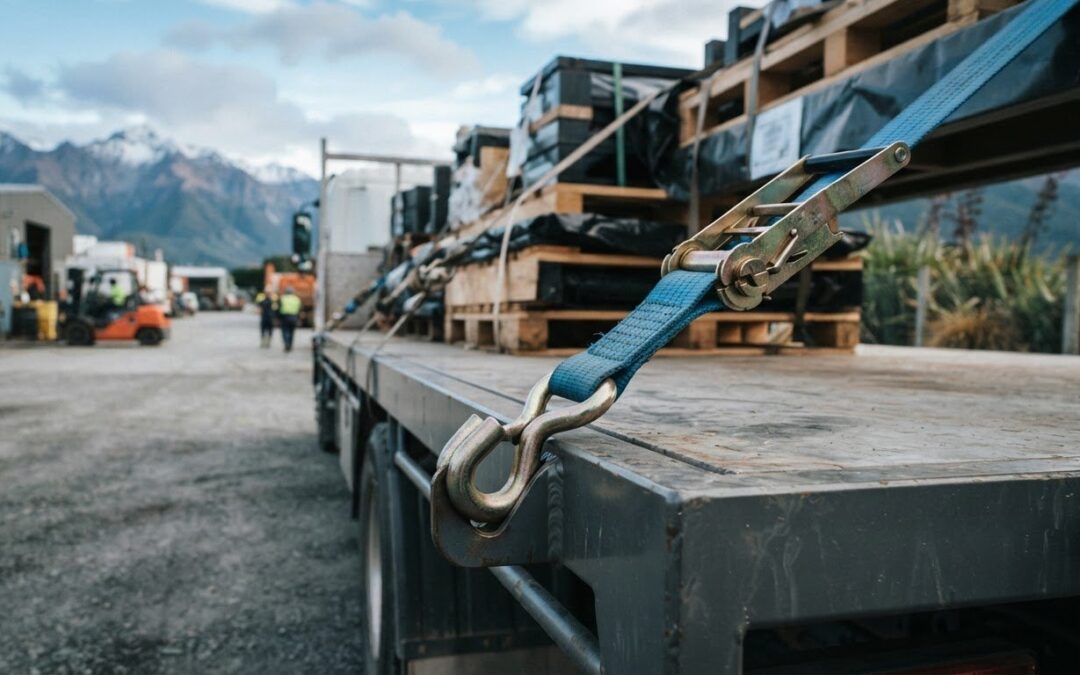
The highest-capacity strap may still be the wrong choice if its hook does not suit your truck’s anchor points. This truck lashing straps hook and keeper NZ buying guide starts with practical fit, not just the rating.
Choosing strap length and width for a particular load can be difficult, especially when product specifications use terms such as lashing capacity (LC) and breaking strength. Check the product label and supplier documentation, and make sure the hook fits the anchor point securely.
This guide covers fit, capacity and hardware considerations for New Zealand freight work, along with what to confirm before ordering. CargoCare NZ lists a Ratchet Tie Down with Hook and Keeper, so compare the current variant details with your load and restraint arrangement before selecting it.
Key Takeaways
- Match the complete ratchet tie-down assembly to the load, restraint arrangement and truck anchor points before ordering.
- Use the load shape, anchor spacing and tie-down path to work out the strap length required.
- Compare truck lashing straps hook and keeper NZ options by checking each variant’s width, length, rated capacity and end fittings.
- Follow a clear selection sequence: define the load task, inspect anchor points, confirm product specifications and check current NZTA guidance for restraint practice.
What to check before buying truck lashing straps with hook and keeper in NZ
A truck lashing strap with a ratchet and hook-and-keeper fittings is a complete assembly, not just a length of webbing. The webbing runs through the ratchet mechanism, and the end fittings connect the assembly to anchor points. Buyers looking for truck lashing straps hook and keeper NZ should assess the whole assembly against the load and planned restraint arrangement, rather than choosing by appearance alone.
Start with the job. Consider the load’s size and shape, the route the strap will follow, and the position and form of the truck’s anchor points. A strap that is too short may not follow the intended path. A fitting that does not seat correctly on an anchor may not suit the setup. For a wider overview of selection and standards, see our load restraint straps guide.
What does the hook and keeper do?
The hook connects to an anchor point, while the keeper is part of the hook fitting. Do not assume exactly how the keeper retains the hook from the product name alone. Check the product details and inspect how the keeper operates on the selected variant. The hook should engage with the anchor point without sitting awkwardly or obstructing the latch.
Anchor designs differ, so no single hook style should be assumed to suit every truck or load. Compare the fitting’s shape and operation with the anchor you plan to use. The tie-down hardware components reference provides general background on ratchets and strap fittings. Confirm the specific assembly details before ordering.
Cargo Care NZ lists a Ratchet Tie Down with Hook and Keeper. Check the current variant specifications, including the end-fitting details, against your application. Product selection is only one part of load restraint. For questions about restraint arrangements and loading practice, consult current NZTA guidance.
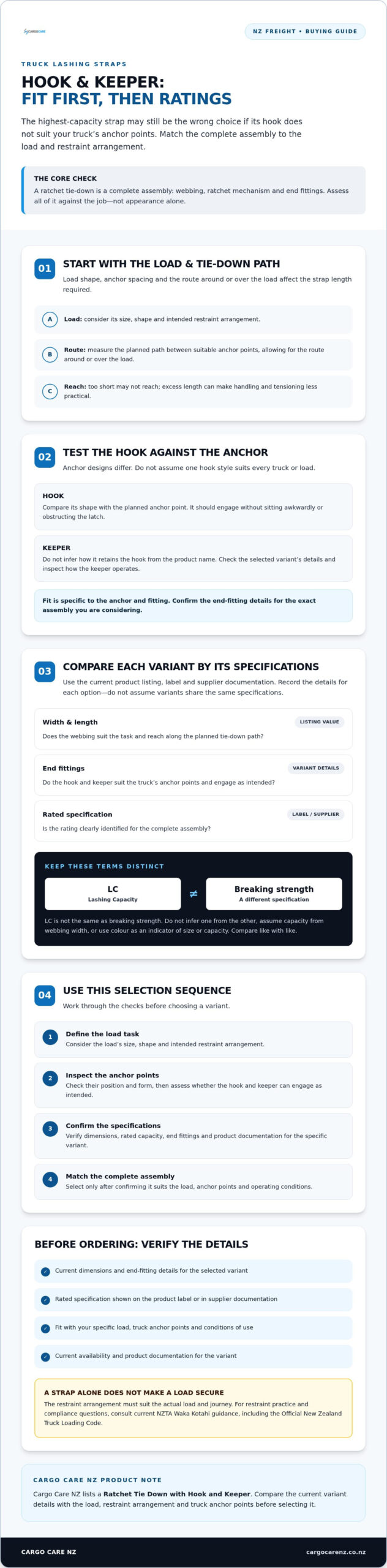
How to compare truck lashing strap length, width and rated capacity
Compare complete strap assemblies against the load and truck setup. Load shape, anchor spacing and the planned tie-down path all affect the length required. With the load in position, measure the route between suitable anchor points, allowing for the path around or over the load. A strap that is too short may not reach, while excess length can make handling and tensioning less practical.
Use the current product listing and supplier documentation to compare options before ordering. Do not rely on colour as an indicator of size or capacity.
| Specification | Variant A | Variant B | What to check |
|---|---|---|---|
| Width and length | Record listing value | Record listing value | Does the webbing suit the task and reach along the planned tie-down path? |
| End fittings | Record listing value | Record listing value | Do the hooks and keepers suit the truck’s anchor points? |
| Rated specification | Copy label or supplier value | Copy label or supplier value | Is the rating clearly identified for the complete assembly? |
Which strap specifications should buyers confirm?
Check the product label and supplier documentation for the strap’s rated capacity. Lashing Capacity (LC) is not the same as breaking strength. Do not infer one from the other or assume capacity from webbing width. Confirm what each label or specification means, and compare like with like. For broader product-range context, read the Silverback transport safety guide.
Before selecting truck lashing straps hook and keeper NZ buyers should verify the current dimensions, end fittings and ratings for each variant. Cargo Care NZ lists a Ratchet Tie Down with Hook and Keeper. Review the current product listing and confirm its specifications before ordering. For load-restraint guidance, consult the Official NZ Truck Loading Code.
Choose and source hook-and-keeper lashing straps for your NZ truck
A clear selection sequence can help prevent mismatches between the load, strap and vehicle. Work through these checks before choosing a variant:
- Identify the load task. Consider the load’s size and shape, and the intended restraint arrangement.
- Inspect the anchor points. Check their position and form, then assess whether the hook and keeper can engage as intended.
- Confirm the specifications. Verify the dimensions, rated capacity, end fittings and product documentation for the specific variant.
- Select a matching assembly. Choose only after confirming it suits the load, anchor points and operating conditions.
Choosing a product does not replace correct loading and restraint practice. For compliance questions, consult current NZTA Waka Kotahi guidance, including the Official New Zealand Truck Loading Code. Check that the restraint arrangement suits the actual load and journey. Do not assume the right strap alone makes a load secure.
What should you confirm before placing an order?
Ask Cargo Care NZ to confirm the current variant dimensions, availability and product documentation. Check that the strap and fittings suit your specific load and anchor points, as well as the conditions in which they will be used. Do not rely on an unverified rating or assume every variant has the same specifications.
A Maxibinder and a ratchet tie-down are different restraint types, so compare them only when both suit the application. The Maxibinder and ratchet binder comparison provides context for assessing those options. For truck lashing straps hook and keeper NZ buyers, Cargo Care NZ’s Ratchet Tie Down with Hook and Keeper is a relevant listing to review. Check the tie-down listing or contact Cargo Care NZ to confirm current details before ordering.
Choose a tie-down that fits the job
For truck lashing straps hook and keeper NZ buyers, the complete setup matters: load shape, strap length, rated capacity and compatibility between the hook and the truck’s anchor points. Check current variant specifications and product documentation before ordering, and use current NZTA guidance for loading and restraint practice.
Cargo Care NZ supplies load-restraint products nationally and is the official New Zealand distributor of Silverback products. Its Ratchet Tie Down with Hook and Keeper is an option to review, with variant details to check against your requirements.
View Cargo Care NZ’s ratchet tie-down range and check the available product information before selecting a variant. Confirm the specifications and consider the restraint arrangement to make an informed choice for your freight operation.
Frequently Asked Questions
What is a hook-and-keeper lashing strap?
It is a ratchet tie-down assembly with webbing and end fittings, including a hook with a keeper. The hook connects to an anchor point, and the keeper is intended to help retain the hook in position. Check the selected variant’s product details to confirm how its fitting operates. Unlike a length of webbing on its own, the assembly includes hardware for tensioning and connection.
How do I choose the right length and width of truck lashing strap?
With the load in position, measure the planned tie-down path, accounting for its shape and the distance between suitable anchor points. Compare that measurement with the strap’s listed length. Choose a width suited to the task and vehicle setup, but do not use width or colour to infer capacity. Confirm the rated specification on the product label and in supplier documentation.
Are ratchet lashing straps suitable for truck loads in New Zealand?
They can be suitable when the complete assembly, rated capacity, fittings and restraint arrangement are appropriate for the load and vehicle. The words truck lashing straps hook and keeper NZ do not guarantee suitability for every freight task. Check current NZTA Waka Kotahi guidance, including the Official New Zealand Truck Loading Code, and ensure the load is restrained correctly for the journey.
What should I check before ordering hook-and-keeper tie-down straps?
Confirm the required length and width, rated capacity, end fittings and compatibility with your truck’s anchor points. Check the product label and supplier documentation rather than assuming a rating. Also verify the current variant dimensions and availability before ordering. Confirm its current specifications against your load and intended restraint arrangement.

Article by
Steve O'Malley