

How much is a single crushed carton actually costing your bottom line when you factor in the insurance claim, the replacement freight, and the damaged reputation? Most truckies and loaders start with cardboard v-board because it’s cheap and accessible. However, they soon find that flimsy protectors lead to strap crush and constant replacement cycles. This guide breaks down the operational reality of plastic pallet angles vs cardboard, showing you how to secure your load while slashing long-term equipment spend.
We’ll examine the durability of high-impact materials, compare per-use costs, and ensure your fleet stays compliant with load restraint standards. While cardboard is a one-way solution, a quality plastic angle can survive over 50 uses. This makes it a strategic investment for any professional logistics operation focused on safety and efficiency. You’ll learn which material delivers the best balance of durability and load security for your specific transport requirements.
Key Takeaways
- Understand the fundamental performance differences of plastic pallet angles vs cardboard when protecting sensitive freight and maintaining strap tension over long distances.
- Discover why high-impact plastic prevents the “strap-slacken” effect common with cardboard protectors in wet conditions, ensuring load security remains intact.
- Learn how to align your transport operations with national load restraint standards by selecting hardware that prevents cargo damage and strap failure.
- Evaluate the total cost of ownership, comparing single-use disposables against reusable plastic angles for improved safety and lower equipment spend.
Assessing Material Integrity: Plastic Pallet Angles vs Cardboard Alternatives
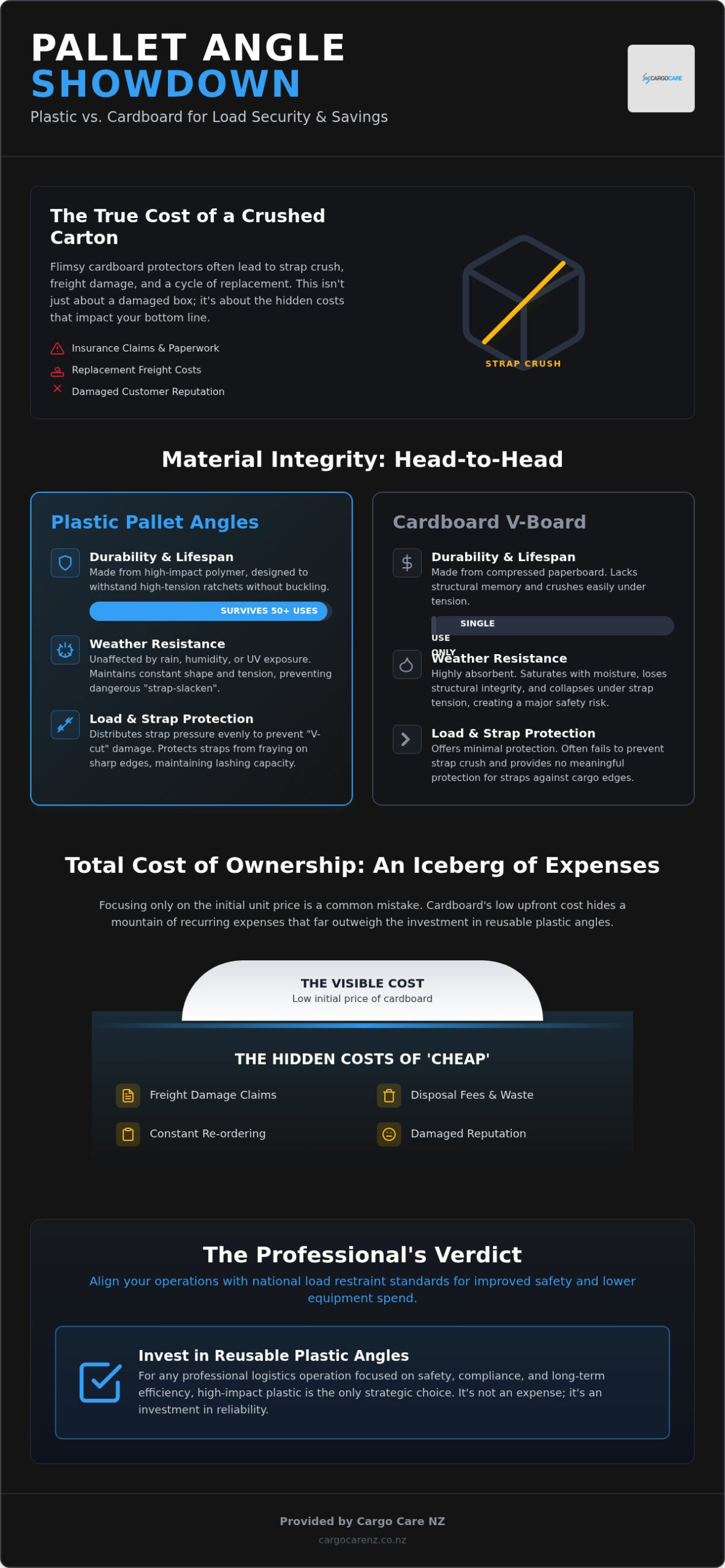
Pallet angles serve two critical functions in transport: they shield cargo edges from strap crush and protect the strapping itself from abrasive damage. When comparing plastic pallet angles vs cardboard, the material composition dictates the level of protection. Cardboard protectors consist of compressed paperboard layers. While lightweight, they lack structural memory and resilience. High-impact plastic angles, such as the 1042mm models sourced from Silverback, use rigid polymers designed to withstand high-tension ratchets without buckling or snapping.
Plastic angles distribute strap pressure across a wider surface area. This prevents the concentrated force that often causes “V-cut” damage in soft goods or palletised cartons. In heavy industrial and construction sectors, cardboard is fundamentally insufficient. Steel, bricks, and timber require the structural rigidity of plastic to maintain tension throughout long-haul transit. Adhering to fundamental load securing principles ensures the angle reinforces the load’s stability rather than merely acting as a buffer.
Initial Outlay vs Total Cost of Ownership
A common procurement error involves focusing solely on the unit price. Cardboard is a single-use consumable. Once a strap is tightened, the paperboard fibres often crush, rendering the protector useless for subsequent legs. Conversely, plastic angles are a reusable asset. Research indicates high-density protectors can survive over 50 uses, which reduces the per-trip cost to a fraction of the price of disposable alternatives.
Hidden costs associated with cardboard include disposal fees for crushed paperboard and the administrative burden of frequent re-ordering. Most importantly, freight damage claims resulting from failed cardboard protectors far outweigh the investment in professional-grade hardware. Silverback plastic angles provide the durability required for high-turnover logistics environments where equipment must perform reliably shift after shift.
Durability in the Elements: Why Plastic Outperforms Cardboard in Transit
New Zealand’s volatile weather conditions directly impact the efficacy of load restraint hardware. When evaluating plastic pallet angles vs cardboard, environmental resilience is a decisive factor. Cardboard is inherently hygroscopic. It absorbs atmospheric moisture and direct rainfall, which compromises the structural integrity of the paperboard fibres. Once saturated, cardboard loses its ability to resist compression, leading to the “strap-slacken” effect.
This phenomenon occurs when the protector softens and collapses under the tension of a tie-down. As the protector shrinks, the strap loses its initial pre-tension. This creates a dangerous risk of load shift during transit. High-impact plastic angles remain unaffected by rain or humidity. They maintain a constant profile, ensuring that the tension applied at the start of the journey remains consistent until arrival. Adhering to federal cargo securement regulations or equivalent local standards requires this level of predictable performance to ensure public safety.
Resistance to Moisture and High-Tension Strapping
Plastic is essential when using high-tension ratchet tie-downs. Consider a scenario where a load of palletised timber is secured with cardboard protectors during a storm. As the cardboard absorbs water, the protector flattens. The resulting slack allows the timber to move, potentially causing a roll-over or loss of cargo. UV stability is equally vital for long-haul freight. Unlike paperboard, which degrades and tears, UV-stabilised plastic withstands prolonged sun exposure without becoming brittle. For any route involving outdoor loading or variable weather, choosing professional plastic pallet angles is the only way to ensure operational continuity. Best practice dictates using plastic for all national long-haul freight to eliminate the variables introduced by environmental degradation.
Compliance and Load Securing: Selecting the Right Protection
Load restraint is a legal requirement, not a suggestion. When considering plastic pallet angles vs cardboard, the decision impacts your compliance with national safety standards. A pallet angle isn’t just a buffer; it’s a critical component of a restraint system. It ensures that downward pressure is maintained without damaging the cargo or the securing hardware. High-quality angles prevent sharp edges from fraying load restraint straps NZ. This is vital because a single nick in a polyester strap can significantly reduce its lashing capacity. Using professional-grade plastic ensures the strap remains in peak condition throughout its service life.
Choosing the correct angle length is essential for load stability. While cardboard often comes in short, fragmented pieces, plastic angles are available in extended lengths to suit specific pallet heights. This prevents point loading where the strap exerts force on a single small area. Instead, it creates a rigid spine along the cargo edge. This is a safety device for truckies. It reduces the risk of strap failure and ensures the load stays put during emergency braking or sharp cornering.
The Role of 1042mm Plastic Angles in Heavy Haulage
The 1042mm plastic pallet angle is the industry standard for full-sized pallets. This specific length provides continuous edge protection for stacked cartons, preventing individual boxes from shifting or collapsing under tension. By using hardware that meets the Silverback products NZ quality standard, operators ensure they’re using equipment tested for the rigours of national distribution. These specialised angles provide a level of security that disposable cardboard simply cannot match in professional haulage environments.
Optimising Load Security for National Freight
The operational reality of plastic pallet angles vs cardboard is clear. While paperboard serves basic one-way needs, it cannot match the structural integrity required for heavy-duty load restraint. High-impact plastic maintains constant strap tension regardless of weather conditions, preventing the costly damage claims associated with moisture-softened cardboard. This shift from consumables to reusable assets significantly lowers your total equipment spend over time.
CargoCare NZ is the official Silverback distributor, supplying specialised 1042mm angles built for the demands of national logistics. We provide the professional-grade hardware and expert support needed to ensure your transport safety and compliance remain beyond reproach. Upgrade your fleet with heavy-duty plastic pallet angles to experience a more reliable, cost-effective way to move cargo. Secure your next load with the confidence that only high-performance protection can provide.
Frequently Asked Questions
Can plastic pallet angles be recycled at the end of their life?
Yes, professional-grade plastic pallet angles are typically manufactured from High-Density Polyethylene (HDPE), which is a fully recyclable polymer. Once an angle reaches the end of its service life due to physical wear, it can be processed through industrial plastic recycling streams. This supports a circular economy, making them a more sustainable choice than single-use cardboard that often ends up as waste.
How many times can I reuse a plastic pallet angle before it needs replacing?
A high-quality plastic pallet angle can be reused over 50 times in standard logistics operations. This durability is a primary advantage when comparing plastic pallet angles vs cardboard, where paperboard alternatives generally fail after a single trip. Provided the angle isn’t subjected to extreme impact or structural cracking, its extended service life offers a significantly lower per-use cost for transport operators.
Are cardboard pallet angles ever better than plastic for specific freight?
Cardboard pallet angles are suitable for one-way international shipping or low-value freight where retrieving reusable equipment isn’t commercially viable. They provide basic edge protection for lightweight cartons in dry environments. However, for national long-haul transport or heavy industrial loads, the structural rigidity and moisture resistance of plastic remain the professional standard for ensuring load security and safety compliance.
Do plastic pallet angles work with all types of ratchet tie-downs and winches?
Yes, these angles are specifically engineered to accommodate standard 50mm and 75mm webbing used with ratchet tie-downs and winches. The wide surface area of the plastic helps distribute the high tension from these tools without the strap cutting into the cargo. This compatibility ensures that the plastic pallet angles vs cardboard choice doesn’t limit your choice of load restraint hardware.

Article by
Steve O'Malley