
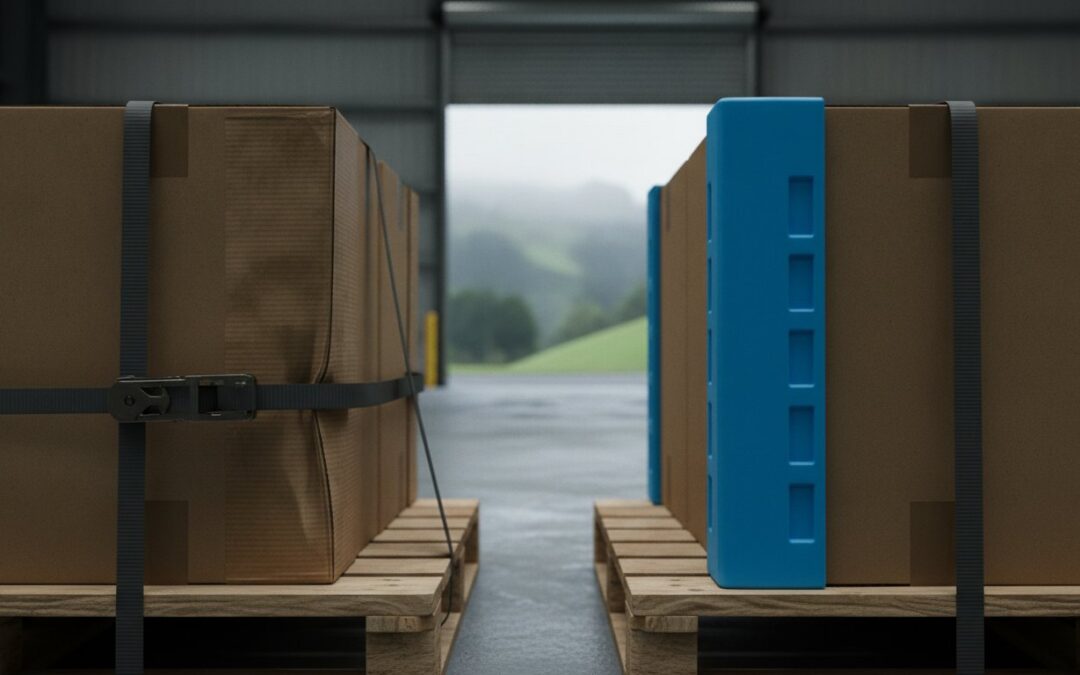
How much does a “cheap” cardboard edge protector actually cost when a heavy rain shower on the Kaimai Range turns it into mush mid-transit? For many logistics professionals, the initial savings on disposable pallet corner protectors NZ suppliers offer are quickly erased by the reality of strap crush and weather-related degradation. You’ve likely dealt with the headache of rejected stock or the stress of an insurance claim because a fragile carton failed under the pressure of a tie-down strap.
It’s a common frustration in the industry, but securing your cargo doesn’t have to be a gamble against the elements. You will discover why high-impact plastic pallet angles are the superior choice for New Zealand transport professionals compared to disposable alternatives. We will examine how these heavy-duty tools ensure compliance with the 2026 Truck Loading Code, reduce cargo damage, and survive the harshest New Zealand climates. This guide compares the long-term value of reusable plastic against traditional cardboard to help you make the most durable choice for your fleet.
Key Takeaways
- Understand the critical role of edge protection in distributing strap tension to prevent damage to fragile packaging and cartons.
- Compare the functional differences between cardboard and plastic pallet corner protectors NZ to choose the right material for your transport route.
- Discover why the 1042mm length is the industry standard for achieving uniform pressure distribution across the entire width of a pallet.
- Identify how heavy-duty plastic angles help your operation maintain compliance with the 2026 Truck Loading Code while resisting weather-related degradation.
The Role of Pallet Corner Protectors in NZ Cargo Safety
Pallet corner protectors NZ serve as a rigid mechanical interface between tensioned webbing and fragile cargo. These L-shaped components are designed to distribute the downward force of a strap across a wider surface area. Without this distribution, high-tension webbing often causes “strap crush”, where the strap bites into the packaging and compromises the structural integrity of the load. This is especially problematic for cardboard cartons or palletised consumer goods destined for retail shelves. Properly applied angles ensure that the force required for safety doesn’t become the cause of damage.
Beyond cargo protection, these angles safeguard the load restraint straps NZ transport operators rely on daily. Sharp freight edges, such as those found on steel crates or timber, can quickly fray or sever expensive webbing during transit. Using a pallet angle creates a smooth radius for the strap to pass over. This practice aligns with fundamental load securing principles, ensuring that tension remains consistent throughout the journey without risking equipment failure or load shifts. It’s a simple tool that prevents costly roadside repairs.
Why Edge Protection is Non-Negotiable for Local Logistics
Reducing insurance claims is a priority for any transport business. Corner damage is a leading cause of rejected deliveries at distribution centres across the country. Drivers know the cost of a rejected load. By using pallet corner protectors NZ hauliers ensure their freight maintains a professional, store-ready appearance upon arrival. This reliability builds trust with retailers and eliminates the administrative burden of handling damaged stock returns or credit notes.
Anatomy of a High-Performance Pallet Angle
A professional-grade pallet angle must withstand more than just strap tension. High-performance models use impact-modified polypropylene to prevent shattering during heavy use or accidental drops. UV-stabilisation is also essential for the New Zealand environment. Our high UV levels make standard plastics brittle within months. Stabilised equipment retains its flexibility and strength through multiple seasons of line-haul work, providing a much lower total cost of ownership than disposable alternatives.
Plastic vs. Cardboard: Choosing the Right Pallet Edge Protectors
Selecting between cardboard and high-impact plastic depends entirely on your operational cycle. Cardboard pallet corner protectors NZ suppliers provide are often suitable for internal warehouse organisation or one-way international shipping where equipment retrieval isn’t feasible. However, for national line-haul and local deliveries, plastic pallet corner protectors NZ transport operators use are the professional standard. The primary differentiator is structural integrity under environmental stress.
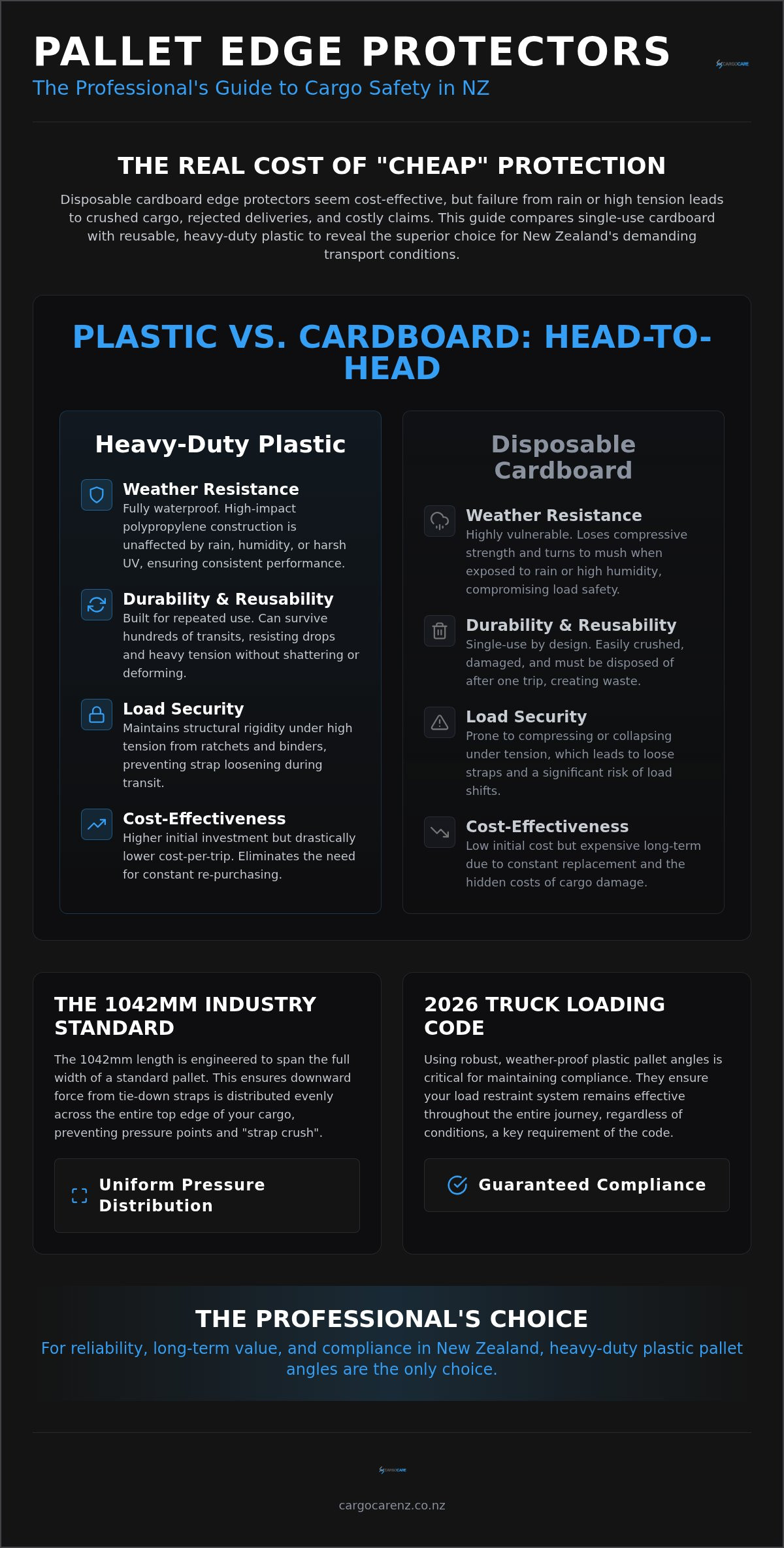
New Zealand’s unpredictable weather presents a significant risk to cardboard. Once exposed to rain or high humidity, cardboard loses its compressive strength and becomes pliable. This failure directly impacts load security, as the tension in the lashing system drops when the protector collapses. Plastic alternatives remain structural regardless of moisture levels. Adhering to the New Zealand truck loading code requires restraints to remain effective throughout the journey; plastic ensures this compliance. While the initial purchase price for plastic is higher, the cost-per-trip is drastically lower. A single heavy-duty angle can survive hundreds of transits, whereas cardboard is typically a single-use expense.
When to Use Heavy-Duty Plastic Angles
High-impact plastic is essential when securing heavy loads with high-tension equipment like Maxibinders or heavy-duty strops. Industries such as apiculture, where hive transport requires absolute stability, or construction, involving steel and timber, rely on the rigidity of plastic. If you need to maintain high pre-tension without the protector failing, reusable plastic pallet angles are the necessary choice.
The Limitations of Disposable Edge Protectors
Disposable cardboard options frequently fail under the force of a standard ratchet tie-down. As the strap is tightened, the cardboard compresses, which can lead to a loose strap mid-transit. There’s also the logistical burden of disposal. Damaged cardboard creates waste at delivery points, whereas reusable plastic stays with the fleet, reducing the environmental footprint and the need for constant restocking.
Optimising Load Restraint with 1042mm Plastic Pallet Angles
The 1042mm length of these pallet corner protectors NZ transport professionals use is specifically engineered to cover the width of a standard pallet. This dimension ensures that the downward force from a 50mm strap is distributed evenly across the entire edge of the cargo, rather than concentrating pressure on specific points. Achieving uniform pressure is a core requirement for maintaining load stability during the vibrations and lateral forces of long-haul transit. Integrating these angles with Silverback products NZ creates a unified cargo handling system that meets high professional standards.
Correct positioning is vital for operational efficiency. For high-stack pallets, drivers should use a specialised telescopic placement tool to seat the angle securely without needing a ladder. Once in place, the strap must be centred over the angle’s guide tracks. This prevents the strop from sliding off the protector during transit, a common issue when using shorter or non-standardised equipment. The Load Restraint Guide highlights that even small shifts in a restraint system can lead to significant tension loss. Rigid plastic angles provide the necessary friction and structural support to keep the webbing exactly where it was tensioned.
Pairing Angles with Professional Tie-Down Hardware
Plastic angles excel when paired with 50mm ratchet straps. The rigid polypropylene prevents the webbing from “biting” into the cargo corners, which preserves both the freight and the strap. For heavier loads like timber or machinery, the synergy between these angles and heavy-duty Maxibinders is unmatched. The angle provides a solid base that can withstand the extreme pre-tension forces generated by a chain binder or high-capacity ratchet without collapsing or deforming.
Sourcing Quality Pallet Protection in New Zealand
Professional transporters consistently choose Silverback-branded hardware for its reliability across national freight routes. Using standardised pallet corner protectors NZ wide ensures fleet consistency, making it easier for drivers to swap gear and maintain uniform safety protocols. CargoCare NZ, as the national distributor, provides equipment that is built to survive the rigours of the New Zealand transport industry, from the humidity of Northland to the alpine conditions of the South Island.
Securing Your Cargo for the Long Haul
Professional logistics requires equipment that withstands the variable New Zealand climate and the physical demands of line-haul transit. Shifting from disposable cardboard to high-impact plastic ensures your load restraint system remains structural from the point of loading to the final destination. It’s a practical investment that eliminates the recurring costs and failure rates associated with single-use alternatives.
Using 1042mm pallet corner protectors NZ wide provides a standardised solution that protects both fragile cargo and expensive tie-down webbing. These tools are essential for meeting the 2026 Truck Loading Code requirements while minimising insurance claims related to strap crush. By choosing gear specifically engineered for the transport sector, you ensure your fleet remains compliant and your freight arrives in store-ready condition.
As the official NZ Silverback distributor, CargoCare NZ provides heavy-duty hardware designed for high-impact transport use. We offer national delivery across New Zealand to keep your fleet equipped with industry-standard protection. View our range of Silverback Plastic Pallet Angles to secure your next load with confidence.
Frequently Asked Questions
Are plastic pallet corner protectors reusable?
Yes, high-impact plastic angles are designed for multiple years of service across a fleet. Unlike cardboard versions that degrade after a single wet-weather trip, these units survive hundreds of transits. The impact-modified polypropylene construction prevents shattering during heavy use or storage. This reusability provides a significantly lower total cost of ownership for transport operators compared to the constant replacement required for disposable edge protection.
What is the standard length for a pallet angle in NZ?
The professional standard length for a pallet angle in New Zealand is 1042mm. This length is specifically calculated to match the width of a standard pallet, ensuring that the protector covers the entire cargo edge. Using a 1042mm angle allows for uniform pressure distribution from the tie-down straps. It’s essential for maintaining the structural integrity of the load during long-haul transit across rugged terrain.
Can I use plastic pallet angles with metal chains or Maxibinders?
Heavy-duty plastic pallet corner protectors NZ suppliers provide are suitable for use with 50mm ratchet straps and high-tension Maxibinders. The rigid material is engineered to withstand the significant pre-tension forces required for securing timber, machinery, or heavy crates. While they are highly durable, always inspect the angles for signs of deformation if you’re using them with extreme tensioning equipment to ensure continued safety.
Do pallet corner protectors help with NZTA load restraint compliance?
Yes, using pallet corner protectors NZ wide is a key factor in complying with the 2026 Truck Loading Code. The NZTA requires that all loads are secured to withstand specific G-forces without shifting. Protectors ensure that lashing tension remains consistent by preventing the strap from cutting into the cargo. This maintains the necessary clamping force required for legal and safe transport on New Zealand roads.

Article by
Steve O'Malley