

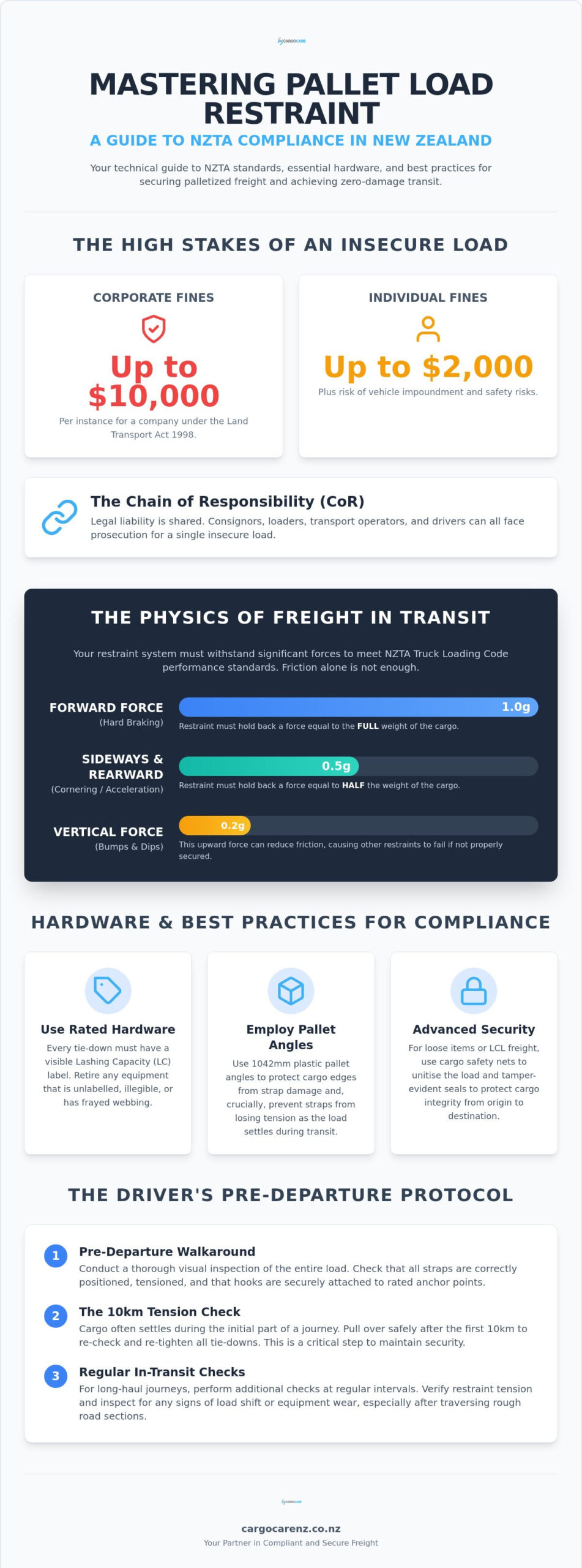
Did you know that a company can face fines of up to $10,000 for a single instance of an insecure load under the Land Transport Act 1998? Securing palletized freight NZ is not just a matter of operational preference. It is a strict legal requirement defined by the NZTA Truck Loading Code. Shifting loads and damaged cargo represent more than just a nuisance; they are a direct threat to your bottom line and operational safety.
We understand that maintaining compliance while keeping turn-around times fast is a constant challenge for logistics professionals. This guide provides the technical expertise you need to master New Zealand load restraint essentials. You will learn how to ensure your cargo remains stationary and undamaged throughout the supply chain, from the warehouse floor to final delivery.
We will examine the specific force requirements for forward and lateral deceleration, the importance of unitising loads with the right materials, and the professional hardware required for zero-damage transit. By following these industry standards, you can achieve full compliance and streamline your loading processes for maximum efficiency.
Key Takeaways
- Understand the NZTA Truck Loading Code performance standards to ensure full compliance and avoid heavy corporate fines.
- Master the selection and application of rated hardware for securing palletized freight NZ to maintain cargo stability.
- Implement 1042mm plastic pallet angles to protect cargo edges and ensure your tie-down equipment doesn’t lose tension during transit.
- Utilise cargo safety nets and tamper-evident seals to protect the integrity of loose items and LCL freight.
- Adopt a methodical pre-departure walkaround and a 10km tension check to ensure every load stays secure until it’s de-vanned.
Table of Contents
Understanding NZ Load Restraint Standards for Pallets
Load restraint is a comprehensive system designed to prevent cargo movement in all directions. It’s not just about stopping a pallet from falling off; it’s about containing and securing the load against every force encountered during transit. In New Zealand, the fundamental framework for this is the NZTA Truck Loading Code. This code dictates how operators must manage their cargo to ensure public safety and road infrastructure protection. Compliance isn’t optional; it’s a core operational requirement for every transport business.
The “Chain of Responsibility” (CoR) means that liability doesn’t stop with the driver. Consignors, loaders, and transport operators all share the legal burden for securing palletized freight NZ. If a load shifts due to poor practice, every party involved in that logistics chain can face prosecution. Under the Land Transport Act 1998, fines for insecure loads reach up to $2,000 for individuals and $10,000 for companies. Beyond the financial impact, non-compliance leads to vehicle impoundment and severe safety risks for road users.
The Physics of Palletised Freight Movement
When a heavy vehicle brakes hard, turns a corner, or hits a bump on a rural road, the cargo experiences significant physical forces. Understanding Load securing principles is vital for managing these dynamics. Forward deceleration (hard braking) requires the restraint system to withstand 1.0g, which is a force equal to the full weight of the load. Sideways cornering and rearward forces require 0.5g resistance.
While friction between the pallet and the truck tray helps, it’s rarely sufficient as a standalone solution. Active restraint, using rated hardware like ratchet tie-downs, is necessary to counteract these forces. “Near enough” is a dangerous mindset in logistics. A pallet that isn’t locked down becomes a projectile during emergency braking. You must also account for the vertical force of 0.2g, which occurs when vehicles hit uneven road surfaces. This movement can lift the load and break the frictional bond, leading to a total failure of the restraint system.
Legal Requirements for NZ Road Transport
New Zealand law is specific about the performance standards for heavy vehicle loads. Operators must ensure their restraint systems meet the 1.0g forward, 0.5g lateral/rearward, and 0.2g vertical force thresholds. Professional drivers must also maintain documentation and conduct regular compliance checks to prove the load is secure. The official New Zealand truck loading code is the primary regulatory document for all NZ transport.
Compliance is verified through roadside inspections by the Commercial Vehicle Safety Team (CVST). If your restraint system doesn’t meet the performance standards, the vehicle can be prohibited from moving until the load is rectified. This causes significant delays in the supply chain and damages professional reputations. Using the correct hardware is the only way to guarantee these legal standards are met consistently while securing palletized freight NZ across the national road network.
Essential Hardware for Securing Palletised Freight
Professional standards for securing palletized freight NZ require hardware that is specifically rated for the task. Using generic or unbranded straps is a significant risk that can lead to both cargo damage and legal liability. Every piece of equipment in your restraint system must have a clearly visible rating. This ensures it can withstand the forces defined in the Official New Zealand Truck Loading Code. High-quality hardware provides the predictability needed for safe transport across the varied terrain of the New Zealand road network.
Silverback products are widely recognised as the industry standard for durability in local conditions. Their equipment is designed to handle the high UV exposure and damp environments common in NZ logistics. While webbing straps are the workhorse for most palletised goods, heavier or sharper loads may require chain systems. However, for the vast majority of commercial palletised freight, a heavy-duty Ratchet Tie Down with Hook and Keeper remains the most efficient and reliable choice. It offers the necessary tension without the excessive weight of chains.
Ratchet Tie-Downs and Webbing
Understanding Lashing Capacity (LC) is fundamental to load safety. The LC is the maximum force that a restraint system is designed to sustain in use. You’ll find this value on the strap’s identification label. If a label is missing, illegible, or the webbing is frayed, the strap must be retired immediately. The hook and keeper design is particularly effective for NZ transport. It ensures the hook remains attached to the anchor point even if the load settles and the strap momentarily loses tension. This prevents the restraint from failing entirely during a journey.
Load Binders and Tensioning Tools
For applications requiring higher tension than a standard ratchet can provide, the Maxibinder 8mm is the professional choice. These geared binders allow for significant force with less physical effort. This ergonomic benefit is vital for reducing driver fatigue and preventing long-term strain injuries. When you’re securing palletized freight NZ, it’s essential to apply even tension across the entire load. Unevenly tightened straps can cause pallets to skew or lean, which compromises the stability of the entire trailer. Consistent tensioning ensures the load remains centered and secure.
Maintaining a fleet with reliable equipment is a non-negotiable part of modern logistics. Many operators choose to source professional-grade restraint tools to ensure their cargo remains stationary and their drivers stay safe. Investing in rated hardware is the most effective way to prevent the shifting loads that lead to costly insurance claims and NZTA fines.
The Role of Pallet Angles in Load Protection
Edge protection is a critical component of securing palletized freight NZ that operators often overlook. While the primary goal of a tie-down is to apply downward pressure, that pressure must be distributed evenly to be effective. Without pallet angles, the concentrated force of a 50mm webbing strap can easily crush outer packaging or damage fragile contents. This creates a dilemma where a driver must choose between a loose, non-compliant load or damaged goods. Using professional-grade angles removes this conflict by providing a rigid buffer between the strap and the freight.
Protecting the cargo is only half the job. Pallet angles also safeguard your investment in restraint hardware. Sharp edges on crates or timber pallets can fray webbing over time. This leads to a sawing effect where road vibrations cause the strap to cut into the load or, conversely, the load to cut the strap. By eliminating these sharp contact points, you extend the service life of your tie-downs and reduce the frequency of strap replacement. It’s a simple addition that significantly lowers long-term operational costs.
Benefits of the 1042mm Plastic Pallet Angle
The Plastic Pallet Angle – Blue 1042mm has become the professional standard across the New Zealand logistics landscape. This specific length is optimised for standard NZ pallet dimensions, ensuring full coverage across the width of the load. Unlike cardboard alternatives that lose structural integrity when exposed to the elements, heavy-duty plastic angles remain rigid in rain and high humidity. Using these blue angles also helps organise your load, presenting a uniform and professional appearance to the receiver upon arrival. It signals a commitment to cargo care that reflects well on the transport provider.
Improving Load Stability with Edge Protectors
Edge protectors facilitate much higher tensioning levels without risking structural damage to the freight. This is essential for meeting the 1.0g forward deceleration standard required by law. For high-stack pallets, positioning the angles at the top corners helps unitise the load, preventing individual boxes from shifting independently. This creates a single, stable mass that is far easier to restrain effectively. For maximum stability, ensure the angle is seated squarely on the corner and the strap is centered on the angle’s recessed track. This alignment prevents the strap from slipping off during transit, which is a common cause of tension loss when securing palletized freight NZ.
Advanced Security: Binders, Nets, and Seals
Professional load restraint extends beyond preventing physical movement. It involves protecting the integrity of the entire supply chain. Cargo shrinkage and unauthorised access are operational risks that can lead to significant financial loss and insurance complications. Advanced security measures ensure that goods arrive not only stationary but also untampered. By integrating containment tools with physical restraints, operators can achieve a higher level of reliability when securing palletized freight NZ across the national logistics network.
This focus on integrity is just as vital for export and import operations; you can explore International Sea Freight services that prioritise the same level of care for containerised goods crossing international waters.
The choice of tensioning hardware is a critical factor in this process. While standard binders are common, the Maxibinder 8mm offers a geared tensioning system that provides superior mechanical advantage. This allows for higher lashing tension with less physical effort from the driver, which is a major benefit during long-haul routes across New Zealand. These tools ensure the load remains compressed and stationary even when the vehicle encounters harsh road conditions or emergency braking scenarios. This geared approach addresses the common issue of tension loss found in lower-quality alternatives.
High-Security Bolt Seals for Containerised Pallets
For containerised pallets or high-value shipments, physical locks are often insufficient to deter professional theft. Tamper Evident Secure Bolt Seals are the industry standard for ensuring a shipment remains untouched from the point of origin to the final destination. These seals are designed to be destroyed upon removal, making any attempt at unauthorised access immediately obvious. Tamper-evident secure bolt seals provide a clear audit trail for logistics providers by linking a unique serial number to specific shipping documentation.
Efficient de-vanning is equally important for maintaining fast turn-around times at the warehouse. Traditional manual cutters are often slow and physically demanding for staff. The Phoenix Cordless Bolt Seal Cutter 18V allows warehouse personnel to remove high-security seals in seconds with minimal effort. This tool streamlines the receiving process while maintaining safety standards on the loading dock, ensuring that the transition from transit to storage is as fast as possible. For warehouse managers, it is also beneficial to learn more about NOVALIFT and their specialist maintenance for freight lifts to ensure internal logistics remain seamless.
Cargo Safety Nets for Multi-Drop Logistics
Multi-drop deliveries present a specific risk profile for securing palletized freight NZ. As the tray is partially unloaded at various stops, the remaining pallets can lose their collective stability and “lean” into empty spaces. A Cargo Safety Net acts as a secondary containment system, preventing loose items or smaller packages from falling from the vehicle. These nets are particularly effective for LCL (Less than Container Load) freight where items may not be perfectly unitised on a single pallet. Integrating these nets with standard ratchet tie-downs provides a comprehensive, 360-degree security solution that protects both the cargo and other road users.
To maintain the highest standards of supply chain integrity, you should invest in rated security hardware that meets New Zealand’s rigorous transport requirements. Ensuring your fleet is equipped with the right tools is the most effective way to eliminate cargo loss and maintain professional standards.
Best Practices for Pre-Departure Load Checks
The final stage of securing palletized freight NZ involves a rigorous inspection routine before the vehicle leaves the yard. A five minute walkaround is a non-negotiable professional standard that identifies potential failures before they occur on the road. During this check, you must verify that every ratchet tie down with hook and keeper is correctly seated and that the webbing is free from twists. A twisted strap doesn’t distribute pressure evenly across the Plastic Pallet Angle – Blue 1042mm, which can lead to localised stress and eventual strap failure under load.
Settling is a common physical occurrence during the initial stage of a journey. Professional drivers conduct a secondary tension check after the first 10km of travel. This is the period when palletised goods are most likely to shift slightly, causing straps to lose their initial lashing capacity. If your load includes hazardous materials, this is also the time to ensure the Class 3.0 Flammable Liquid Label – 250 mm is clearly visible and securely attached to the vehicle. Compliance with dangerous goods regulations is as critical as the physical restraint itself.
The Load Restraint Checklist
A methodical approach to inspections prevents oversight. Every driver should follow a specific hardware focused routine to ensure total compliance with the NZTA Truck Loading Code. This includes the following steps:
- Inspect all ratchet mechanisms to ensure they operate smoothly and lock into the final position.
- Verify that every Maxibinder 8mm is fully closed and the handle is secured against accidental release.
- Confirm that all pallet angles remain squarely seated on the cargo edges to maintain even pressure.
- Check that Tamper Evident Secure Bolt Seals are intact and that the serial numbers match the shipping manifest exactly.
Maintaining Your Securing Hardware
The longevity of your restraint equipment depends on proper maintenance and storage. Webbing straps are particularly susceptible to UV degradation and moisture damage, which can hiddenly reduce their rated strength. When not in use, store all straps in a dry, dark environment to maintain their integrity. Periodically cleaning and lubricating the moving parts of ratchet handles and binders ensures they don’t seize during critical tensioning. If a strap shows signs of fraying or a binder mechanism feels gritty, it must be removed from service immediately to prevent a failure while securing palletized freight NZ.
Maintaining a high standard of hardware care is the best way to avoid the $10,000 corporate fines associated with insecure loads. To ensure your fleet is equipped with the most durable tools for the job, View our full range of Silverback load restraint gear at Cargo Care NZ. Investing in professional grade equipment and a strict inspection routine is the only way to guarantee cargo safety and operational continuity.
Optimising Your Load Restraint Strategy for Long-Term Success
Mastering the technical requirements of the NZTA Truck Loading Code is the foundation of a reliable transport operation. By prioritising the use of rated hardware and implementing rigid edge protection, you eliminate the risks of cargo shifting and equipment failure. A disciplined approach to pre-departure checks and mid-journey inspections ensures that your load remains stationary and compliant from the moment it leaves the dock until it reaches the receiver.
Professional standards for securing palletized freight NZ require a commitment to quality tools and methodical processes. Maintaining this level of cargo care protects your personnel, your equipment, and your professional reputation within the New Zealand logistics industry. It’s about more than just avoiding fines; it’s about ensuring operational continuity and road safety for everyone.
As the Official NZ Distributor of Silverback Products, Cargo Care NZ provides a comprehensive range of NZTA-compliant hardware. We are specialists in transport security and cargo safety, dedicated to keeping your operations moving efficiently. Equip your fleet with New Zealand’s leading load restraint hardware at Cargo Care NZ. Your commitment to these professional standards ensures that every pallet arrives in perfect condition, every time.
Frequently Asked Questions
What are the NZTA requirements for securing palletised loads?
NZTA requires all load restraint systems to withstand 1.0g forward deceleration, 0.5g sideways and rearward forces, and 0.2g vertical movement. These performance standards are defined in the official New Zealand truck loading code. Every operator is legally responsible for ensuring their hardware meets these specific force thresholds to maintain road safety and avoid fines.
Why should I use plastic pallet angles instead of cardboard?
Plastic pallet angles are superior to cardboard because they maintain structural integrity in wet New Zealand weather. Cardboard softens and fails when exposed to rain or high humidity, leading to immediate tension loss in your straps. Heavy-duty blue plastic angles are reusable and provide consistent edge protection for securing palletized freight NZ.
How many ratchet straps do I need for a standard pallet?
Most standard pallets require at least two rated ratchet tie-downs to ensure stability and prevent pivoting during transit. The exact number depends on the weight of the load and the lashing capacity of your equipment. You must ensure the combined lashing capacity is sufficient to counteract the 1.0g forward force requirement encountered during hard braking.
What is lashing capacity and how do I find it on my gear?
Lashing capacity (LC) is the maximum force a restraint system is designed to sustain during normal use. You can find this value printed clearly on the identification label sewn into the webbing of your ratchet straps or embossed on metal components. If the label is missing or the LC is illegible, the strap is no longer compliant and must be retired from service.
Can I use a cargo net instead of straps for heavy pallets?
No, a cargo net is designed for containment and secondary security rather than acting as the primary restraint for heavy pallets. While a Cargo Safety Net is excellent for loose items or LCL freight, heavy palletised goods require active restraint like ratchet straps to meet legal force requirements. Nets should be used in conjunction with straps for comprehensive security.
What is the best way to remove high-security bolt seals safely?
The most efficient way to remove high-security seals is with a Phoenix Cordless Bolt Seal Cutter 18V. Using manual bolt cutters is physically demanding and increases the risk of strain injuries for warehouse staff. A cordless power tool allows for rapid de-vanning of containers while maintaining a high safety standard on the loading dock.
How often should I replace my load restraint webbing?
You must replace load restraint webbing immediately if you detect any fraying, cuts, or significant UV degradation during your daily inspection. There is no fixed expiry date, but any strap with a damaged label or compromised stitching is considered non-compliant. Regular replacement of worn gear is essential for safety when securing palletized freight NZ.
Do I need specific labels for palletised flammable liquids in NZ?
Yes, New Zealand dangerous goods regulations require specific placards for transporting flammable liquids. You must display a Class 3.0 Flammable Liquid Label – 250 mm if your load exceeds the specified quantity thresholds. Ensuring these labels are visible and compliant is a mandatory part of your pre-departure checklist for hazardous cargo.
Article by
Steve O'Malley