
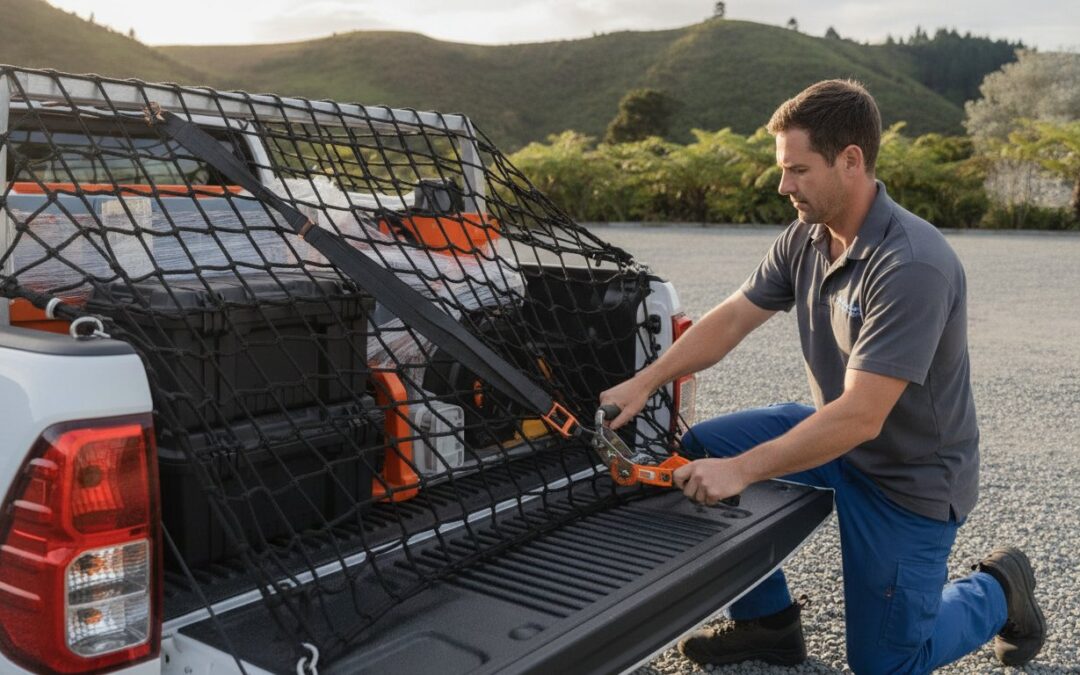
A cheap, tangled net isn’t just a daily frustration; it’s a liability that could cost your business $10,000 in non-compliance fines under the 2026 NZTA truck loading code. Most operators agree that securing a load requires more than just a basic cover. You need equipment that withstands harsh New Zealand UV levels and remains secure during heavy braking or sharp cornering. Choosing a high-quality cargo net for truck tray NZ applications is the difference between a safe arrival and a costly roadside inspection.
We understand that your priority is operational continuity and safety. This guide will teach you how to select a professional-grade restraint system that meets rigorous NZTA standards while resisting the common issues of tearing or tangling. We will compare material durability, load ratings, and sizing standards to ensure your fleet remains compliant and your cargo stays protected on every journey across the country.
Key Takeaways
- Understand the mandatory NZTA load restraint standards to avoid significant fines and ensure your containment system meets legal force requirements.
- Evaluate the performance differences between webbing, mesh, and bungee materials to match the specific durability needs of your transport operations.
- Learn how to apply the “Overhang Rule” when selecting a cargo net for truck tray NZ to ensure full containment of high or irregular loads.
- Identify essential technical features like integrated attachment points and UV-stabilised components that prevent premature failure in the harsh New Zealand climate.
- Ensure operational continuity by sourcing professional-grade equipment from a trusted distributor that understands local transport regulations and requirements.
Table of Contents
Understanding NZTA Load Restraint Requirements for Loose Loads
Operating a commercial vehicle in New Zealand carries a strict legal obligation to secure every load. This requirement applies regardless of the trip distance or the perceived weight of the cargo. Under the Land Transport Act 1998, drivers must ensure their load does not leak, spill, or fall from the vehicle. A professional cargo net for truck tray NZ applications serves as a critical containment tool for loose or light items that traditional tie-down straps cannot effectively hold. These nets are engineered to prevent debris from becoming a road hazard, directly addressing the common issue of fines for unsecure loads.
Professional transport operators distinguish between a simple cover and a rated restraint. While a basic mesh cover might stop light litter from blowing away, it often lacks the structural integrity required by the NZ Transport Agency (NZTA). Effective Load securing principles dictate that a restraint system must withstand specific G-forces during emergency braking or cornering. Relying on generic, unrated mesh instead of professional-grade equipment puts both the driver and the public at risk. Professional-grade nets are built with reinforced webbing and verified attachment points to ensure they function as a safety barrier rather than just a visual deterrent.
The Role of Nets in the NZ Load Restraint Manual
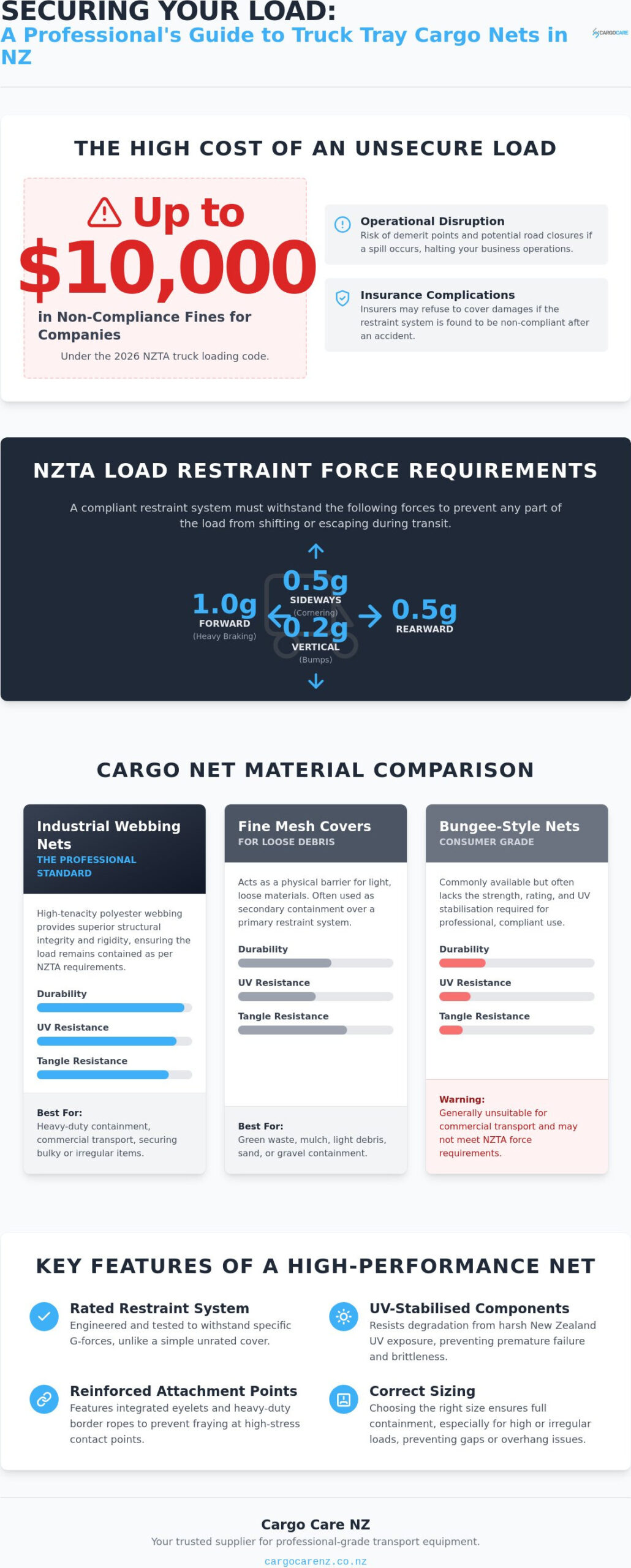
The 2026 edition of the official New Zealand truck loading code provides clear guidance on containing loose bulk items like green waste, light debris, or small equipment. For many professional trays, a net is used in conjunction with tie-down straps to provide secondary containment. This dual-layer approach ensures that while the heavy items are lashed down, smaller components remain trapped within the tray area. A compliant load restraint according to NZTA standards is a system capable of withstanding forces of 1.0g in the forward direction, 0.5g sideways and rearward, and 0.2g vertically to prevent any part of the load from shifting or escaping.
Consequences of Non-Compliance on NZ Roads
Failure to meet these standards results in significant financial and operational penalties. As of July 2026, fines for unsecure loads can reach NZ$2,000 for individuals and up to NZ$10,000 for companies. Beyond the immediate fine, commercial operators face the risk of demerit points and potential road closures if a spill occurs. Using unrated or damaged nets also complicates insurance claims. If an accident is caused by escaped cargo and the restraint system is found to be non-compliant, insurers may refuse to cover the resulting damages. Investing in professional equipment is a necessary step for maintaining business continuity and protecting your bottom line.
Comparing Cargo Net Materials: Webbing vs Mesh vs Bungee
Material durability is the primary factor in long-term performance. In New Zealand, the high UV index causes rapid degradation of non-industrial plastics; selecting a cargo net for truck tray NZ requires an understanding of how different fibres respond to tension and environmental stress. While bungee-style nets are common in consumer retail, they often lack the tensile strength and UV-stabilisation necessary for commercial transport. Professional operators prioritise materials that won’t become brittle or lose their elasticity after a single summer on the road.
The weight of the material also influences operational efficiency. A net must be heavy enough to remain stable under wind pressure but light enough for a single operator to deploy quickly. Industrial-grade polyester offers an ideal balance, providing high break strength without the excessive bulk that makes handling difficult in windy conditions. Silverback-engineered materials are specifically designed for this purpose, utilising high-tenacity fibres that resist abrasion and chemical exposure common in the logistics sector.
Industrial Webbing Nets: The Professional Standard
Polyester webbing, typically in 25mm or 50mm widths, provides the structural foundation for heavy-duty containment. Unlike thin elasticated cords, industrial webbing doesn’t stretch excessively under wind pressure or centrifugal force. This rigidity ensures that the load remains within the tray perimeter as per NZTA Load Restraint Requirements. These nets feature reinforced eyelets and heavy-duty border ropes, which prevent fraying at high-stress contact points. High-tenacity webbing is also naturally tangle-resistant. It stays flat when unfolded, allowing for faster deployment compared to cord-based nets that often knot during storage.
Mesh Covers vs Open-Hole Nets
Fine mesh covers are indispensable when transporting green waste, mulch, or loose light debris. They act as a physical barrier against wind-induced lift, preventing small particles from escaping the tray. However, for larger items like tools, crates, or boxed goods, open-hole webbing nets offer superior aerodynamics. This reduces drag and improves fuel efficiency during highway transit. Many professional systems now incorporate both strength and flexibility, ensuring the net contours to irregular load heights without compromising security. For the highest level of security, some operators choose hybrid designs that combine a mesh layer with a secondary webbing frame. If you’re unsure which material suits your tray configuration, reviewing the specifications of a professional Cargo Safety Net can provide a clear performance baseline.
Key Features of a High-Performance Cargo Net for Truck Trays
Professional transport equipment is defined by its ability to perform under constant mechanical stress and environmental exposure. A high-performance cargo net for truck tray NZ requirements must possess specific technical attributes that prevent load shift and material failure. While consumer-grade nets often rely on thin elastic cords, industrial versions utilise reinforced structures designed for the daily rigours of the logistics sector. Identifying these features ensures you invest in a tool that provides genuine security rather than just a visual cover.
Edge reinforcement is a critical factor in preventing premature failure. The perimeter of a net experiences the highest level of friction and tension when secured to tray rails. Professional models incorporate heavy-duty border ropes or double-stitched webbing perimeters to distribute these forces evenly. This construction prevents fraying at common failure points, such as where the net contacts sharp tray edges or tie-down hardware. Without these reinforced borders, even the strongest mesh will eventually tear under the vibrations of high-speed transit.
UV Resistance and NZ Climate Durability
New Zealand has some of the highest UV radiation levels in the world, which causes rapid polymer degradation in unrated materials. Technical-grade nets use UV-treated polypropylene or polyester to ensure the fibres do not become brittle or lose tensile strength after prolonged sun exposure. You can identify UV damage by looking for “chalking,” where the material develops a white, powdery residue, or by checking for a loss of flexibility. UV-stabilised polymers maintain the structural integrity of synthetic fibres by resisting solar radiation, ensuring a truck tray net remains flexible and secure throughout multiple New Zealand summer seasons.
Hardware and Fastening Systems
The method of attachment determines the speed and reliability of load containment. While plastic hooks are common on light-duty nets, they are prone to snapping under the tension required for professional load restraint. Industrial systems favour metal karabiners or heavy-duty coated steel hooks that provide a positive lock onto the tray rail. These components are often paired with cam buckles, which allow the operator to apply precise tension across the net without the risk of over-stretching the material. This hardware ensures compatibility with standard truck tray tie-down rails and prevents the net from lifting or flapping at highway speeds. Using a professional Cargo Safety Net equipped with integrated cam buckles allows for faster deployment and a more secure fit compared to manual knotting or basic bungee hooks.
Storage and maintenance are equally important for long-term utility. Storing your net in a dedicated bag when not in use protects it from unnecessary UV exposure and mechanical damage from other tools in the tray. Regularly inspecting the hardware for corrosion and checking the webbing for nicks or burns will keep your gear operational for years rather than weeks. A well-maintained, professional-grade cargo net for truck tray NZ applications is a vital asset for any commercial operator focused on safety and efficiency. Furthermore, for those who value organisation on the road, Kapture Travel provides premium supplies to keep your personal gear as secure as your cargo.
Sizing and Fitting Your Net to the Truck Tray
Accurate measurement is the foundation of effective load containment. When selecting a cargo net for truck tray NZ applications, you must measure the length and width of the tray, then add the expected height of your cargo. A flat tray measurement of 2.4m by 1.8m won’t suffice if your load sits 500mm above the tray sides. This additional volume requires a larger net to ensure the perimeter reaches the tie-down rails without over-stretching the material or compromising the structural integrity of the webbing.
The “Overhang Rule” is a professional standard that suggests choosing a net slightly larger than the tray dimensions. This extra material allows for a secure wrap around the edges of the load, providing the necessary downward pressure to keep items stationary. If the net is too small, the tension concentrates on the corners, which increases the risk of material failure and prevents the net from contouring to uneven cargo. Proper sizing is a key component in Preventing Cargo Shift in Transit: A Logistics Guide.
Standard NZ Truck Tray Dimensions
Most New Zealand utes and commercial vehicles follow standardised configurations that dictate net selection. Dual cab utes typically require nets around 1.8m to 2.0m in length, while single cab flatbeds often need 2.5m versions to cover the extended tray area. Heavy commercial flatbeds and custom transport configurations may require specialised sizing to ensure the net reaches all anchor points on the tray perimeter. Ensuring the net is large enough to cover the entire load area is essential for maintaining compliance with the truck loading code and avoiding the penalties discussed in previous sections.
Step-by-Step Fitting for Maximum Security
Achieving even tension distribution starts with centring the net over the highest point of the load. You should attach the front of the net first to the headboard or forward rails, followed by the rear. This creates a stable longitudinal axis before you secure the sides. Once all points are connected, use the integrated cam buckles to remove slack and pull the webbing taut against the cargo. This systematic approach prevents the net from shifting off-centre during transit.
Perform a final safety check using the “Two-Finger Test.” You should be able to slide two fingers between the net and the cargo with firm resistance. If the net is loose enough to flap, it will cause wind drag and potential material wear; if it’s too tight, it may crush fragile cargo or strain the attachment hardware. For professional-grade containment solutions, browse our range of Cargo Safety Net options designed for New Zealand tray sizes.
Why Cargo Care NZ is the Trusted Supplier for Silverback Nets
Cargo Care NZ operates as the official New Zealand Distributor of Silverback Products, providing the local transport industry with direct access to engineered load restraint systems. Selecting a cargo net for truck tray NZ applications requires confidence in the supplier’s technical knowledge and their understanding of local compliance. We position ourselves as a dependable partner for fleet managers and owner-operators who prioritise safety and operational continuity over low-cost, unrated alternatives. Our focus remains on delivering hardware that meets the rigorous force requirements established by the NZTA.
Our national supply chain ensures that professional-grade equipment is available across the country, reducing downtime for busy logistics providers. We maintain a deep inventory of load containment tools, ensuring that your vehicle remains compliant with the latest truck loading codes. By sourcing through a local distributor, operators benefit from technical support and a commitment to durability that generic overseas retailers cannot match. This local expertise is vital for navigating the specific legal and environmental challenges found on New Zealand roads.
The Silverback Advantage in NZ Transport
Silverback has established a reputation for producing rugged, industry-tested safety gear that performs in the most demanding environments. These products are designed specifically for harsh Australasian conditions, where high UV levels and varying weather patterns can quickly degrade inferior materials. Using “Silverback products NZ” certified gear provides peace of mind, knowing the webbing and hardware have been verified for commercial use. This equipment is built to withstand the mechanical stresses of the transport sector, ensuring that your load restraint system remains a reliable asset for years to come.
Ordering and National Support
We provide a streamlined procurement process for both individual operators and large-scale fleet managers. Our range extends beyond containment nets to include a full suite of complementary hardware, such as the Maxibinder 8mm and the Plastic Pallet Angle – Blue 1042mm. These tools work in unison to create a comprehensive safety system that protects both the cargo and the public. Accessing professional gear through a centralised New Zealand source simplifies maintenance and replacement schedules. To secure your load with industry-standard equipment, View the Silverback Cargo Safety Net range at Cargo Care NZ.
Maintain Compliance and Safety on New Zealand Roads
Selecting the right equipment is about more than just avoiding fines; it’s about protecting your assets and ensuring every load arrives intact. This guide has established the importance of adhering to NZTA force requirements and the technical advantages of using industrial webbing over consumer-grade bungee nets. By prioritising UV-stabilised materials and precise sizing, you ensure your equipment survives the harsh local climate while maintaining structural integrity during transit.
As the Official NZ Silverback Distributor, Cargo Care NZ provides industrial-grade hardware trusted by NZ logistics professionals. Choosing a professional cargo net for truck tray NZ applications ensures you have a dependable restraint system that meets the rigours of the transport industry. Secure your load with professional Silverback Cargo Nets from Cargo Care NZ today to keep your operations moving safely and efficiently across the country.
Frequently Asked Questions
Do I legally need a cargo net for my truck tray in NZ?
Yes, you legally require a containment system for loose or light items. The Land Transport Act 1998 mandates that all loads must be secured so they don’t leak, spill, or fall from the vehicle. A cargo net for truck tray NZ applications is the industry-standard solution for containing light debris or green waste that traditional straps cannot hold. Failure to secure these loads results in significant fines under the 2026 NZTA truck loading code.
What is the difference between a rated and unrated cargo net?
Rated nets are engineered and tested to withstand specific G-forces during transit. A rated net provides verified resistance against 1.0g of forward force and 0.5g of lateral force, meeting the legal requirements for commercial load restraint. Unrated nets are generic covers without tested break strengths. They don’t qualify as a primary restraint system and often lack the structural integrity needed for high-speed highway transport or heavy-duty containment.
How do I know if my cargo net meets NZTA standards?
Check for a manufacturer’s compliance tag or a technical data sheet. A compliant net must be capable of withstanding the force requirements outlined in the official New Zealand truck loading code. Professional-grade equipment sourced from a reputable distributor will clearly state its load capacity and material specifications. If a net lacks a rating or official documentation, it’s likely intended for light domestic use rather than professional transport applications.
Can I use a cargo net to secure heavy machinery?
No, cargo nets aren’t suitable for securing heavy machinery. Large equipment requires direct lashing methods using chains or heavy-duty ratchet tie downs with a verified lashing capacity. A cargo net is designed for the containment of loose items or as a secondary safety layer over smaller equipment. You must always use primary restraints that match the specific weight and dimensions of the machinery you’re transporting.
How long does a professional truck cargo net last in NZ?
A professional-grade net typically lasts several years when properly maintained. Industrial-grade polyester with UV stabilisation is designed to resist the high solar radiation levels found in New Zealand. While cheaper, unrated alternatives might become brittle and tear within months, high-tenacity webbing maintains its tensile strength and flexibility through multiple seasons. Regular inspections for nicks or hardware corrosion will ensure the net remains safe for daily operational use.
What size cargo net do I need for a standard 2.4m tray?
You should select a net at least 2.5 metres in length for a 2.4-metre tray. This additional length accounts for the height of your cargo and ensures the webbing can wrap securely around the edges of the load. Following this “Overhang Rule” allows you to reach all anchor points on the tray perimeter. Choosing a slightly larger cargo net for truck tray NZ configuration prevents excessive tension and premature wear on the net corners.
Are Silverback cargo nets UV resistant?
Yes, Silverback nets are manufactured with high UV resistance for long-term durability. They use technical-grade polymers specifically treated to withstand the intense solar radiation common in the Australasian region. This stabilisation prevents the synthetic fibres from breaking down, becoming brittle, or “chalking” when exposed to the sun daily. This makes them a dependable choice for New Zealand operators who require equipment that survives the local climate without losing structural integrity.
How do I clean and store my truck tray net?
Clean your net using mild detergent and fresh water, then air dry it completely before storage. Don’t use high-pressure washers, as the force can damage the internal fibre structure of the webbing. Store the net in a dedicated storage bag in a cool, dry location away from direct sunlight and chemicals. Keeping the net protected when it’s not in use prevents unnecessary UV exposure and mechanical damage from other tools in your tray.
Article by
Steve O'Malley