
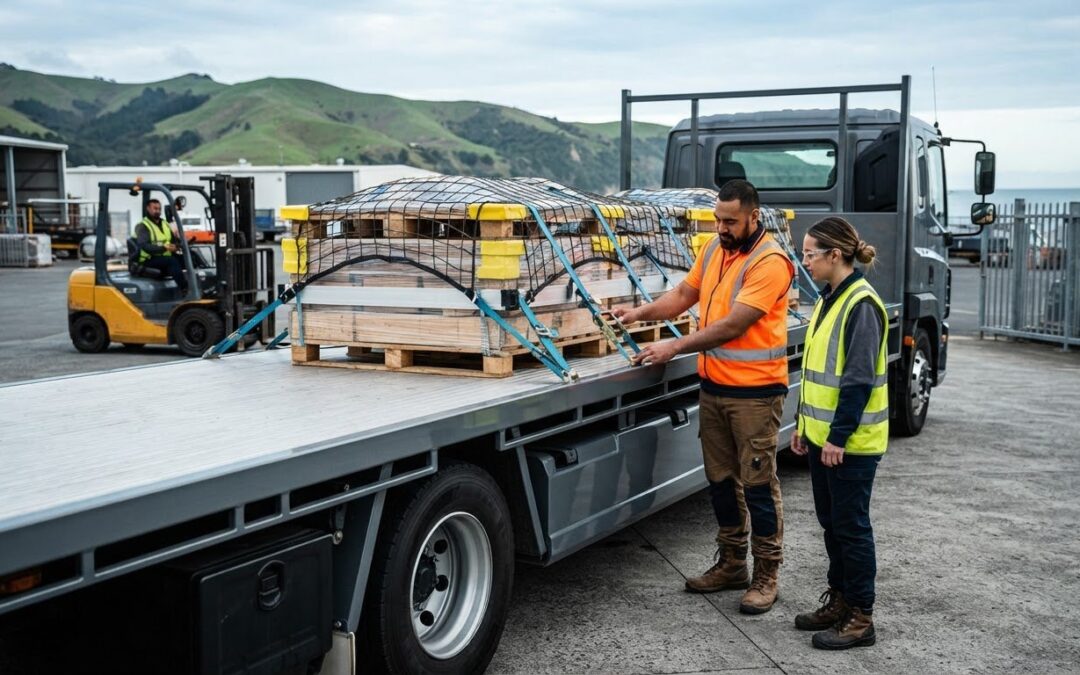
NZTA load restraint requirements call for a setup that suits the freight, vehicle and journey. A load can be tied down and still be inadequately restrained if it shifts, loosens or is poorly supported on the road.
To apply the requirements consistently, assess the load, select suitable restraint and protection equipment, inspect the setup and record checks before transport. This guide explains how NZTA guidance and relevant rules fit together, and gives you a practical process to follow for different loads.
Restraint hardware, edge protection and containment each have a different role. Equipment alone doesn’t make a load compliant, so the complete arrangement needs to be suitable for the freight and vehicle. The aim is a load-specific process your team can apply before departure and maintain throughout the journey.
Key Takeaways
- Understand how NZTA load restraint requirements relate to the Load Restraint Guide and applicable legal rules.
- Use a load-specific pre-journey check to assess cargo, vehicle, load distribution, restraint points and journey conditions.
- Check restraint condition, attachment, tension and cargo stability, and document the inspection as part of a consistent process.
- Match restraint hardware, edge protection and containment to their distinct roles. Equipment supports a safe system, but doesn’t establish compliance on its own.
What NZTA load restraint requirements mean for New Zealand transport
Load restraint means securing freight so it doesn’t shift or fall from a vehicle during normal transport. A safe arrangement depends on more than the strap or net. The cargo’s weight, shape, packaging and position all matter, as do the vehicle’s load area and restraint points, and the conditions of the journey.
For example, a palletised load may need restraint hardware to hold it in position and edge protection to reduce damage where straps contact the packaging. A cargo safety net can help contain items, but it has a different function from a tie-down. These components support a load-securing plan; none makes a setup compliant by itself. The broader load securing principles include methods such as blocking and lashing, but operators must apply the relevant New Zealand guidance to the actual freight and vehicle.
Which NZTA guidance and rules should operators consult?
Use the current NZTA Truck Loading Code, also known as the Load Restraint Guide, alongside applicable legislation and rules. The legal framework includes the Land Transport Act 1998 and the Land Transport Rule: Vehicle Dimensions and Mass 2016. Check the latest official versions, as guidance and rule wording can change.
The Code provides practical guidance; applicable legislation and rules set the legal duties. The Code isn’t a substitute for those duties, but it is an important reference for understanding safe loading practice and may be considered in court proceedings.
There’s no universal restraint recipe. Assess the vehicle, cargo, packaging, load distribution, restraint points and route conditions before selecting a method. Consider which directions the load could move, and whether individual items might shift or separate. A setup that suits stable, uniform freight may not control irregular, fragile or shifting items. Match restraint hardware, edge protection and containment to their separate roles, then check that the complete arrangement holds the load securely.
How to apply NZTA load restraint requirements before a journey
A reliable pre-departure check follows the load from assessment to final stability check. A rated strap or binder is only one part of the system. It must suit the load, connect to suitable restraint points and be positioned to control likely movement.
What should a pre-departure load restraint check cover?
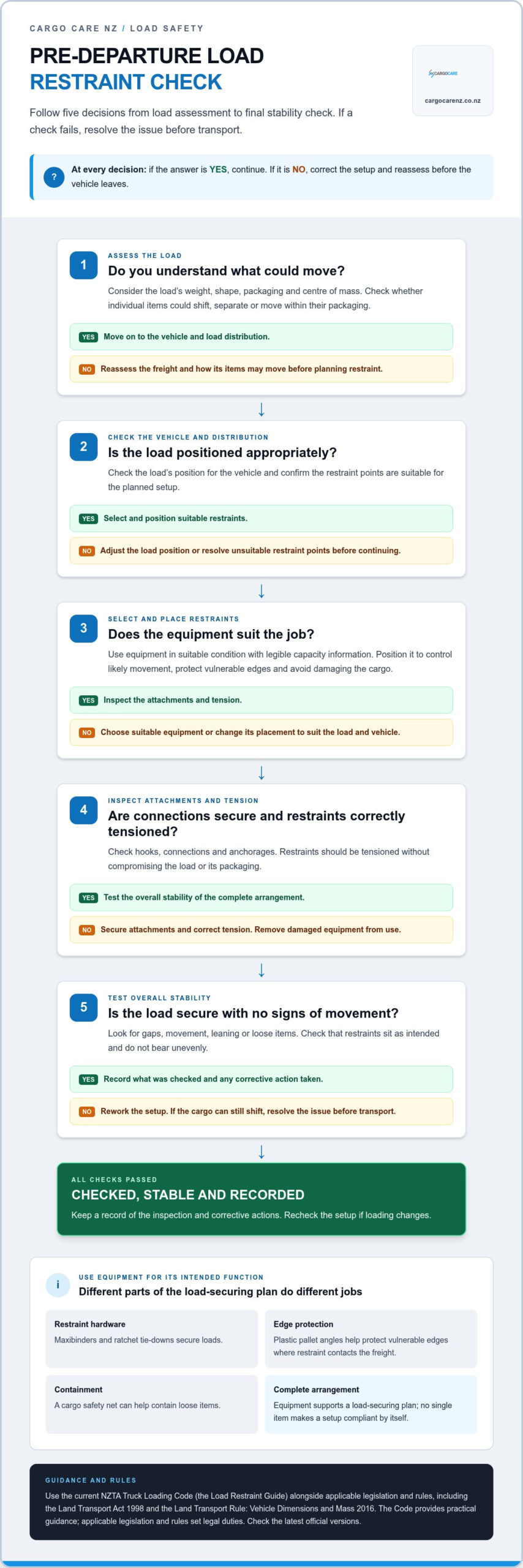
Checks must match the load and vehicle configuration. Use this sequence before the vehicle leaves:
- Assess the load. Consider its weight, shape, packaging and centre of mass. Check whether individual items could shift, separate or move within their packaging.
- Check the vehicle and distribution. Confirm the load is positioned appropriately for the vehicle and that restraint points are suitable for the planned setup.
- Select and place restraints. Use equipment with legible capacity information and suitable condition. Position it to control likely movement, protect vulnerable edges and avoid damaging the cargo.
- Inspect attachments and tension. Check hooks, connections and anchorages are secure. Remove damaged equipment from use, and ensure restraints are tensioned without compromising the load or packaging.
- Test overall stability. Look for gaps, movement, leaning or loose items. Check that restraints sit as intended and don’t bear unevenly. Rework the setup if the cargo can shift.
Plastic pallet angles can help protect vulnerable edges where restraint contacts the load. A cargo safety net can help contain loose items. Neither replaces restraint that controls the load against movement. Recheck the setup if loading changes, and follow the current NZTA guidance for the vehicle and freight involved.
Record what was checked and any corrective action taken, so the process is clear for the people loading and driving the vehicle. For equipment options that support different parts of a load-securing plan, explore CargoCare NZ load restraint and cargo protection products.
Build a repeatable NZTA load restraint process for every load
Turn the NZTA load restraint requirements into a consistent operating procedure, then adapt each load plan to the freight and vehicle. A repeatable process helps loaders identify issues before departure and gives drivers a clear basis for checking the load and raising concerns.
- Plan: Identify the cargo type, packaging, vehicle and restraint method. Set out the intended load position, restraint points and any edge protection or containment needed.
- Load and check: Follow the plan, then inspect restraint condition, connections, tension and cargo stability. Record the check and any changes made.
- Escalate: If equipment is damaged, anchorages are unsuitable or the load remains unstable, stop and resolve the issue before transport. Reassess the setup if the cargo or loading arrangement changes.
Keep the procedure practical for different freight and vehicle configurations. A process for palletised goods may not suit machinery or loose items, so don’t treat a previous load as a universal template. Operators still need to use judgement and follow current official guidance. Equipment supports a compliant system; it doesn’t establish compliance on its own.
Match restraint equipment to the job it performs
Maxibinders and ratchet tie-downs are restraint hardware used to secure loads. Plastic pallet angles help protect vulnerable edges where restraint contacts the freight, while a cargo safety net can support containment of loose items. These functions are distinct. One item doesn’t replace another when the load needs both restraint and protection. For further detail, see our guides to load restraint straps and Maxibinder versus ratchet binder.
Build the right equipment into your loading procedure, and view Cargo Care NZ load restraint and protection products for options that support different parts of a load-securing plan.
Make load restraint checks part of every departure
Apply the NZTA load restraint requirements to the actual freight and vehicle, not a one-size-fits-all setup. Assess the load, choose restraint and protection for their intended functions, then check the complete arrangement before transport. A repeatable process helps your team identify movement, equipment or attachment issues and record how they were addressed.
Restraint hardware, edge protection and containment each contribute differently. The right equipment supports the plan, but operator judgement and current official guidance remain essential. Cargo Care NZ supplies load restraint and cargo protection products throughout New Zealand and is the official New Zealand distributor of Silverback products. The range includes Maxibinders, ratchet tie-downs, cargo safety nets and plastic pallet angles.
View Cargo Care NZ load restraint and cargo protection products to find equipment options for your load-securing process. Build the checks into everyday loading practice and send each load out with a clear, considered restraint plan.
Frequently Asked Questions
What are NZTA load restraint requirements?
NZTA load restraint requirements concern securing freight so it doesn’t move or fall from a vehicle during transport. The method needs to suit the cargo, packaging, vehicle, restraint points and journey. Use current NZTA guidance and applicable rules to assess each load, then check that the complete restraint arrangement is stable and appropriate before departure.
Is the NZTA Load Restraint Guide the same as the law?
No. The NZTA Load Restraint Guide, also referred to as the Truck Loading Code, provides practical guidance; it isn’t legislation. Applicable legal duties arise under legislation and rules, including the Land Transport Act 1998 and the Land Transport Rule: Vehicle Dimensions and Mass 2016. Consult current official versions of both the guidance and relevant rules.
Can a rated tie-down make any load compliant?
No. A tie-down’s rating is only one factor in a complete restraint system. Its condition, placement, attachment points and suitability for the cargo all matter, as do load distribution, packaging and the vehicle. Edge protection or containment may also be needed for their specific functions. Assess the whole setup against current guidance rather than relying on one piece of equipment.
How often should load restraints be checked during a trip?
Don’t assume one fixed inspection interval applies to every load. Check the restraint setup before departure, and reassess it if the load shifts, the arrangement changes or a concern arises during the journey. Follow current NZTA guidance and your organisation’s procedures for the specific freight and vehicle. Address any issue affecting load stability before continuing.

Article by
Steve O'Malley