
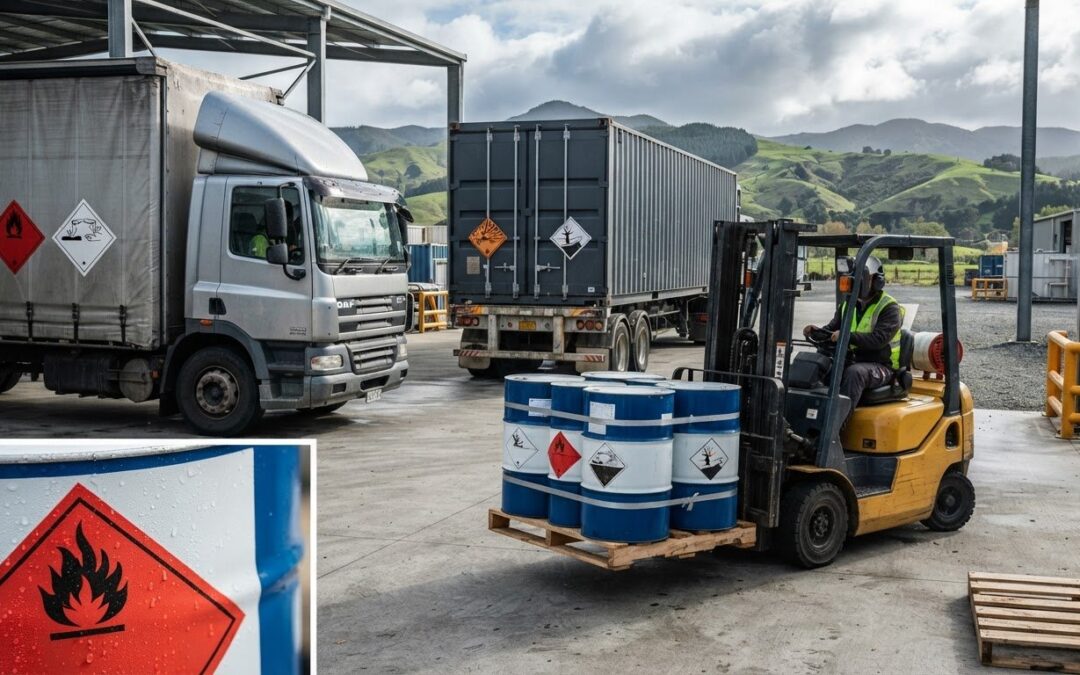
A single peeling corner on a hazard diamond can sideline a commercial rig faster than a mechanical failure. Sourcing fully compliant dangerous goods labels NZ transport operators can rely on isn’t merely an administrative exercise; it protects your freight schedules from immediate roadside infringement notices. Anyone managing transport operations knows the frustration of vehicle enforcement stops where faded decals or ambiguous markings trigger commercial penalties and ground loaded units.
You can eliminate transit delays by mastering NZS 5433 labelling rules, precise dimensional standards, and weatherproofing requirements under Land Transport Rule: Dangerous Goods 2005. Below, we break down package-level dimensions versus vehicle transport placards, legal threshold triggers, and the industrial vinyl specifications needed to endure demanding long-haul transit cycles.
Key Takeaways
- Clarify legal responsibilities under Land Transport Rule: Dangerous Goods 2005 to keep your fleet aligned with core UN hazard classifications.
- Distinguish between 100 mm package diamonds and 250 mm vehicle placards to ensure dangerous goods labels NZ carriers display satisfy exact dimensional rules.
- Identify mandatory placard placement points across curtain-side bodies, shipping containers, and road tankers to avoid vehicle enforcement detentions.
- Specify industrial-grade Silverback vinyl labels designed to withstand severe weather, wash-bay chemicals, and long-haul road abrasion across national routes.
Understanding New Zealand Dangerous Goods Labelling Regulations and Class Systems
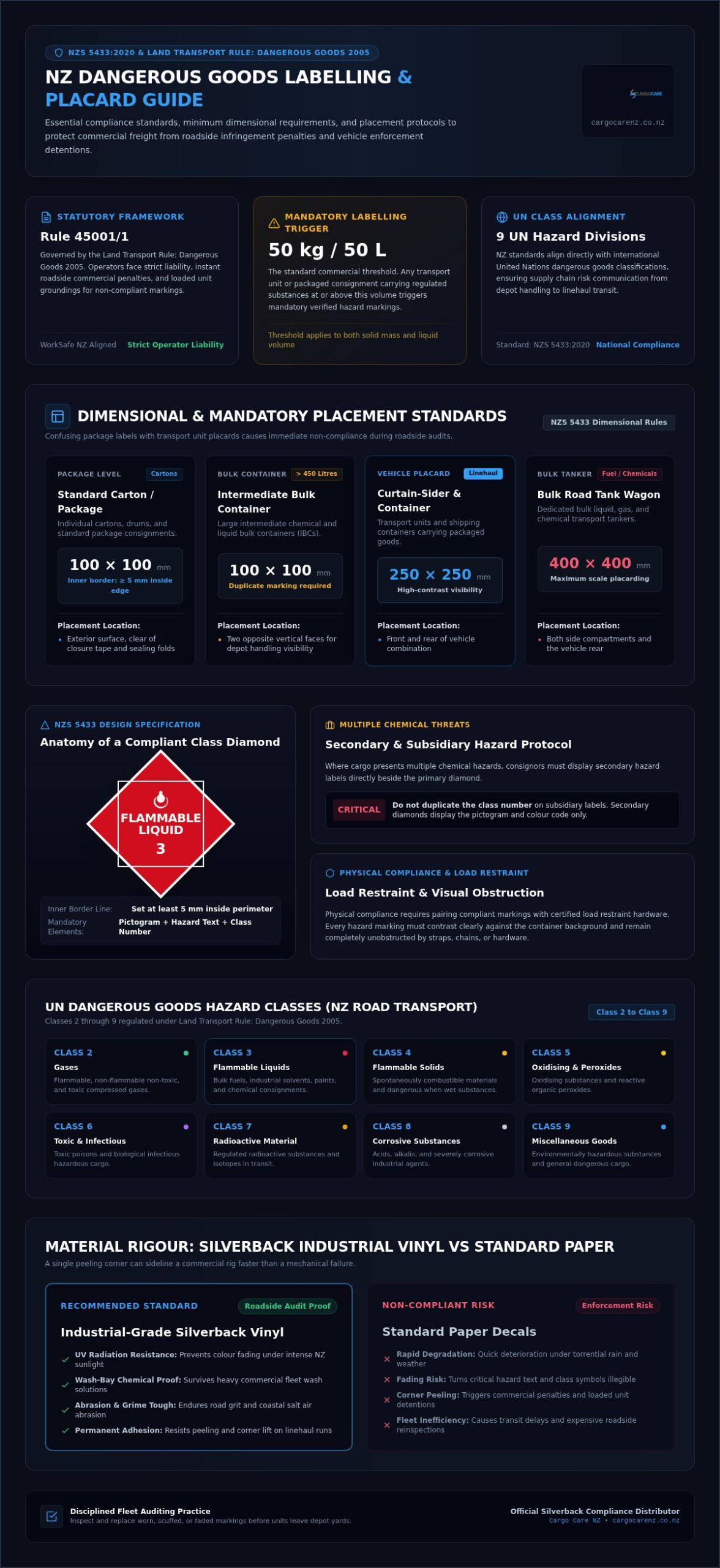
Commercial freight operators moving hazardous cargo across New Zealand must comply with the Land Transport Rule: Dangerous Goods 2005 (Rule 45001/1). This legislation dictates that any transport unit or packaged consignment carrying regulated items above statutory triggers, such as the standard commercial threshold of 50 kilograms or 50 litres, must display verified hazard markings. Operating with missing, illegible, or damaged dangerous goods labels NZ enforcement officers monitor results in immediate commercial penalties, vehicle detentions, and strict operator liability. New Zealand road transport standards align directly with the international UN dangerous goods classification system, covering nine distinct substance divisions:
- Class 2: Gases (flammable, non-flammable non-toxic, and toxic)
- Class 3: Flammable liquids
- Class 4: Flammable solids, spontaneously combustible, and dangerous when wet
- Class 5: Oxidising substances and organic peroxides
- Class 6: Toxic and infectious substances
- Class 7: Radioactive material
- Class 8: Corrosive substances
- Class 9: Miscellaneous dangerous goods and environmentally hazardous cargo
Deciphering NZS 5433 Class Diamonds and Package Marking Protocols
NZS 5433:2020 mandates that every hazard warning diamond serves as an immediate visual safeguard, incorporating specific colour codes, standardised pictograms, class numbers, and an inner border line set at least 5 mm inside the perimeter. Where materials present multiple chemical threats, consignors must display secondary hazard labels directly beside the primary diamond without duplicating the class number on the subsidiary label. Deploying compliant, high-clarity dangerous goods labels NZ drivers and depot handlers depend upon ensures vital risk communication across the entire supply chain.
Package Labels Versus Vehicle Placards: Dimensional and Placement Rules
Confusing individual package diamonds with transport unit placards creates immediate non-compliance during roadside audits. Under the Land Transport Rule: Dangerous Goods 2005, package-level hazard markings require minimum dimensions of 100 mm × 100 mm with an inner border set 5 mm from the edge. Transport units, including curtain-siders and shipping containers carrying packaged consignments, require 250 mm × 250 mm placards displayed clearly at the front and rear. Bulk tank wagons demand 400 mm × 400 mm placards positioned across both side compartments and the rear.
Specifying Label Dimensions, Visibility, and Weatherproof Material Standards
Standard paper labels deteriorate quickly under torrential rain, UV radiation, and high-pressure commercial wash bays. Freight operations shouldn’t risk faded markings; long-haul transport demands industrial-grade vinyl engineered to resist peeling, tearing, and road grime. Every label must contrast clearly against the container background and remain unobstructed by load restraint equipment.
| Freight Configuration | Minimum Dimensions | Placement Locations |
|---|---|---|
| Standard Carton / Package | 100 mm × 100 mm | Exterior surface, clear of closure tape |
| Intermediate Bulk Container (>450 L) | 100 mm × 100 mm | Two opposite vertical faces |
| Transport Unit / Shipping Container | 250 mm × 250 mm | Front and rear of vehicle combination |
| Bulk Road Tanker | 400 mm × 400 mm | Both side compartments and rear |
Any intermediate bulk container exceeding 450 litres requires duplicate markings on opposing sides to maintain visibility during depot handling. Sourcing heavy-duty dangerous goods labels NZ carriers trust keeps commercial freight moving without unexpected inspection penalties.
Sourcing Industrial Dangerous Goods Labels and Maintaining Fleet Compliance
Fleet operators cannot treat hazardous markings as afterthoughts. Road freight across the country encounters intense UV radiation, coastal salt air, and regular fleet wash chemicals. Paper decals break down under these conditions, turning vital hazard warnings illegible and exposing your fleet to commercial vehicle enforcement detentions. Establishing a disciplined fleet auditing schedule ensures worn, scuffed, or faded markings are replaced before units leave the depot yard.
CargoCare NZ operates as the official national distributor for Silverback compliance products, supplying transport-grade dangerous goods labels designed specifically for harsh operating environments. Deploying heavy-duty Class 3.0 flammable liquid labels alongside industrial markings ensures your bulk fuel, solvent, and chemical consignments stay fully compliant on linehaul routes. In transit, these labels must also align with workplace standards; review the official WorkSafe NZ labelling requirements to verify that package markings satisfy site-handling rules upon arrival.
Integrating Durable Labelling with Complete Transport Safety Hardware
Physical compliance requires pairing compliant markings with certified load restraint hardware. A marked chemical drum that shifts in transit creates immediate environmental and physical hazards. Integrating certified Silverback products NZ transport operators rely on provides total consignment integrity. Securing chemical freight involves several coordinated components:
- Heavy-duty vinyl labels: Resisting abrasion, fuels, and weather extremes without lifting at the edges.
- Ratchet tie-downs with hook and keeper: Restraining palletised drums to vehicle tie-rails to stop transit movement.
- Plastic pallet angles: Spreading strap tension across package edges to protect hazardous containers from crush damage.
- Tamper-evident security seals: Protecting container valves and curtain buckles from unauthorised interference.
Equipping your vehicles with industrial dangerous goods labels NZ fleets depend upon maintains complete operational compliance from origin to destination.
Protect Your Fleet with Standards-Aligned Transport Compliance
Maintaining regulatory compliance under Land Transport Rule: Dangerous Goods 2005 safeguards your linehaul schedules against costly roadside enforcement detentions. Matching exact hazard diamond dimensions, clearly distinguishing package labels from vehicle placards, and replacing damaged signage before dispatch ensures your transport operations remain penalty-free.
CargoCare NZ is the official New Zealand distributor of Silverback products, delivering comprehensive transport compliance solutions nationwide. Engineered with heavy-duty vinyl substrates designed for rugged road conditions, our high-tack decals endure harsh weather, wash-bay detergents, and highway debris. Sourcing durable dangerous goods labels NZ operators trust guarantees clear hazard communication across every leg of the journey. Equip your fleet with certified dangerous goods labels from CargoCare NZ and ensure your freight moves without delay.
Frequently Asked Questions
What is the standard size for dangerous goods labels in New Zealand?
The standard size for dangerous goods labels on packages in New Zealand is 100 mm × 100 mm. Under NZS 5433 and Land Transport Rule: Dangerous Goods 2005, each diamond label requires an inner border at least 5 mm inside the edge. Proportional reductions down to 50 mm × 50 mm are permitted only when packages are physically too small to fit full-sized decals.
What is the difference between a dangerous goods label and a transport placard?
Dangerous goods labels mark individual packages, whereas transport placards identify hazards on the vehicle or bulk shipping container itself. Package labels measure at least 100 mm × 100 mm, while transport unit placards measure 250 mm × 250 mm for general freight. Bulk road tankers demand larger 400 mm × 400 mm placards to ensure emergency services can identify hazards from a distance.
Can commercial transport operators print dangerous goods labels on standard office paper?
No, standard office paper fails to meet the legal durability and weather-resistance standards that dangerous goods labels NZ regulations require. Road freight exposes consignments to severe rain, UV degradation, and chemical wash bays that quickly destroy paper decals. Operators must deploy heavy-duty vinyl labels with industrial adhesives to prevent peeling, tearing, or illegibility across long-haul transit cycles.
When are Class 3.0 flammable liquid labels legally required on transport units?
Commercial transport units must display Class 3.0 flammable liquid placards whenever carrying quantities exceeding the statutory threshold of 50 litres. Consignments surpassing this limit legally require external vehicle placarding at the front and rear, formal transport declarations, and a D-endorsed driver. Uncleaned empty drums or tanks previously containing flammable liquids require the same placarding until fully purged and certified gas-free.

Article by
Steve O'Malley