
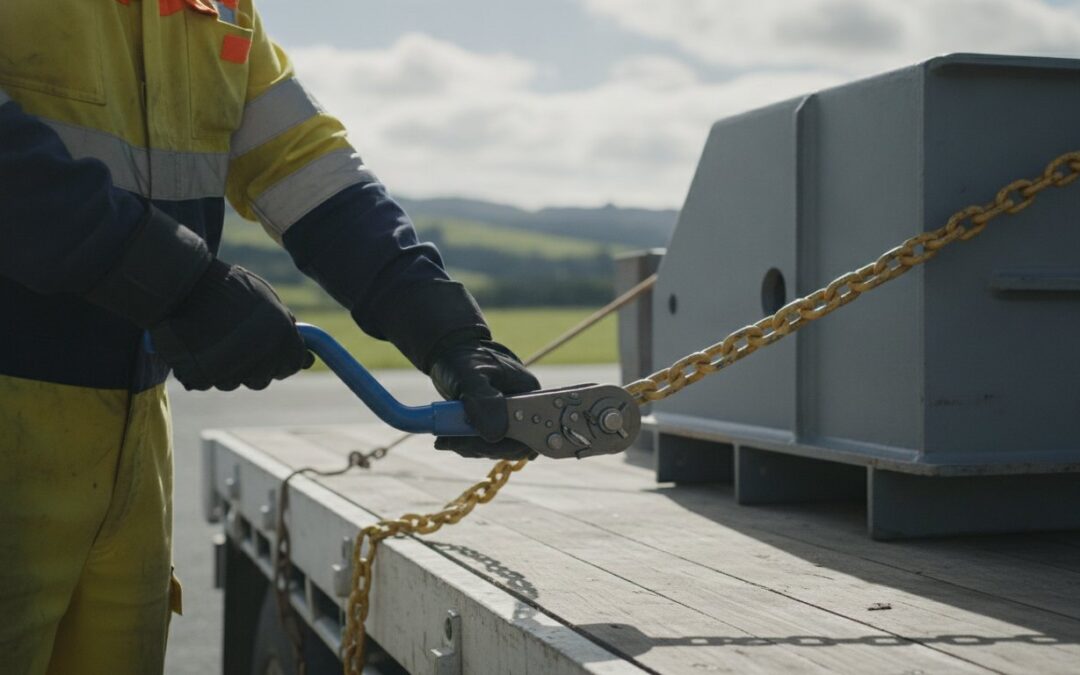
The traditional lever dog might be the most common tool on your deck, but it’s often the most dangerous point of failure in your load restraint system. You know that selecting the right chain binders NZ operators trust requires a balance between speed and safety. It’s a high-stakes environment where a single oversight can lead to gear failure or serious operator injury. Under the Land Transport Act 1998, companies face fines of up to $10,000 for insecure loads, making the choice of hardware a critical operational decision.
This guide provides the technical clarity you need to master the differences between various load restraint options. You’ll learn how to ensure your fleet meets the latest NZTA safety standards while protecting your drivers from the whip-back risks associated with traditional tools. We’ll examine the shift toward modern ratchet-style Maxibinders and explain how to maintain compliance following the withdrawal of AS/NZS 4344:2001 in December 2024. This overview identifies the most efficient restraint for your specific fleet to help you reduce long-term gear replacement costs.
Key Takeaways
- Identify the critical role of AS/NZS 4344 in governing lashing chains and how to maintain compliance following recent regulatory shifts in the transport sector.
- Compare the durability and tension retention of steel chain against synthetic webbing to determine the most effective restraint for abrasive or heavy machinery loads.
- Learn how to correctly match hardware to Grade 70 chain, specifically focusing on the selection of chain binders NZ professionals utilise for 8mm and 10mm applications.
- Understand why winged or cradled grab hooks are essential to prevent chain deformation and ensure your equipment maintains its full 100% lashing rating.
- Discover the operational advantages of the Silverback Maxibinder as a safer, more precise alternative to traditional lever-style tensioning devices.
Understanding Chain Binder Types and AS/NZS 4344 Standards
Chain binders, frequently referred to in the transport industry as load binders, dogs, or twitches, are mechanical tools used to tension High-tensile transport chain. These devices provide the leverage required to secure heavy cargo, ensuring it remains stationary under the forces encountered during transit. In the professional selection of chain binders NZ operators must consider the AS/NZS 4344 standard. Although this standard was withdrawn in December 2024 and is currently pending revision, it remains the primary industry reference for lashing chains and fittings. It’s vital to remember that chain binders are strictly for load restraint; they must never be used for lifting applications.
Selecting the correct chain binders NZ suppliers provide involves matching the hardware to Grade 70 (G70) transport chain. This is the industry standard for heavy haulage, typically recognisable by its gold or yellow chromate finish. G70 chain provides a high strength-to-weight ratio suitable for most heavy-duty applications. Using binders with non-compliant or lower-grade chain compromises the entire restraint system and risks non-compliance with the NZTA Truck Loading Code.
Lever Binders vs. Ratchet Binders: The Safety Shift
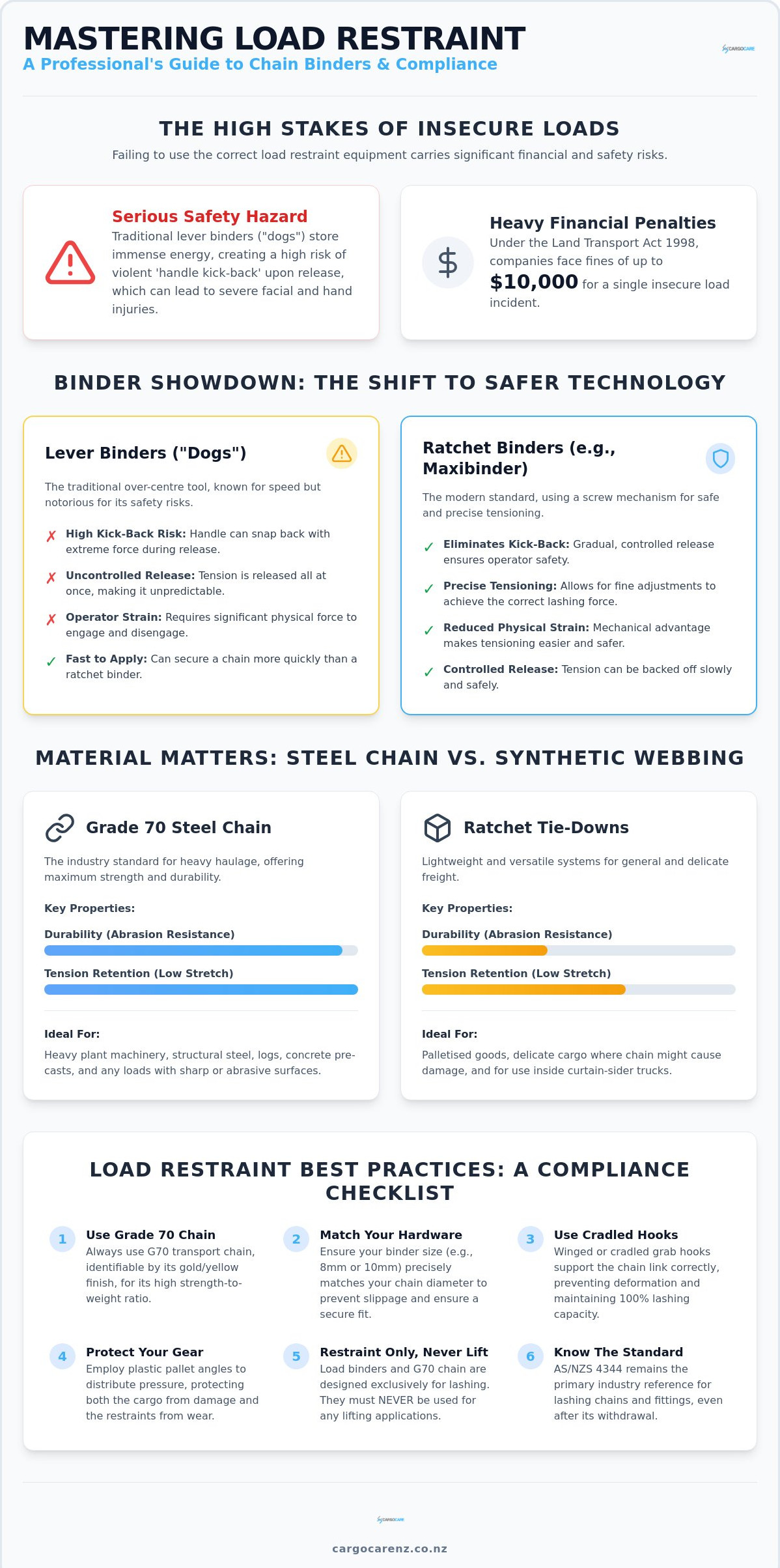
Traditional lever binders rely on an over-centre design. While they’re fast to apply, they present a major safety risk known as handle kick-back. When releasing the tension, the handle can snap back with extreme force, leading to serious facial or hand injuries. This stored energy makes them unpredictable in wet or oily conditions where an operator’s grip might slip. Many modern fleets are phasing out these “dogs” to prioritise driver safety.
Ratchet binders solve this issue by using a geared screw mechanism. They allow for incremental tensioning, giving the operator precise control over the lashing force. The release is controlled and gradual, which removes the danger of sudden handle movement. The Silverback Maxibinder is a high-tensile ratchet binder designed to reduce operator strain and improve safety during heavy-duty securing.
Chain Binders vs. Ratchet Tie-Downs: Which Should You Use?
Choosing between webbing and steel depends on the load’s physical characteristics and the required lashing capacity. While synthetic webbing is common for general freight, chain binders NZ professionals select are indispensable for abrasive or high-mass cargo. Steel chain offers superior durability when securing loads with sharp edges or rough surfaces that would easily sever polyester webbing. It’s a matter of matching the equipment to the environmental demands of the job.
Tension retention is another critical performance factor. Synthetic webbing naturally stretches under load, often requiring re-tensioning shortly after departure. In contrast, Grade 70 chain provides near-zero stretch, making it the preferred choice for heavy machinery. The NHVR Load Restraint Guide outlines that restraints must withstand 1.0g of forward force; this standard is more easily met on heavy loads using non-stretch materials. For lighter, palletised freight, the weight and speed of ratchet tie-downs provide a clear operational advantage.
To protect both the cargo and the restraint equipment, operators should use plastic pallet angles. These components distribute pressure evenly and reduce friction. This prevents the chain or webbing from cutting into the load while simultaneously protecting the restraint from wear. It’s a simple addition that extends the life of your gear and maintains load integrity.
When to Choose Chain for Heavy Haulage
Certain load types, such as logs, heavy plant machinery, structural steel, and concrete pre-casts, demand the high Lashing Capacity (LC) only steel can provide. For these applications, matching the LC of your chain binders NZ to the chain itself is mandatory to meet NZ load securing rules. These high-mass loads require the uncompromising grip of steel to ensure the cargo remains stationary during sudden braking or cornering.
For those hauling heavy marine equipment, maintaining the engine’s condition is vital for performance upon arrival; for professional servicing insights, check out Compass Marine.
The Versatility of Ratchet Tie-Downs
For curtain-siders or palletised freight, a ratchet tie down with hook and keeper is often more efficient. These systems are lightweight and faster to deploy for delicate cargo where chain might cause surface damage. You can view our full range of transport restraints to find the right tool for your specific freight profile.
Best Practices for Selecting and Maintaining Load Binders
Precision in hardware selection is the foundation of a safe restraint system. When sourcing chain binders NZ operators must ensure the binder size exactly matches the Grade 70 chain in use, typically 8mm or 10mm. An undersized binder won’t seat correctly, while an oversized one can lead to slippage. This technical alignment follows the International Safe Load Securing Guidelines, which emphasise that every component in a lashing system must be compatible to maintain its rated strength.
The type of hook on your binder is just as important as the mechanism itself. Professional-grade binders should feature winged or cradled grab hooks. These designs support the chain link on both sides, preventing the deformation that occurs with standard hooks. By distributing the load across the link, you maintain a 100% lashing rating and extend the service life of your transport chain. Sourcing gear from an authorised Silverback products NZ distributor ensures you receive hardware that meets these stringent engineering requirements.
Ergonomics play a vital role in operational efficiency. Ratchet binders with longer handles provide greater mechanical advantage, allowing drivers to achieve maximum tension with significantly less physical effort. This reduces the risk of repetitive strain injuries and ensures the load is properly secured even during long shifts. High-quality chain binders NZ fleets deploy prioritise this balance of power and operator safety.
Inspecting Gear for NZTA Compliance
Regular inspections are a legal necessity under NZTA standards. You must check for cracked welds, bent handles, and worn screw threads that could fail under tension. Elongated chain links are a clear sign of overloading and indicate that the chain is no longer fit for purpose. Every binder must have a clear identification tag showing the manufacturer and the Lashing Capacity (LC) to remain compliant on the road.
Any binder showing signs of deformation or missing ID tags must be removed from service immediately.
Optimising Your Fleet for Safety and Compliance
Mastering load restraint involves more than just selecting a tool; it requires a technical understanding of how your hardware interacts with Grade 70 chain. By transitioning from traditional lever dogs to modern ratchet-style tensioners, you protect your drivers from snap-back injuries while achieving the precise tension needed for heavy machinery and structural steel. Consistency in matching binder sizes and using winged grab hooks ensures your equipment maintains its full lashing rating during transit.
Beyond industrial haulage, these safety principles apply to any high-value cargo transport, including the sophisticated audio-visual rigs managed by LivewireAV for major events across the region.
Maintaining a compliant fleet depends on sourcing certified gear and conducting rigorous equipment inspections. As the official NZ distributor of Silverback products, CargoCare NZ provides heavy-duty Maxibinders and transport hardware specifically designed to meet the demands of the local professional sector. Implementing these high-quality chain binders NZ operators trust will help you avoid costly NZTA fines and ensure your cargo reaches its destination securely.
View our range of Silverback Maxibinders and Load Restraint Gear to upgrade your securing systems today. We’re here to help you keep your operations moving safely across the country.
Frequently Asked Questions
What is the difference between a load binder and a twitch?
A load binder and a twitch are different names for the same mechanical device used to tension transport chain. While “twitch” or “dog” are colloquial terms frequently used by drivers on the ground, “load binder” is the formal technical name found in industry standards and product catalogues. Both tools perform the identical function of pulling chain links together to secure cargo firmly to a trailer bed.
Are lever binders (dogs) legal to use in New Zealand?
Lever binders remain legal for use in New Zealand as long as they comply with the performance standards set out in the NZTA Truck Loading Code. However, many professional fleets are transitioning to ratchet-style chain binders NZ suppliers provide due to safety concerns. The stored energy in a lever binder can cause the handle to kick back violently during release, whereas ratchet versions offer a controlled, incremental tensioning process.
How do I calculate how many chain binders I need for a load?
You determine the required number of binders by comparing the total weight of your cargo against the Lashing Capacity (LC) of your equipment. According to the NZTA Truck Loading Code, your restraint system must withstand 1.0g of force in the forward direction. If you’re securing a 10-tonne machine, your combined lashing capacity must equal at least 10,000kg. Always round up the number of binders to ensure you exceed the minimum legal requirement.
Can I use a chain binder for overhead lifting?
No, you must never use a chain binder for overhead lifting applications. These devices are engineered specifically for the horizontal tensioning required in load restraint and do not possess the safety factors or design specifications necessary for lifting. Using restraint hardware for lifting purposes is a serious breach of health and safety regulations and risks catastrophic equipment failure.
What chain grade is required for transport load binders in NZ?
Grade 70 (G70) transport chain is the industry standard for load securing in New Zealand. This high-tensile chain is specifically designed for lashing and is typically recognisable by its distinct gold or yellow chromate finish. It’s critical to verify that your chain binders NZ are correctly rated to match the diameter of the G70 chain you’re using, which is most commonly 8mm or 10mm for heavy haulage.
How often should I inspect my load restraint hardware?
You should perform a visual inspection of your binders and chains before every single trip. Look for obvious signs of damage such as cracked welds, bent handles, or screw threads that have become stripped or fouled. In addition to these daily checks, formal inspections should be part of your regular fleet maintenance schedule. Any binder that shows deformation or is missing its identification tag must be pulled from service immediately.
Article by
Steve O'Malley